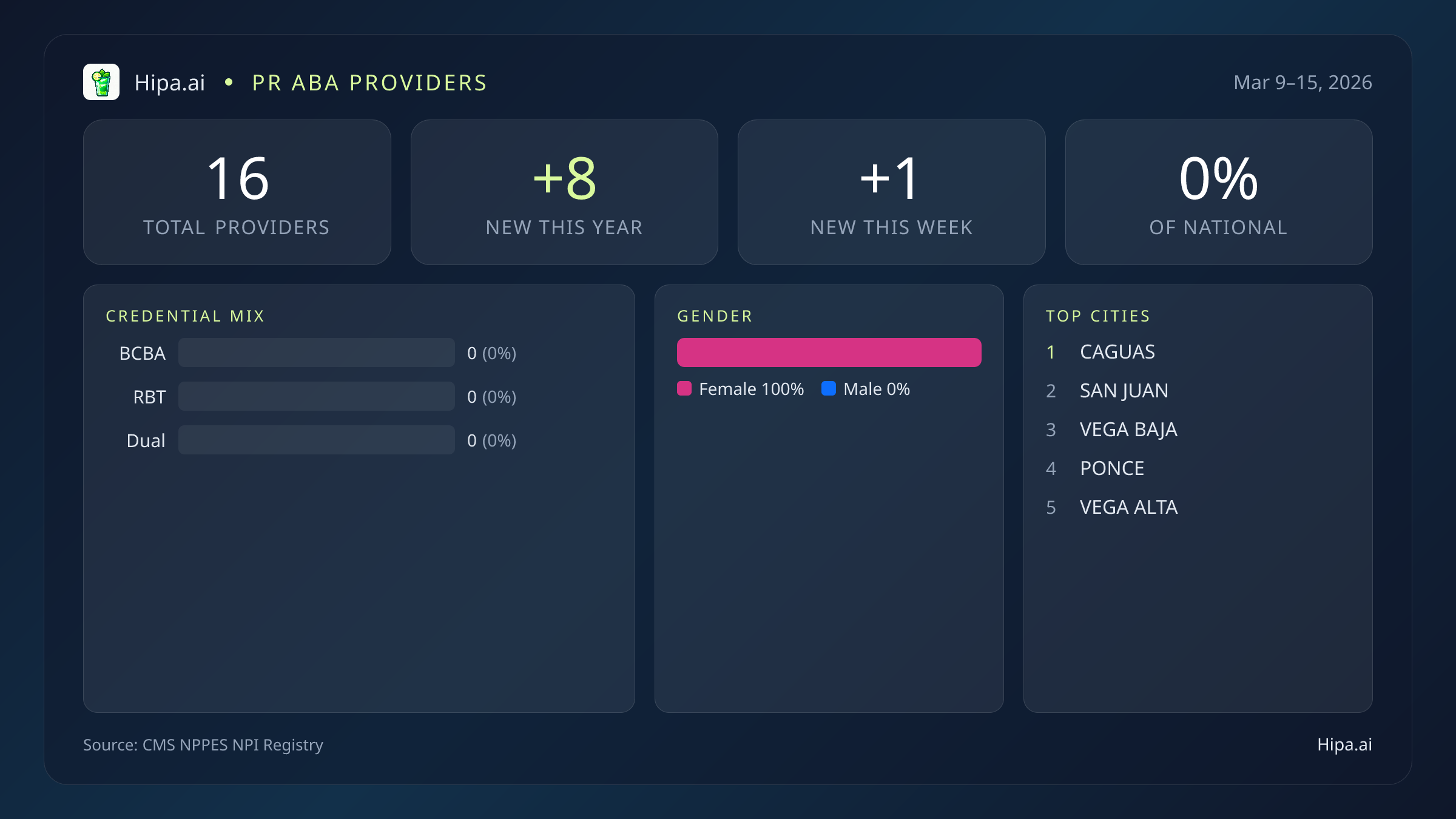
Puerto Rico's behavioral health sector saw a modest influx in the latest CMS NPI registry weekly update, with a total of 16 providers added. This figure represents 0% of the national weekly total, indicating a localized growth pattern rather than a significant share of national movement. Of these, 1 provider was new this week, contributing to a year-to-date total of 8 new providers. The new additions comprise 9 individual providers and 7 organizational entities, suggesting a mix of independent practitioners and structured service delivery expanding their presence across the territory.
Credential Landscape and ABA Workforce Gaps
A critical observation for the ABA community is the complete absence of Board Certified Behavior Analyst (BCBA) and Registered Behavior Technician (RBT) credentials among the new providers. The data shows 0 BCBA and 0 RBT credentials, with no individuals holding dual BCBA+RBT certifications. This signals a significant gap in the specific ABA workforce as reflected in this NPI update for Puerto Rico. Instead, the credentials observed are primarily from broader behavioral health fields, including 1 LCDA (Licensed Chemical Dependency Counselor), 1 MSW (Master of Social Work), 1 PHL (Public Health License), and 1 MCSW (Master Clinical Social Worker). For ABA clinic operators and BCBAs, this lack of ABA-specific credentials points to substantial challenges in establishing or expanding services due to limited supervision capacity and a restricted pool of RBTs, making it difficult for multi-state chains to enter the market.
Workforce Demographics and Geographic Distribution
Delving into the demographics of the individual providers, a clear trend emerges: 9 female providers account for 100% of the individual additions, with no male or nonbinary providers recorded in this update. This highlights a predominantly female workforce in the behavioral health fields represented. Geographically, the new providers are distributed across several key cities, including CAGUAS, SAN JUAN, VEGA BAJA, PONCE, and VEGA ALTA, indicating a spread of services rather than a single concentrated hub. Additionally, 4 providers hold multiple taxonomies, suggesting a diverse skill set within the overall behavioral health community, although these do not include ABA-specific specializations. The absence of specific notable organizations appearing multiple times in this dataset further suggests that large, multi-state ABA providers are not significantly expanding their footprint in Puerto Rico within this particular reporting period.
The data collectively suggests that while Puerto Rico is seeing some growth in its general behavioral health workforce, there remains a pronounced need for developing and attracting ABA-specific professionals to enhance access to critical services across the territory.