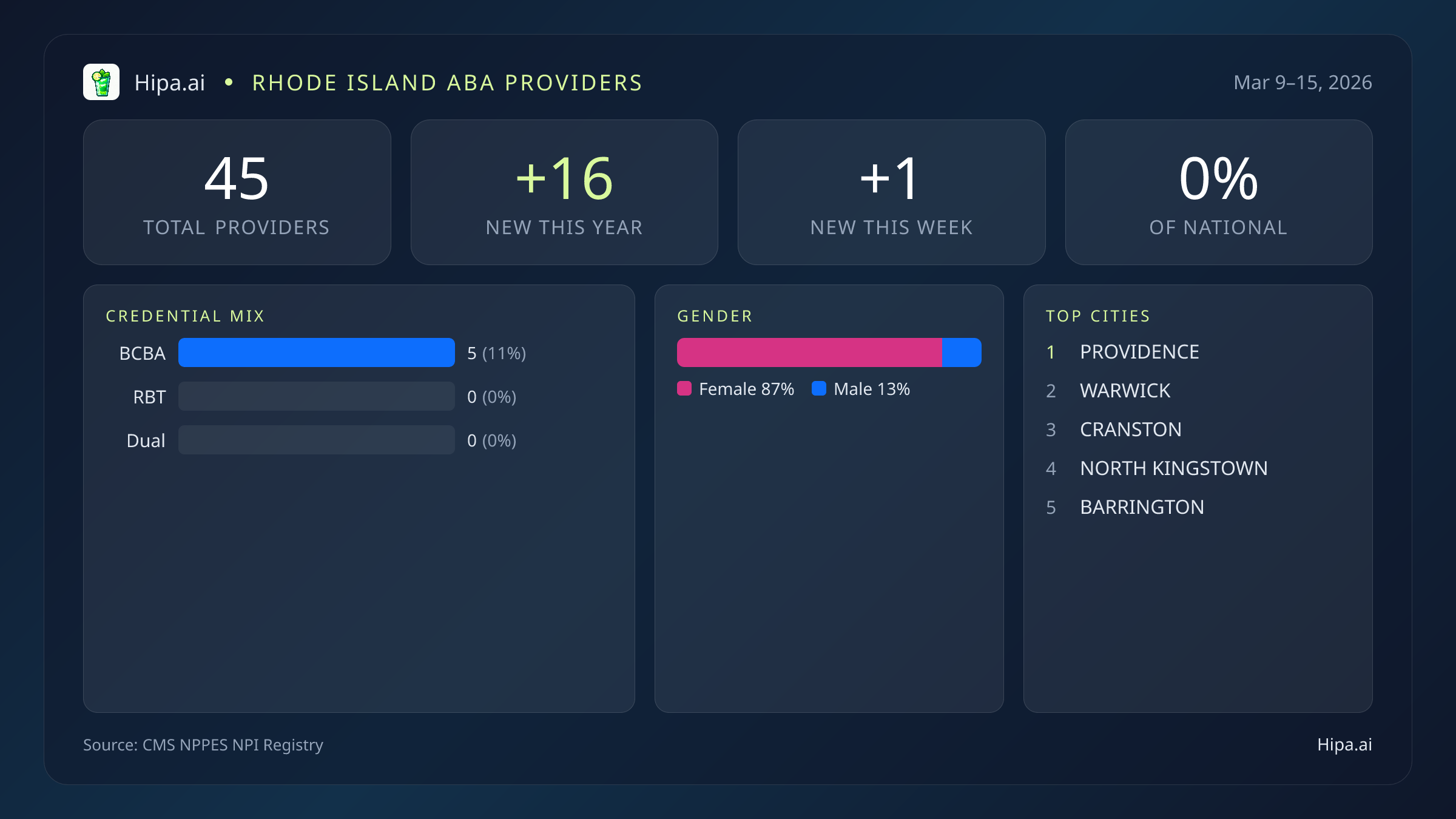
Rhode Island's behavioral health sector saw a modest influx of 45 providers in the latest CMS NPI registry weekly update. While this number contributes to the state's total, it represents 0% of the national weekly total, indicating that Rhode Island’s weekly additions are a very small fraction of the broader national growth. Of these, 1 provider was new this week, contributing to a year-to-date total of 16 new providers. The new entries are split between 30 individuals and 15 organizations, reflecting a mix of private practitioners and institutional growth within the state.
Credentialing and ABA Workforce Dynamics
Delving into the credential mix, the data shows 5 providers holding BCBA credentials in this update. Critically for the ABA field, there were 0 RBTs and 0 dual BCBA+RBT credentialed individuals reported this week. The absence of newly registered RBTs suggests no immediate expansion of the entry-level direct service workforce for ABA through this particular update. With only 5 BCBAs among the new entries, the capacity for supervision, which is essential for RBTs, remains limited. The majority of other credentials observed include 7 LICSWs, 3 LMHCs, 2 LCDPs, and 2 PhDs, among others like MSW, LCSW, and LMHC-A, indicating a broader focus on clinical social work and mental health counseling in this week's additions.
Demographics and Organizational Presence
The individual provider demographics highlight a significant gender imbalance, with 26 female providers making up 87% of the total, compared to 4 male providers at 13%. No nonbinary providers were reported in this dataset. Geographically, Providence, Warwick, and Cranston are among the top cities for these new providers. Notably, "THE PROVIDENCE CENTER" appeared twice in the organizational listings, suggesting its continued or expanding presence in the state's behavioral health landscape. Furthermore, 11 providers hold multiple taxonomies, indicating a diverse skill set or broader scope of practice among a portion of the state's behavioral health professionals, potentially allowing for more integrated care models.
Overall, this snapshot suggests a slow but steady growth in Rhode Island's behavioral health workforce, predominantly in mental health and social work disciplines, with a clear need to monitor BCBA and RBT credentialing to ensure adequate ABA service capacity and supervision for the future.