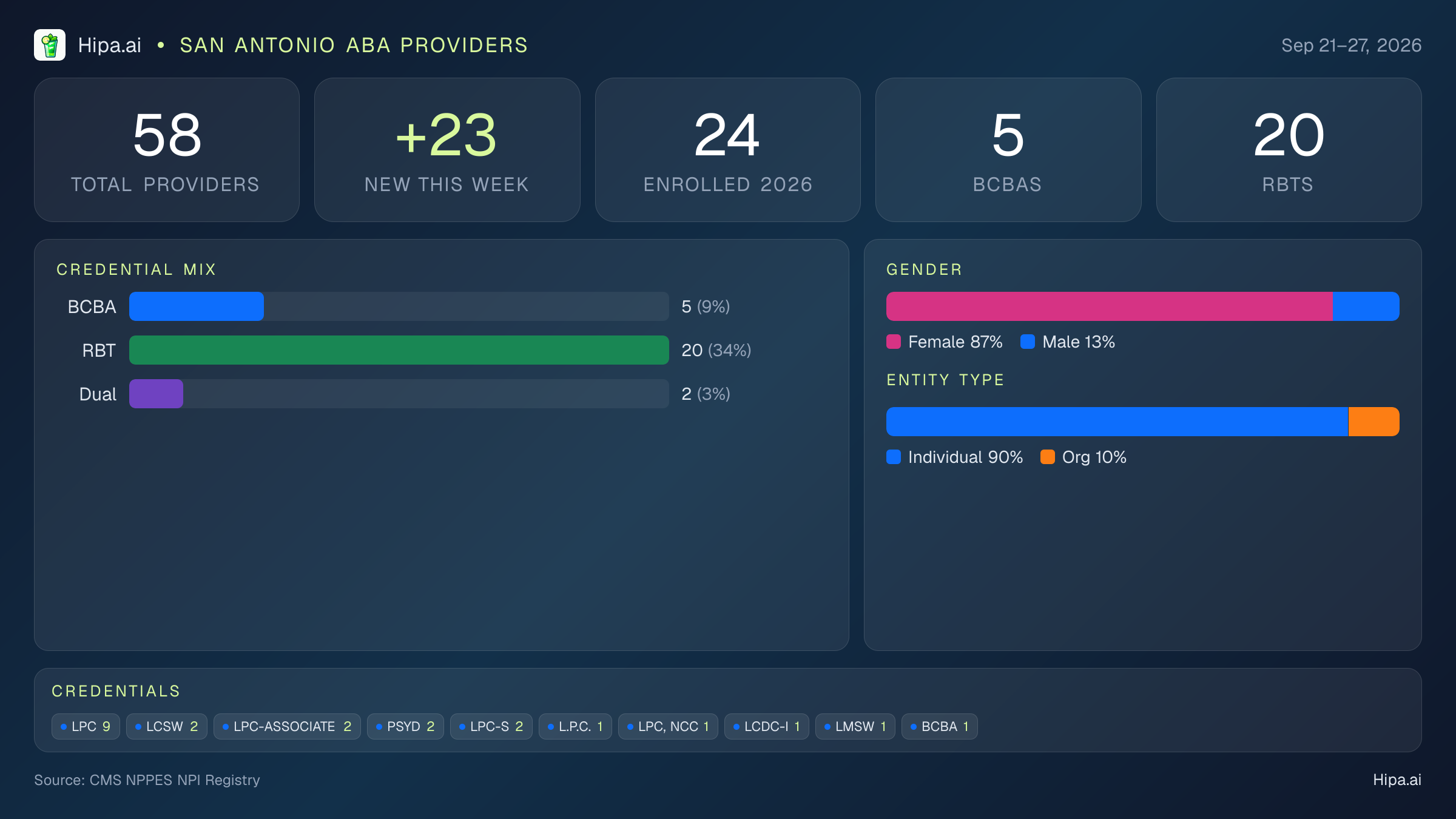
San Antonio had 58 providers in the latest CMS NPI registry weekly update, representing 1% of the national weekly total. The registry lists 23 new providers this week and 24 this year; 52 are individuals and 6 are organizations. That concentration marks a notable local presence in the weekly count, but NPI records do not show whether providers are currently practicing, accepting patients or delivering ABA services.
ABA Credential Mix
The registry reports 5 BCBA providers and 20 RBT providers, plus 2 dual credentials. The dual BCBA-and-RBT credentials overlap the BCBA and RBT categories, so the counts should not be added as separate workforce groups. The larger RBT count suggests more listed direct-care capacity than supervisory capacity; BCBAs oversee RBTs, so the smaller BCBA pool may constrain how quickly services can expand. The registry’s credential and taxonomy fields are not interchangeable, and 10 providers have multiple taxonomies, further cautioning against treating categories as distinct shares.
Workforce Demographics
Women account for 45 listed providers, or 87%; men account for 7, or 13%, and no nonbinary providers are listed. The update identifies no notable organizations appearing multiple times, though it includes 6 organizations overall. The listed workforce is therefore predominantly individual providers, with no repeated organization identified in the supplied data. The mix spans ABA credentials and other behavioral health disciplines, including counselors, social workers and psychologists; those records do not necessarily indicate ABA practice. For local ABA access, the combination of a substantially larger RBT count and a smaller BCBA pool suggests that supervisory capacity may be a key factor in whether direct-care workforce activity translates into expanded services.