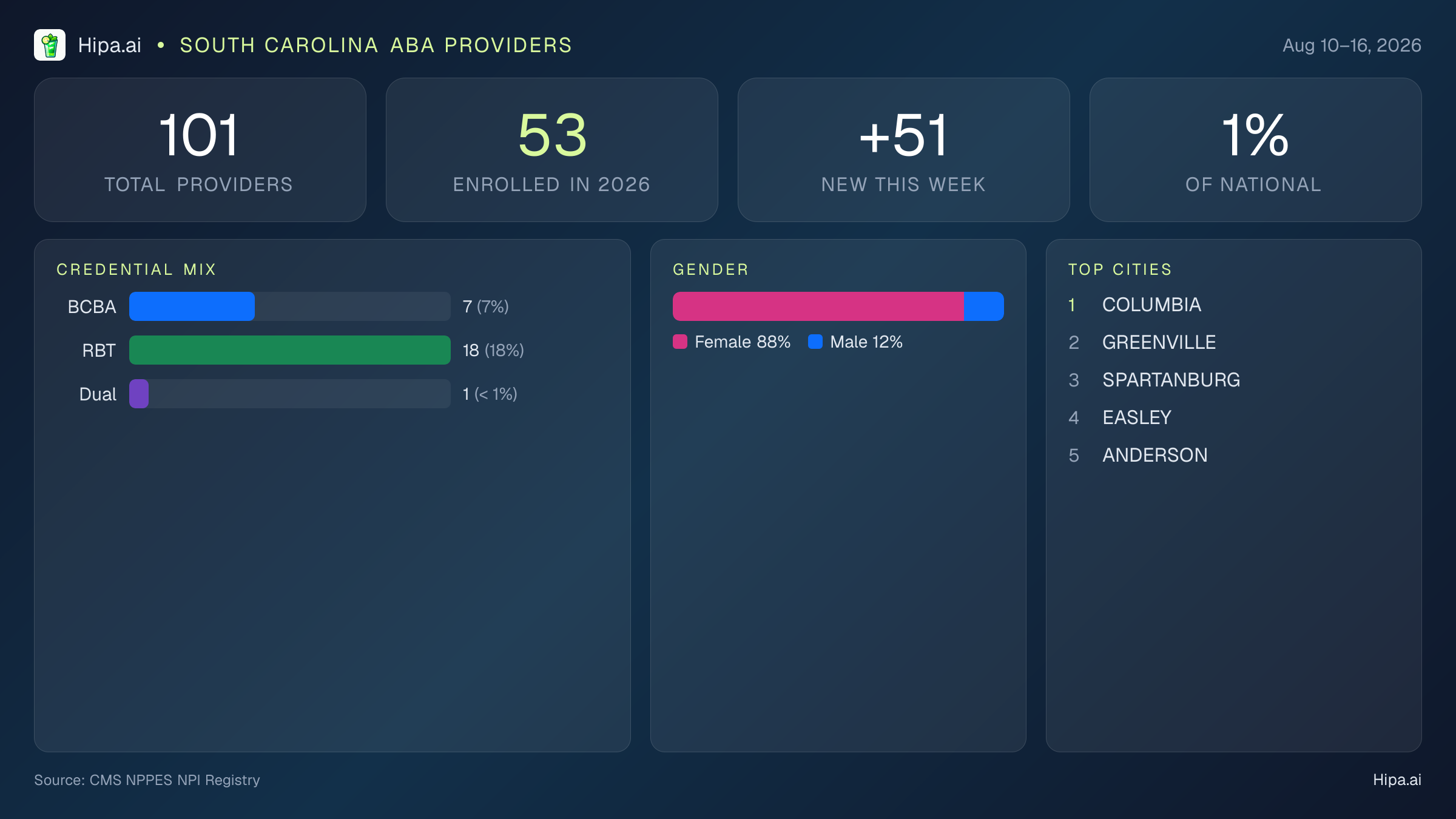
South Carolina recorded 101 providers in the latest CMS NPI registry weekly update, representing 1% of the national weekly total. The registry added 51 new providers this week, bringing the year-to-date total to 53. With 86 individuals and 15 organizations, the state’s activity signals a growing but still relatively small slice of national behavioral health expansion.
ABA Workforce Mix
The credential summary lists 7 BCBA credentials and 18 RBT credentials, including 1 dual BCBA-RBT credential. These categories are not mutually exclusive: providers can carry more than one credential or taxonomy, and the broader registry count includes counselors, social workers, speech-language pathologists and other professionals. The RBT-to-BCBA pattern indicates a larger direct-service workforce than supervisory workforce. Because BCBAs supervise RBTs and guide treatment planning, the mix suggests that supervision capacity could constrain how quickly ABA clinics expand services, particularly as new technician entries accumulate.
Demographics and Provider Activity
Individuals make up most of the registry, while organizations account for the remaining providers. Gender data identifies 76 female providers, 10 male providers and no nonbinary providers; the registry reports those groups as 88%, 12% and 0%, respectively. The strong female majority is consistent with broader behavioral health workforce patterns, although NPI data describes registry participation rather than total employment or clinical availability.
No notable organization appears multiple times in the update, and the data does not identify a repeated PE-backed ABA chain. Provider activity is concentrated in Columbia, Greenville, Spartanburg, Easley and Anderson. Overall, the update points to expanding ABA participation in South Carolina, but the comparatively smaller BCBA presence suggests clinical supervision may remain a key limit on access.