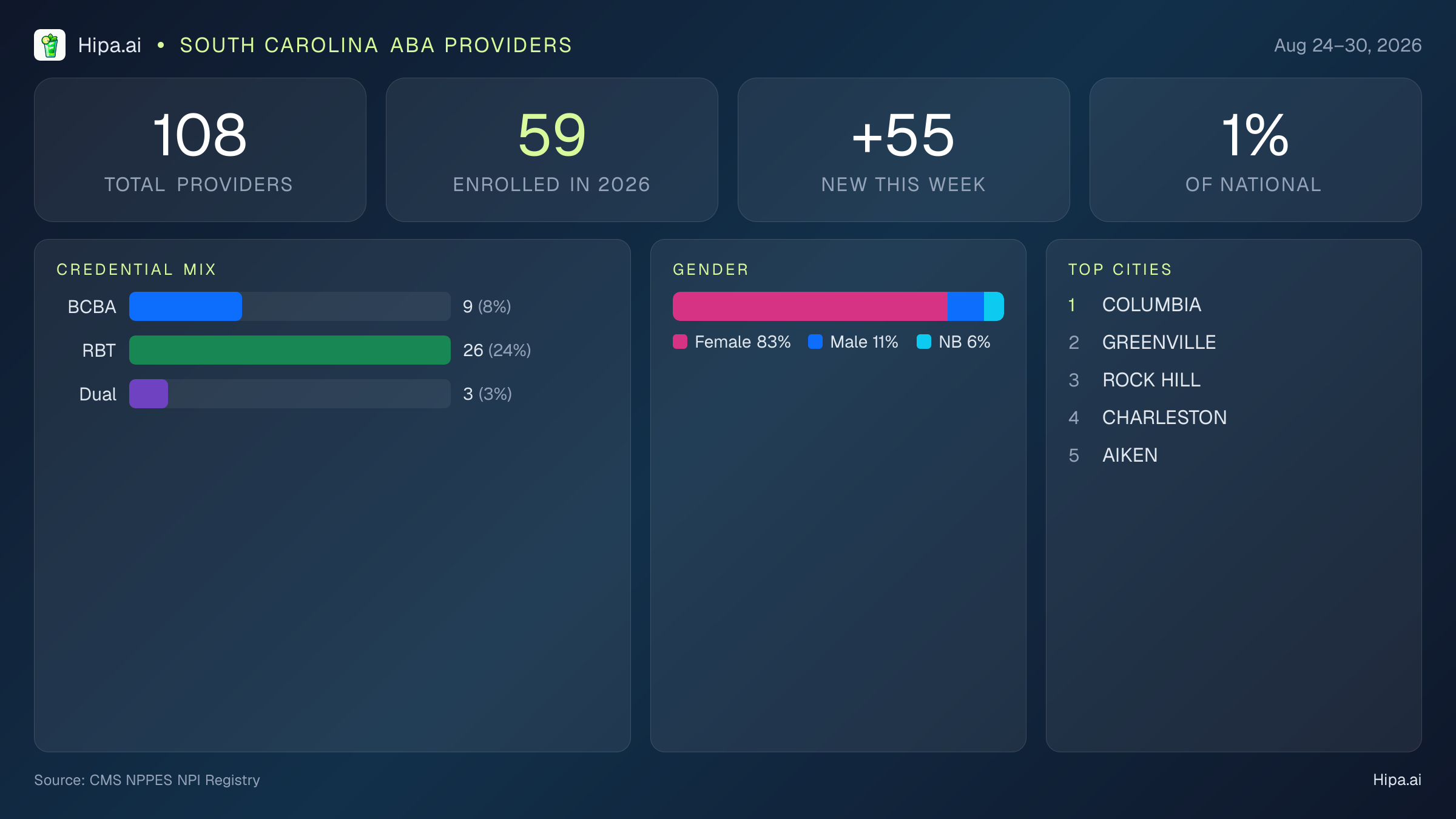
South Carolina recorded 108 providers in the latest CMS NPI registry weekly update, representing 1% of the national weekly total. The update includes 55 new providers, alongside 89 individuals and 19 organizations. That activity gives South Carolina a visible, though limited, share of national behavioral health expansion. The concentration suggests continued provider formation and registration across the state, while NPI activity alone does not establish active caseloads, staffing levels or open appointment capacity.
ABA Workforce Mix
The credential file lists 9 BCBA credentials, 26 RBT credentials and 3 dual BCBA-RBT credentials. These categories overlap and are not mutually exclusive shares of the provider total: some providers may carry multiple credentials, and taxonomy and credential fields can describe the same person differently. The larger RBT count points to a workforce weighted toward direct implementation of behavior-analytic services, while the smaller BCBA pool indicates a narrower supervisory base. Because BCBAs supervise RBTs, develop treatment plans and monitor clinical quality, that ratio may limit how quickly clinics can expand services. The dual-credential count is notable enough to show some progression between technician and advanced clinical roles, but it remains a small part of the listed credential activity.
Demographics and Organizations
Gender data identifies 74 female providers, 10 male providers and 5 nonbinary providers, corresponding to 83%, 11% and 6%. These counts total 89, matching the individual-provider count rather than the full provider total. The leading cities are Columbia, Greenville, Rock Hill, Charleston and Aiken, indicating activity across several of the state’s major behavioral health markets. The registry reports no notable organizations appearing multiple times in this update, so the data does not point to concentrated activity from a named multi-state or PE-backed ABA operator.
South Carolina’s RBT-heavy mix suggests expanding direct-service capacity, but the smaller BCBA pool may remain a constraint on ABA access and workforce growth.