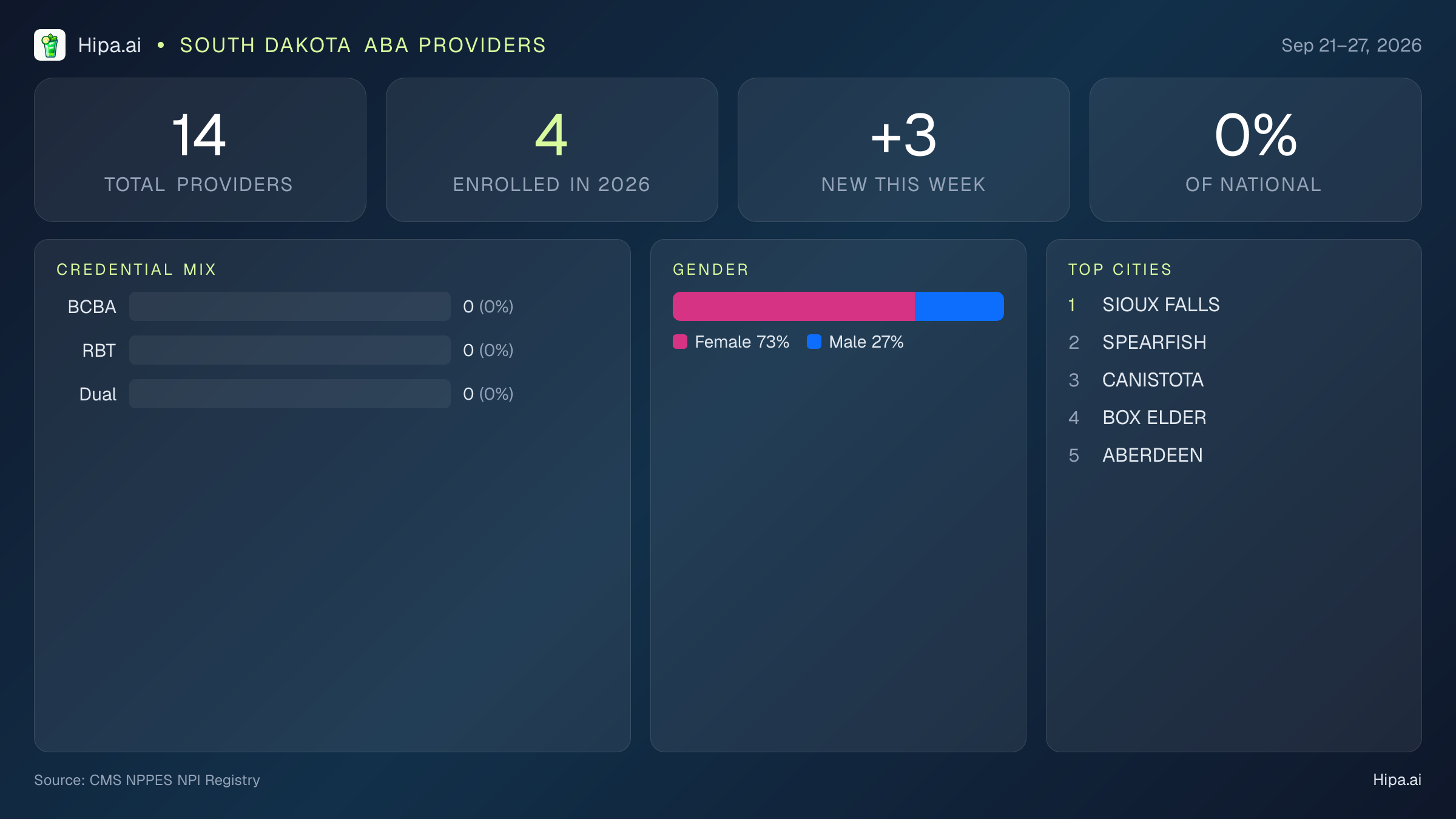
South Dakota recorded 14 providers in the latest CMS NPI registry weekly update, representing 0% of the national weekly total as reported in the data. That rounded share signals that the state accounts for a very small portion of registry activity nationally, not that it has no behavioral health workforce. The update lists three providers added this week and four added this year; 11 are individuals and three are organizations. NPI records track enrollment, not hiring, staffing levels or appointment availability.
ABA workforce mix
The credential summary reports 0 BCBAs, 0 RBTs and zero providers with dual BCBA-RBT credentials. With neither credential represented, a BCBA-to-RBT ratio cannot be calculated, and the registry snapshot offers no evidence of ABA supervision capacity among these records. The listed credentials instead include counseling and social-work qualifications. Six providers have multiple taxonomies, an overlapping classification that should not be added to credential counts or treated as a separate workforce group. These records may reflect broader behavioral health activity rather than ABA-specific enrollment.
Demographics and organizations
Among the individual providers, eight are female and three are male; the data reports no nonbinary providers. The percentage breakdown is 73% female and 27% male. These figures describe the listed individuals, not necessarily the state’s ABA workforce. The registry identifies three organizations, but the notable-organizations field is empty, so it does not flag any organization appearing multiple times. Sioux Falls is the most recurrent city in the provider list, with records also distributed across Spearfish, Canistota, Box Elder, Aberdeen and Rapid City.
For ABA access, the absence of BCBA and RBT records in this weekly snapshot is a signal to monitor, not proof that South Dakota lacks ABA services or qualified workers.