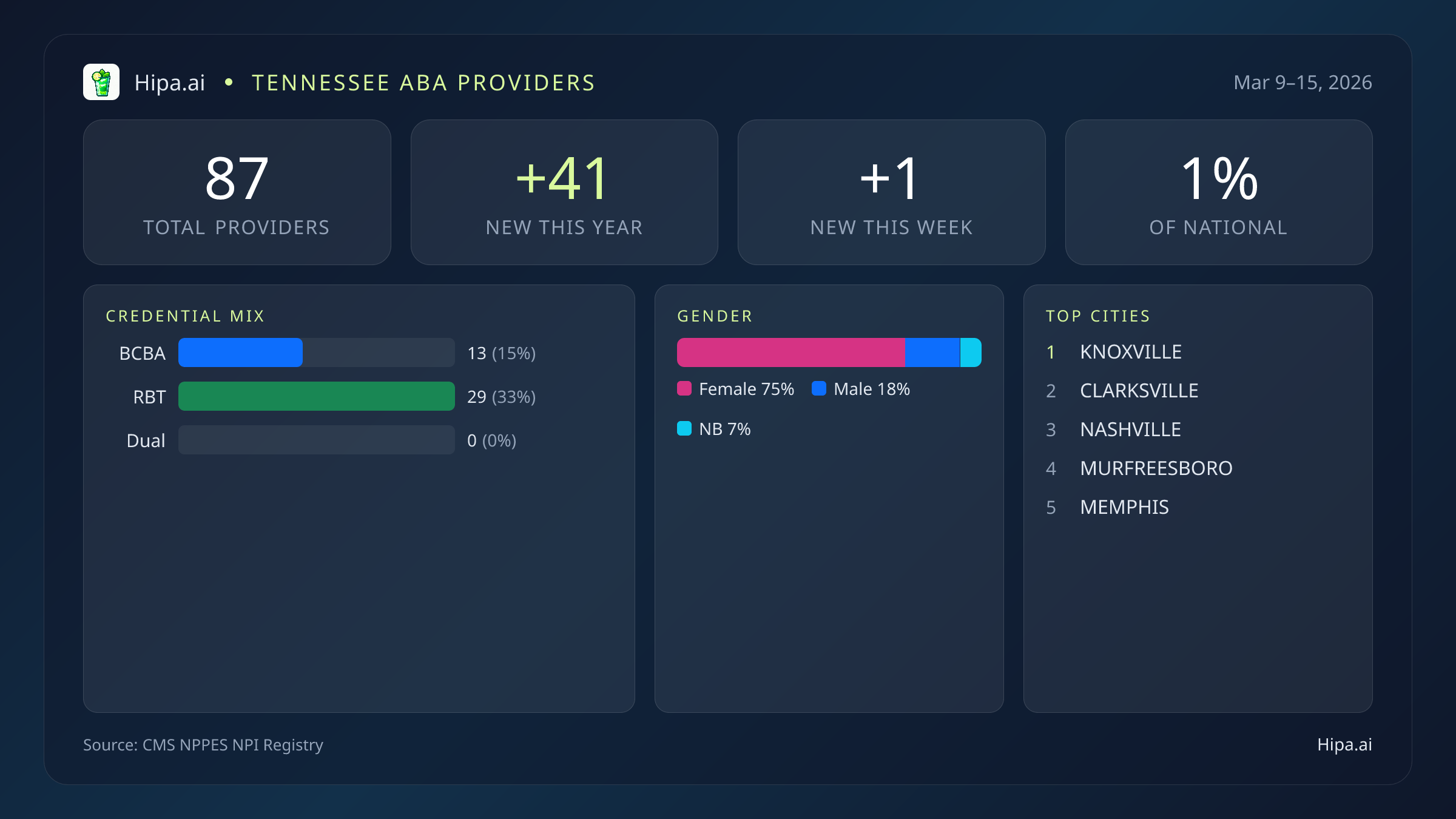
Tennessee's behavioral health sector saw a total of 87 providers in the latest CMS NPI registry weekly update, representing 1% of the national weekly total. This moderate concentration signals consistent, albeit not explosive, growth within the state's behavioral health workforce. One provider was newly added this week, contributing to a year-to-date total of 41 new providers in Tennessee, indicating a steady expansion of services across the state.
Credentialing and Supervision Landscape
The credential mix among individual providers offers insight into the state's ABA workforce structure. The data shows 13 professionals with BCBA credentials and 29 individuals holding RBT credentials. No providers were identified with dual BCBA and RBT credentials in this update. This ratio of approximately 2.23 RBTs per BCBA suggests a relatively manageable supervision load compared to states with higher RBT-to-BCBA ratios, potentially supporting quality oversight for direct ABA services. It is noteworthy that one provider holds the specific credential "M.S., BCBA, LBA," indicating a Board Certified Behavior Analyst who also holds a state license in Tennessee.
Workforce Demographics and Practice Diversity
Analyzing the demographics of Tennessee's individual behavioral health providers reveals a predominantly female workforce, with 54 female providers accounting for 75%. Male providers total 13 individuals, making up 18%, while 5 providers identify as nonbinary, representing 7%. The data includes 15 organizations alongside the 72 individual providers, indicating a mix of independent practitioners and structured clinics. Furthermore, 20 providers hold multiple taxonomies, suggesting a diverse range of specializations and broader scopes of practice within Tennessee's behavioral health community. This blend of credentialed professionals and organizational entities supports a varied approach to addressing behavioral health needs.
Overall, this data suggests a growing but still developing behavioral health workforce in Tennessee, with a strong female presence and a foundational capacity for ABA supervision, which is crucial for expanding access to care across the state.