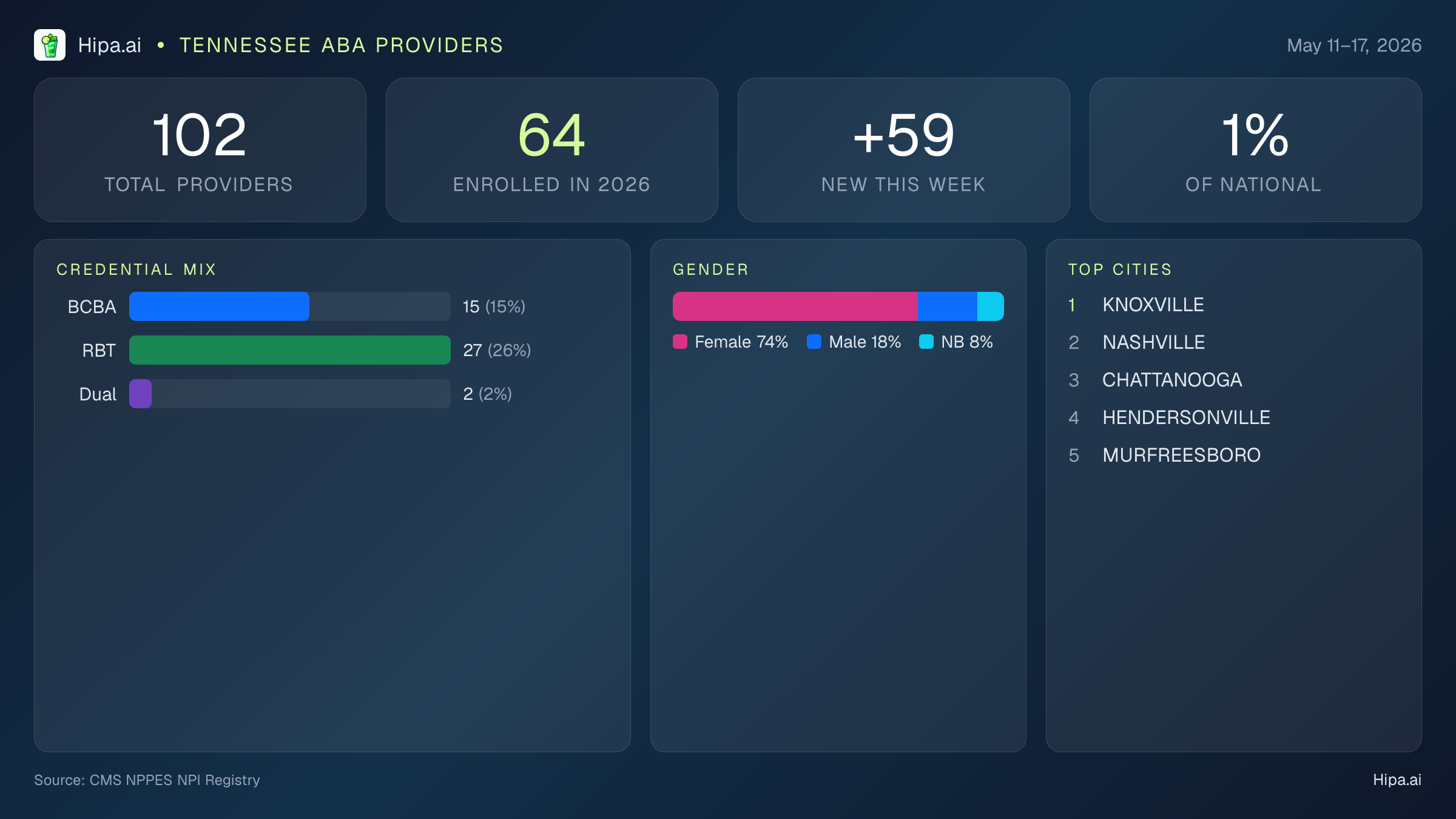
Tennessee saw 102 behavioral health providers added in the latest CMS NPI registry update, representing 1% of the national weekly total. This activity included 59 new enrollments this week, indicating a consistent, albeit smaller, growth trajectory for the state's behavioral health workforce. Of these, 87 were individual practitioners and 15 were organizations.
ABA Workforce Composition
Focusing on the applied behavior analysis sector, the update shows 15 providers with BCBA credentials and 27 with RBT credentials. It is important to note that these categories can overlap, as 2 individuals hold both BCBA and RBT credentials, signaling career progression. The resulting RBT-to-BCBA ratio of approximately 1.8:1 is significantly lower than typical operational ratios in ABA clinics, which often range from 5:1 to 8:1. This suggests either a high proportion of BCBAs not primarily supervising RBTs, or a potential bottleneck in direct service capacity if RBTs are underrepresented relative to available supervision.
Provider Demographics
Among the individual providers, the gender breakdown shows 74% are female, 18% are male, and 8% identify as nonbinary. No single organization appeared multiple times in this week's new registrations. This snapshot of Tennessee's behavioral health workforce highlights a notable female majority, consistent with broader trends in the caregiving professions.
The current data suggests Tennessee is actively growing its behavioral health provider base, particularly with new RBTs, but the low RBT-to-BCBA ratio points to a potential need for more RBTs to maximize the impact of its supervisory capacity and improve access to direct ABA services.