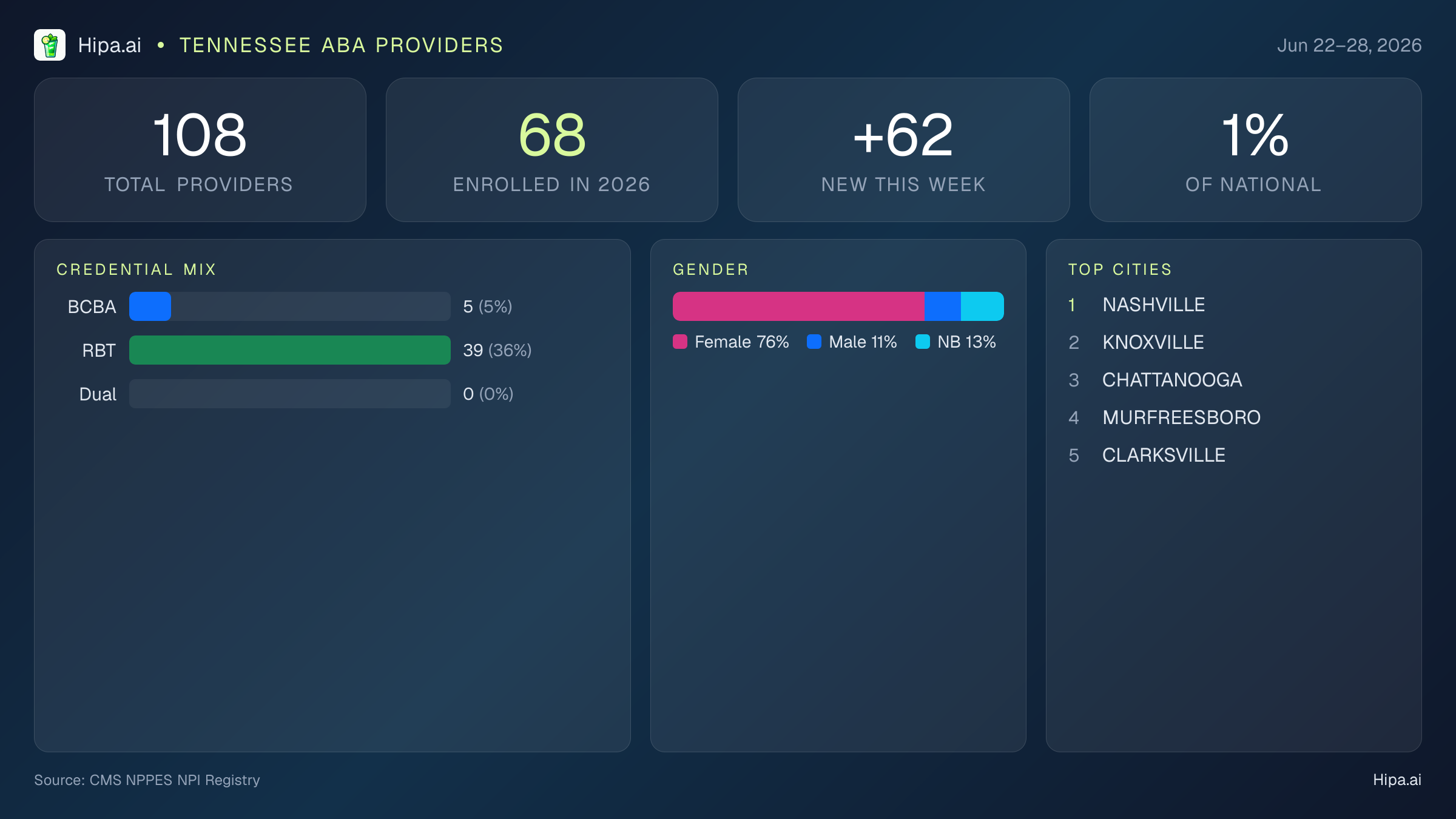
Tennessee recorded 108 total providers in the latest CMS NPI registry weekly update, representing 1% of the national total. A substantial 62 new providers were added this week, indicating a steady, albeit smaller, influx of professionals into the state's healthcare landscape. This consistent growth is vital for a state aiming to meet evolving behavioral health needs.
ABA Workforce Dynamics
Within the applied behavior analysis (ABA) sector, the data shows 5 BCBA credentials and 39 RBT credentials. It is important to note that these credential counts are not mutually exclusive, though no individuals in this specific update held both BCBA and RBT credentials. The ratio of RBTs to BCBAs, approximately 8 RBTs for every BCBA, highlights a significant demand for direct service providers. This imbalance underscores the critical need for more BCBAs to provide the necessary supervision for RBTs, ensuring quality and ethical ABA service delivery across the state.
Provider Demographics and Organizational Presence
Of the 99 individual providers in this update, 75 female (76%) are female, 11 (11%) are male, and 13 (13%) identify as nonbinary. This gender distribution is consistent with national trends observed in the behavioral health workforce. The update also included 9 organizations, though no single organization appeared multiple times, suggesting a diverse entry of new practices rather than significant expansion by established multi-state chains in this particular week.
The continued growth in Tennessee's behavioral health workforce, particularly the high number of RBTs relative to BCBAs, signals an ongoing effort to expand ABA services, but also points to a persistent need for more supervisory-level professionals to support this expansion and improve client access.