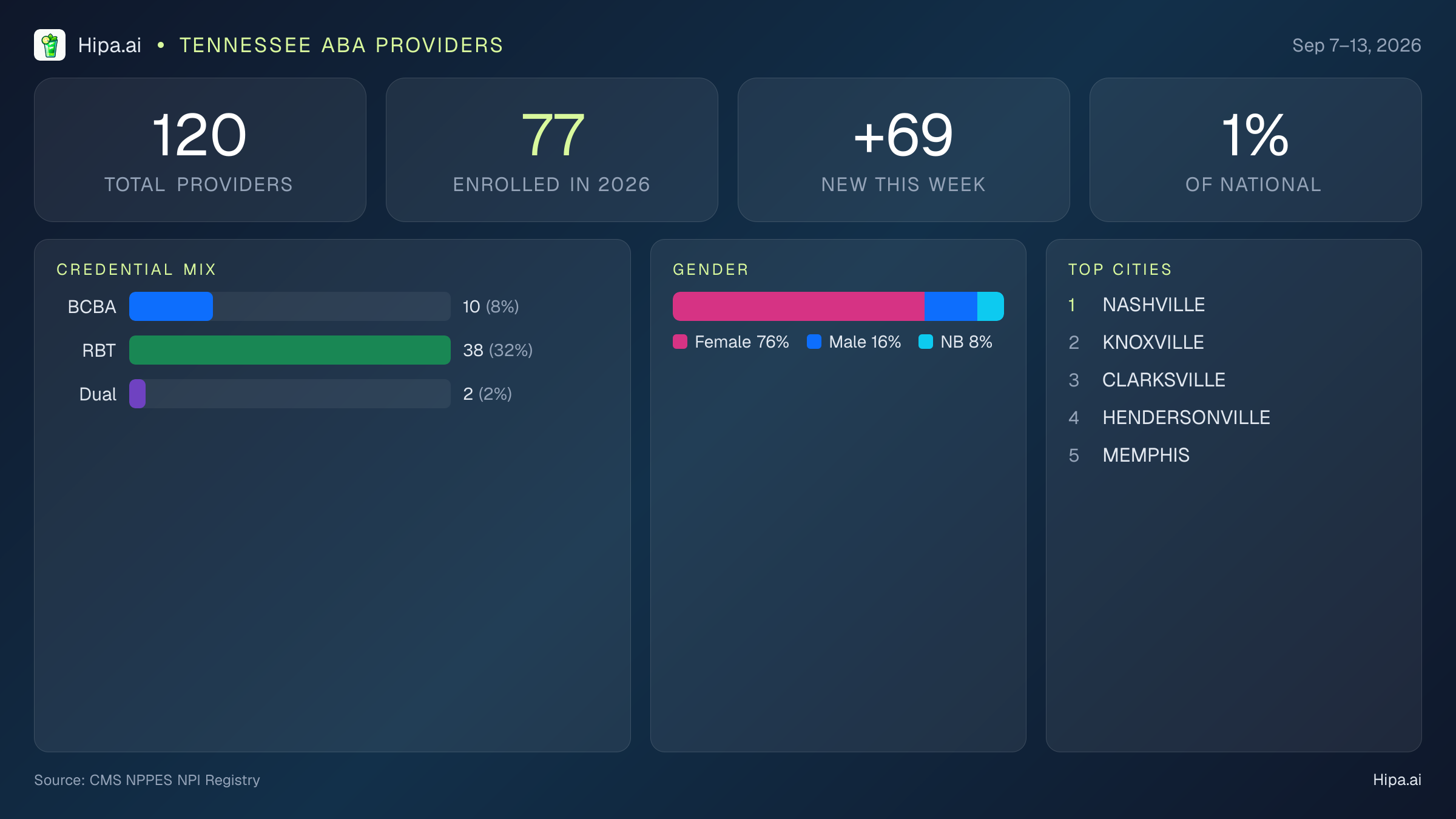
Tennessee recorded 120 providers in the latest CMS NPI registry weekly update, representing 1% of the national weekly total. The update includes 69 new providers this week and 77 added this year, with 102 individuals and 18 organizations. That activity signals a meaningful but still limited share of national behavioral health registry growth. NPI records reflect enrollment activity, not confirmed staffing, caseloads or appointment availability, so the figures show provider participation rather than guaranteed access.
ABA Workforce Mix
The credential summary lists 10 BCBAs, 38 RBTs and 2 providers with dual BCBA-RBT credentials. These categories overlap: the dual-credential providers are included in the broader BCBA and RBT counts and should not be treated as separate groups. The registry also identifies 20 providers with multiple taxonomies, another sign that classifications can overlap. The technician-heavy mix indicates more direct-service capacity than supervisory capacity. BCBAs supervise RBTs, oversee treatment planning and monitor clinical quality, so the ratio points to potential pressure on Tennessee’s supervisory pipeline. The credential-text field reports 3 BCBA and 3 RBT entries, further underscoring that field-based totals do not align cleanly.
Demographics and Organizations
Gender data identifies 78 female providers, 16 male providers and 8 nonbinary providers, or 76%, 16% and 8%, respectively. The update flags no notable organization appearing multiple times. Listed activity spans Nashville, Knoxville, Clarksville, Hendersonville and Memphis, while ABA-related organizations include Autism Centers of Tennessee, ABC Behavior Therapy LLC and Sunshine State of Mind ABA LLC.
Tennessee’s update suggests expanding RBT capacity, but sustaining broader ABA access will depend on recruiting enough BCBAs to supervise that workforce.