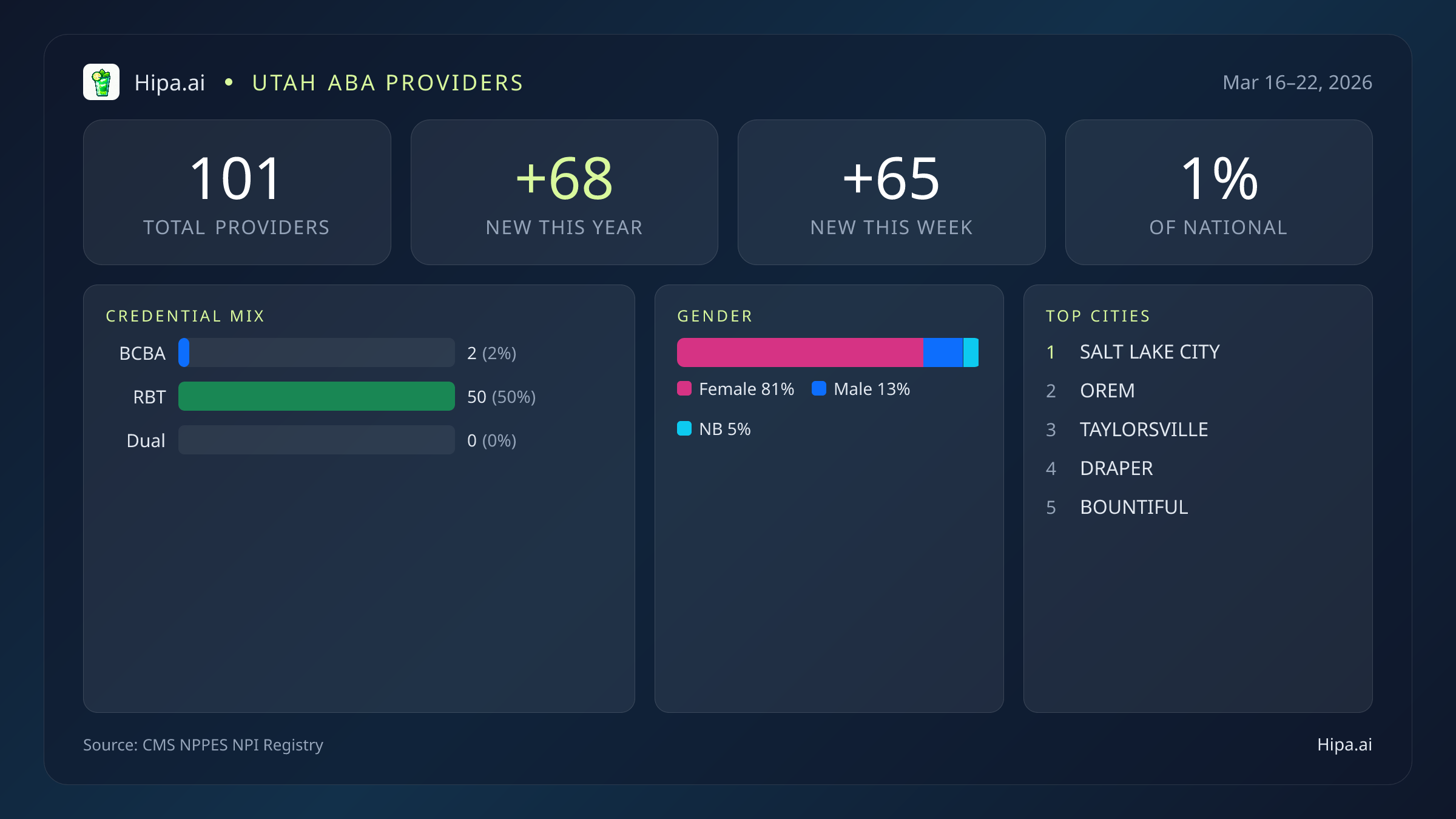
Utah's behavioral health provider registry includes 101 total providers, representing 1% of new weekly national activity. The state added 1 provider this week and 68 year-to-date, indicating steady but modest growth in a region where ABA workforce expansion remains incremental compared to larger markets.
The credential breakdown reveals a significant structural gap: Utah lists only 2 BCBAs against 50 RBTs, a ratio that signals potential supervision capacity constraints. The absence of 0 dual BCBA+RBT credentials suggests limited career progression pathways within the state's ABA workforce. By contrast, the registry includes 5 LCSWs and 5 CSWs, reflecting Utah's reliance on general mental health credentials to fill behavioral health roles where ABA-specific licensure remains scarce.
The workforce skews heavily female: 74 providers (81%) identified as women, compared to 12 men (13%) and 5 nonbinary individuals (5%). The 91 individuals across 10 organizations suggests a fragmented market without dominant regional employers—a pattern distinct from states where PE-backed chains consolidate staff under single corporate entities. Providers concentrate in the Wasatch Front corridor, with Salt Lake City, Orem, Taylorsville, Draper, and Bountiful leading the distribution.
With so few BCBAs relative to RBTs, Utah's ABA sector may face supervision bottlenecks that constrain service delivery and slow clinical growth.