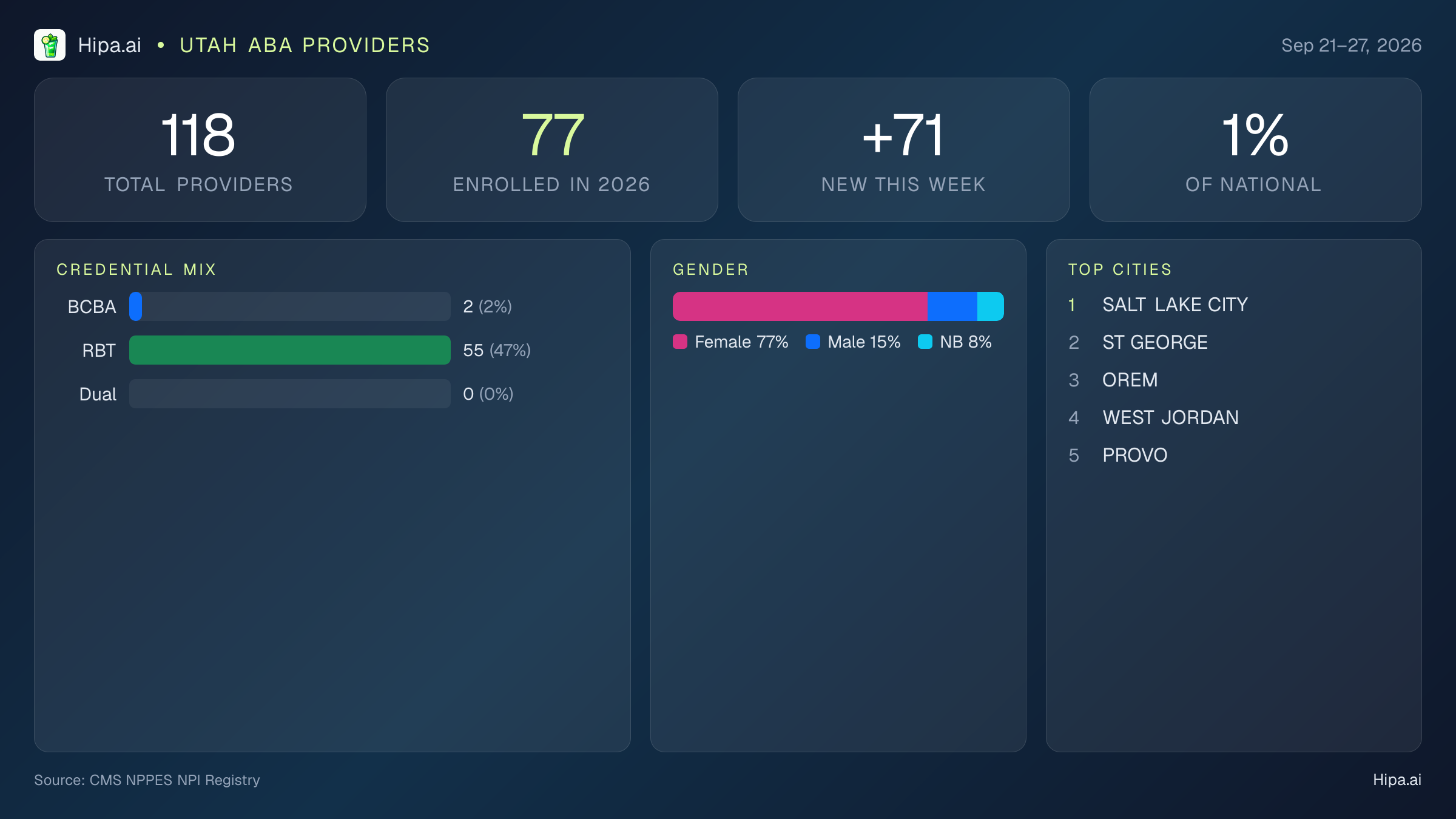
Utah had 118 providers in the latest CMS NPI registry weekly update, representing 1% of the national weekly total. That share indicates a limited slice of recorded national activity, not a measure of Utah’s population-adjusted workforce or service availability. The update lists 71 providers added this week and 77 this year; registry entries do not confirm new hires, active caseloads or appointment access.
ABA Workforce Mix
The credential summary lists 55 RBTs, 2 BCBAs and no dual BCBA-RBT credentials. The counts are credential categories, not necessarily separate workforce groups, though the reported dual count is zero. The large gap between RBT and BCBA records points to a technician-heavy profile and raises a supervision-capacity concern: RBTs deliver direct services under BCBA supervision, so technician growth alone does not establish that supervisory capacity is keeping pace. The registry also reports 15 providers with multiple taxonomies, another reason not to treat classification counts as separate populations.
Demographics and Organizations
Among listed providers, 81 are female, or 77%; 16 are male, or 15%; and 8 are nonbinary, or 8%. These figures describe the broader provider registry, not ABA practitioners alone. The update includes 105 individuals and 13 organizations, but its notable-organizations field is empty, so it does not identify any organization appearing multiple times. Salt Lake City, St. George, Orem, West Jordan and Provo are the leading listed cities, suggesting activity across both northern and southern population centers.
Utah’s registry points to substantial RBT representation but few BCBA records, making growth in qualified supervision central to any effort to expand ABA access.