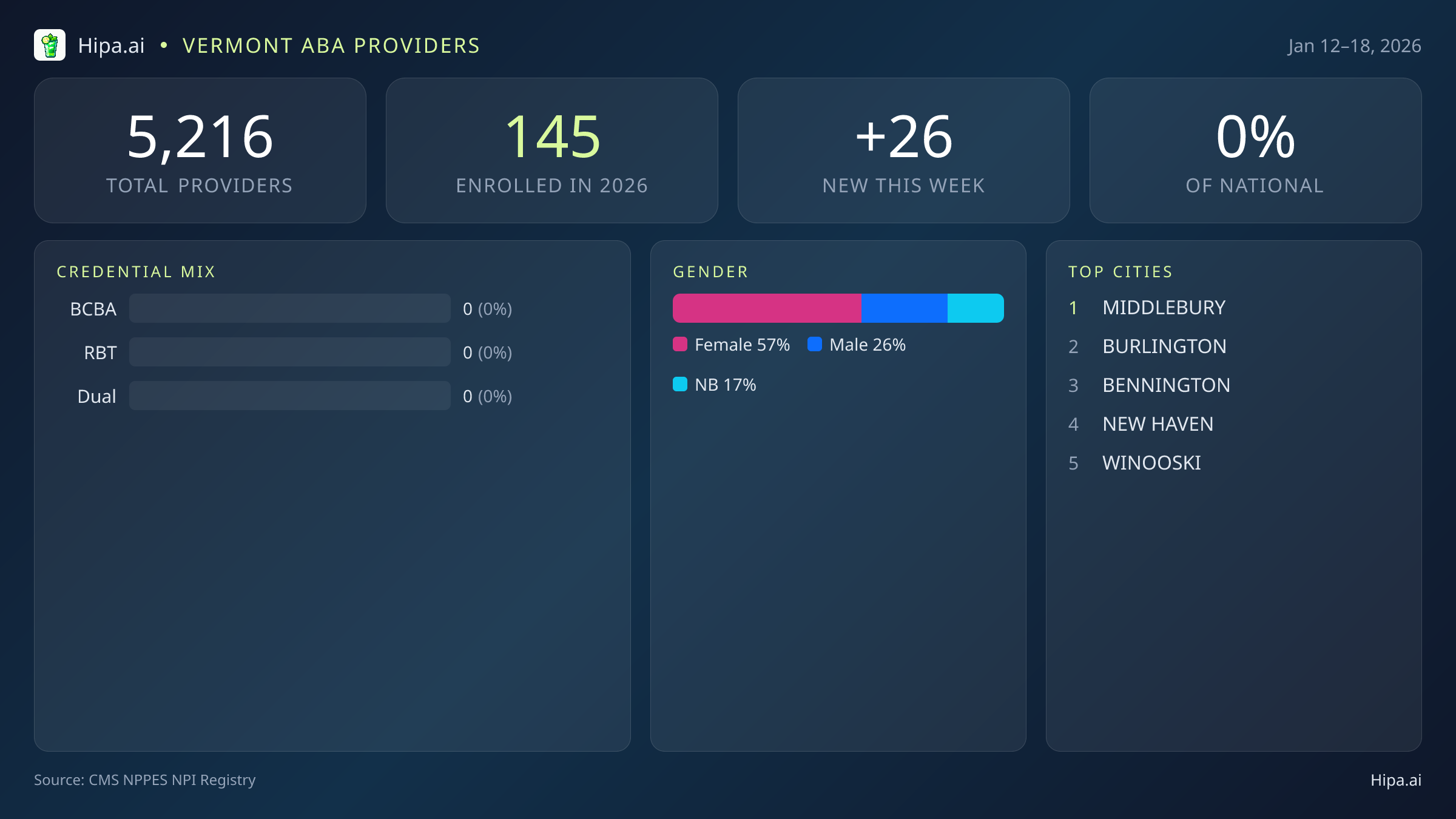
Vermont added 26 behavioral health providers in the latest weekly CMS update, accounting for 1% of the national total. This modest influx suggests a steady, albeit small, expansion of the state's behavioral health workforce, indicating a localized response to demand rather than a broad surge.
ABA Workforce Composition
Crucially for the applied behavior analysis (ABA) industry, this week's data for Vermont includes no new Board Certified Behavior Analysts (BCBAs) or Registered Behavior Technicians (RBTs). There are also no individuals reported with dual BCBA and RBT credentials. The only specific credential listed among the new providers is 1 MA. This absence of ABA-specific credentials means that the recent growth in Vermont's behavioral health sector, as reflected in this update, does not directly contribute to the state's ABA workforce capacity, which relies heavily on these certified professionals for supervision and direct service delivery.
Provider Demographics and Focus
Among the 23 individual providers, the gender breakdown shows 13 female providers (57%), 6 male providers (26%), and 4 nonbinary providers (17%). In addition to individuals, 3 organizations were added, though no single organization appeared multiple times. The primary taxonomies observed among these new providers include Mental Health Counselors, Clinical Social Workers, and Addiction Counselors, with new providers concentrated in cities such as Middlebury, Burlington, and Bennington.
This week's data suggests that while Vermont is seeing some growth in general behavioral health services, the specific pipeline for ABA professionals remains unaddressed in this update, potentially impacting the expansion of ABA access within the state.