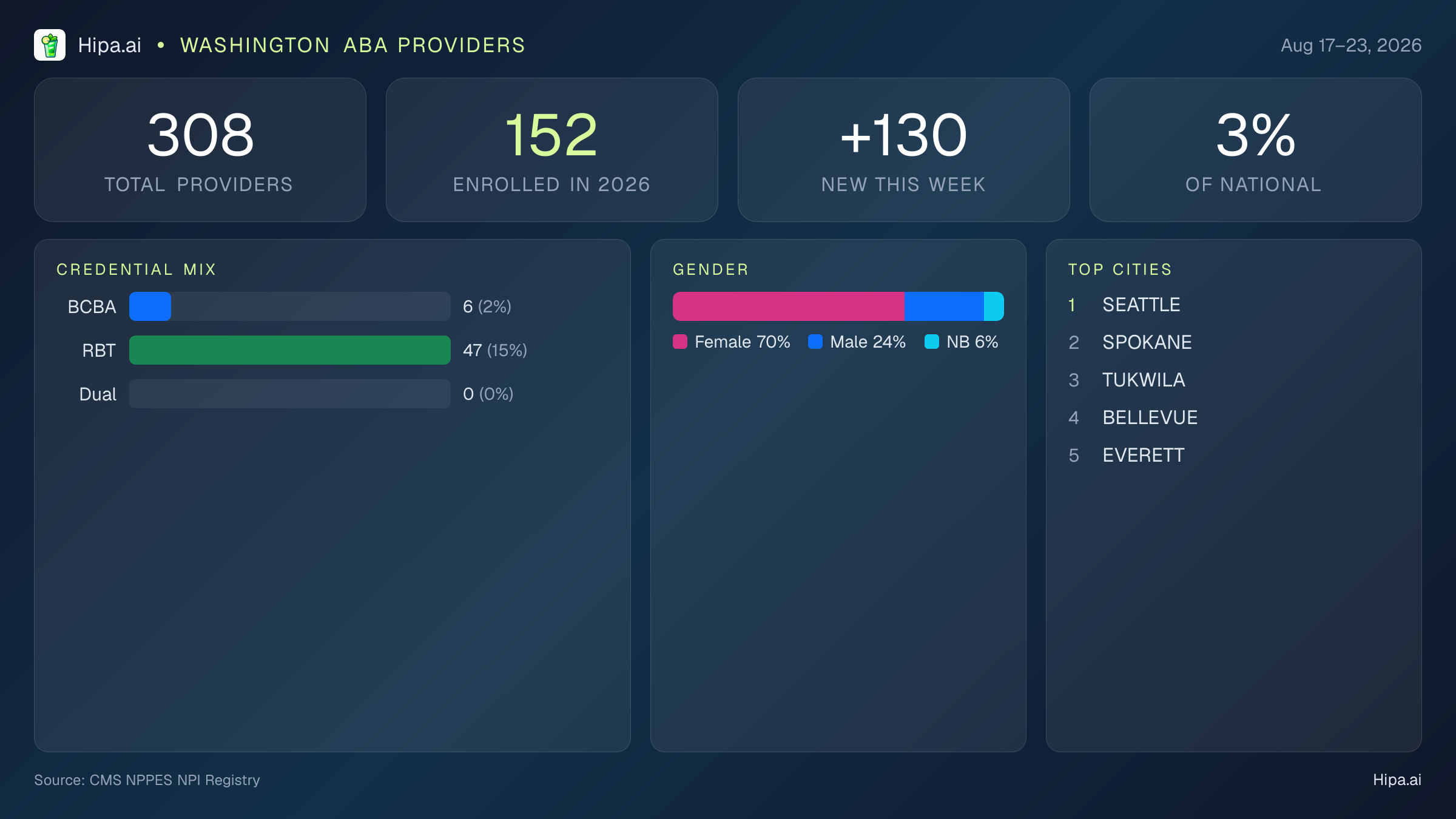
| AINSWORTH, NICHOLAS | PUYALLUP, WA | - | Mental Health Counselor | 08/20/2026 |
| AIWORO, CLINTON | EVERETT, WA | - | RBT | 08/19/2026 |
| ALFERD, ISAAC | VANCOUVER, WA | - | RBT | 08/20/2026 |
| AMALFARD, BAHAR | TUKWILA, WA | - | Counselor | 08/18/2026 |
| ANDRIYIVNA, MARINA | SEATTLE, WA | - | Counselor | 08/19/2026 |
| AOUD, MAURICE | SEATTLE, WA | - | Counselor | 11/19/2024 |
| BAL, LOVELEEN | SEATTLE, WA | - | RBT | 08/19/2026 |
| BALT, CAMERON | SEATTLE, WA | - | RBT | 08/19/2026 |
| BARAJAS, DAVID | EVERETT, WA | MA | Counselor | 08/15/2024 |
| BARBER, IRENE | GIG HARBOR, WA | - | Mental Health Counselor | 08/19/2026 |
| BAXTER, STEPHANIE | LONGVIEW, WA | - | Clinical Social Worker | 04/23/2019 |
| BECKMAN, CHANNA | GIG HARBOR, WA | M.A.,CCC-SLP | Speech-Language Pathologist | 06/12/2007 |
| BEHESHTI, NAZANIN | BOTHELL, WA | - | RBT | 08/15/2025 |
| BERKELEY, ALEXIS | SPANAWAY, WA | PHD | Mental Health Counselor | 08/21/2026 |
| BERUKOFF, NATASHA | YAKIMA, WA | - | Case Manager/Care Coordinator | 09/09/2024 |
| BLANCO, BIANCA | CAMAS, WA | - | Mental Health Counselor | 08/19/2026 |
| BOELTER, ELIZABETH | YAKIMA, WA | - | Addiction (Substance Use Disorder) Counselor | 08/02/2018 |
| BOLTON, MORGAN | SPOKANE, WA | MSW, LSWAIC | Clinical Social Worker | 08/10/2020 |
| BOONE, MOSIEO | EVERETT, WA | - | Counselor | 08/19/2026 |
| BORBRIDGE, MELISSA | FEDERAL WAY, WA | - | Counselor | 08/27/2024 |
| BOYES, LAYKIN | SPOKANE, WA | PMHNP, LMHC | Mental Health Counselor | 10/15/2018 |
| BRAZER, JENNIFER | TACOMA, WA | - | Clinical Social Worker | 01/27/2016 |
| BRECHT, BENJAMIN | EVERETT, WA | - | Mental Health Counselor | 04/18/2025 |
| BRITTANY AGUILA THERAPY, LLCORG | SPOKANE, WA | - | Mental Health Counselor | 11/25/2025 |
| BROOME, JACK | BELLINGHAM, WA | - | Mental Health Counselor | 08/18/2026 |
| BROWN, ATHRETTIS | TACOMA, WA | - | Mental Health Counselor | 08/20/2026 |
| BUCK, SHELDON | PASCO, WA | - | Addiction (Substance Use Disorder) Counselor | 03/30/2017 |
| CAIN, KAYLA | YELM, WA | - | RBT | 08/20/2026 |
| CAMP, CHRISTINE | TACOMA, WA | PH.D., CCC-SLP | Speech-Language Pathologist | 03/01/2007 |
| CAO, XUEAO | GRAHAM, WA | - | Speech-Language Pathologist | 08/17/2026 |
| CARMONA-LOPEZ, ITZEL | PUYALLUP, WA | - | Speech-Language Pathologist | 08/21/2026 |
| CARNESI, GREGORY | TACOMA, WA | LSWAIC | Counselor | 08/18/2026 |
| CARUSO, MILES | BELLINGHAM, WA | - | RBT | 08/18/2026 |
| CASCADE COMMUNITY HEALTHCAREORG | CENTRALIA, WA | - | Community/Behavioral Health Agency | 09/27/2006 |
| CERDA, PEDRO | SEATTLE, WA | - | Counselor | 08/18/2026 |
| CHEN, FANGYE | BELLEVUE, WA | - | Mental Health Counselor | 08/19/2026 |
| COVERT, CHRISTINA | SEATTLE, WA | - | Addiction (Substance Use Disorder) Counselor | 01/16/2024 |
| CREMIN, SHARON | BRIER, WA | MSW, LICSW | Clinical Social Worker | 12/20/2021 |
| DANIELS, MASON | TACOMA, WA | - | RBT | 09/03/2025 |
| DARBOE, NJOBA | BELLEVUE, WA | - | Mental Health Counselor | 12/08/2023 |
| DAVIDSON, ANALISA | EPHRATA, WA | - | Counselor | 03/14/2021 |
| DAVIS, DAMARA | SEDRO WOOLLEY, WA | MA | Addiction (Substance Use Disorder) Counselor | 08/17/2026 |
| DAVIS, EBONY | SEATTLE, WA | - | Counselor | 08/18/2026 |
| DAVIS, HANNAH | VANCOUVER, WA | - | Counselor | 08/18/2026 |
| DECK, DALEEN | SPOKANE, WA | M.A. | Counselor | 08/18/2026 |
| DENMARK, ANNABELLE | OLYMPIA, WA | LPC | Professional Counselor | 01/18/2023 |
| DEREIX CALONGE, IDUAR | TUMWATER, WA | - | Mental Health Counselor | 07/19/2023 |
| DICK, KENZIE | TUKWILA, WA | - | Mental Health Counselor | 08/18/2026 |
| DOAR PROFESSIONAL COUNSELING LLCORG | BOTHELL, WA | - | Mental Health Counselor | 08/17/2026 |
| DONAHOO, NICOLE | SEATTLE, WA | LMP, LMFTA | Mental Health Counselor | 07/28/2012 |
| DONDERO, BRENDA | EVERETT, WA | LICSW | Clinical Social Worker | 08/21/2026 |
| DUFFY, BRITTANY | SPOKANE, WA | LICSW | Clinical Social Worker | 01/07/2019 |
| DUMAS, LIA | EVERETT, WA | - | Counselor | 11/21/2018 |
| DUVALL, PEYTON | SEATTLE, WA | - | Counselor | 08/18/2026 |
| EMERALD CITY BEHAVIORAL HEALTHORG | UNIVERSITY PLACE, WA | - | Community/Behavioral Health Agency | 11/23/2023 |
| ENGELKER, MANDY | BLACK DIAMOND, WA | - | BCBA | 06/30/2016 |
| ENSMINGER-STAPP, SHARMAN | EASTSOUND, WA | - | Mental Health Counselor | 11/22/2025 |
| EPPS, JUSTYN | SPOKANE VALLEY, WA | - | Counselor | 04/11/2025 |
| FAIRBANKS, PRICE | TACOMA, WA | - | RBT | 08/17/2026 |
| FARRELL, CRYSTAL | SEATTLE, WA | - | RBT | 08/17/2026 |
| FEARS, AMBER | VANCOUVER, WA | MC70042060 | Counselor | 11/02/2022 |
| FEDEL, MEGAN | SPOKANE, WA | LMHC | Mental Health Counselor | 11/11/2022 |
| FERRARO, STEPHANIE | EDGEWOOD, WA | - | RBT | 01/05/2026 |
| FESER, MESERET | SPOKANE, WA | - | Clinical Social Worker | 07/25/2019 |
| FLANARY, BRYAN | RICHLAND, WA | - | Mental Health Counselor | 08/21/2026 |
| FLOWERS, TAKESHA | TUKWILA, WA | - | Mental Health Counselor | 08/05/2019 |
| FORREST, VALARIE | SPOKANE VALLEY, WA | BHSS AAC | RBT | 08/19/2026 |
| FOX, MICHAEL | SPOKANE, WA | LICSW SUDP | Clinical Social Worker | 03/27/2017 |
| FREGOSO, MATTHEW | SPOKANE, WA | - | Mental Health Counselor | 06/24/2020 |
| FRIDDELL, LAILA | AUBURN, WA | - | RBT | 06/16/2026 |
| FRIEDRICHSEN, ANN | TUKWILA, WA | LICSW | Clinical Social Worker | 08/21/2026 |
| GAGE, MARY | EVERETT, WA | MA, LMHC, CDPT | Mental Health Counselor | 07/19/2017 |
| GAKINYA, TERESA | PUYALLUP, WA | - | RBT | 07/22/2026 |
| GAMMON, ARIANA | SEATTLE, WA | - | Psychologist | 08/27/2025 |
| GARZA, JOEY | RICHLAND, WA | LICSW | Clinical Social Worker | 07/21/2021 |
| GATES, JENNIFER | BELLEVUE, WA | LMHC | Mental Health Counselor | 01/26/2012 |
| GENERATIONAL WELLTH LLCORG | SPOKANE VALLEY, WA | - | Counselor | 08/22/2026 |
| GIDLEY, JORDAN | SEATTLE, WA | LMHCA | Case Manager/Care Coordinator | 06/23/2022 |
| GILLIS, MARGO | EVERETT, WA | - | Psychologist | 08/17/2026 |
| GITAU, STEPHEN | PUYALLUP, WA | - | RBT | 06/04/2026 |
| GITONGA, SIMON | PUYALLUP, WA | - | RBT | 06/04/2026 |
| GONZALES, ISABELLA | PULLMAN, WA | CAAR | Mental Health Counselor | 08/19/2026 |
| GOTTFRIED, ADAM | SEATTLE, WA | MSW, LICSW | Clinical Social Worker | 09/25/2012 |
| GREENE, ERIN | SPOKANE, WA | MSW, LICSWA | Clinical Social Worker | 08/19/2026 |
| GROVER, APRIL | RENTON, WA | MSCP, LMHC | Mental Health Counselor | 10/01/2018 |
| GUIDED PATH THERAPY PLLCORG | BOTHELL, WA | - | Mental Health Counselor | 08/20/2026 |
| HAMASU, RYAN | TUKWILA, WA | - | Counselor | 08/18/2026 |
| HAMPTON, SARAH | LACEY, WA | - | Counselor | 07/09/2025 |
| HARDIN, TERRI | TUKWILA, WA | MA, LMHCA | Mental Health Counselor | 05/05/2016 |
| HARSHBARGER, SAMANTHA | BELLEVUE, WA | - | RBT | 08/17/2026 |
| HARTSOCK, KAYLIE | TUKWILA, WA | - | RBT | 08/19/2026 |
| HASHIMOTO, JASMINE | BELLEVUE, WA | - | Counselor | 08/20/2026 |
| HAUGAN, KATELIN | PORT ORCHARD, WA | BCBA | BCBA | 10/03/2018 |
| HAWKINSON, JOEY | FERNDALE, WA | M.A., SLP | Speech-Language Pathologist | 09/27/2022 |
| HAYS, EMMA | SPOKANE, WA | - | RBT | 08/19/2026 |
| HEINZE, AIMEE | TACOMA, WA | - | Counselor | 04/26/2025 |
| HENDRICKSON, WENDY | SNOHOMISH, WA | LMHC, CDP | Mental Health Counselor | 01/14/2008 |
| HERMAN, CORY | BELLINGHAM, WA | - | Speech-Language Pathologist | 08/18/2026 |
| HERRERA, STEPHANIE | SEATTLE, WA | - | Counselor | 08/21/2026 |
| HOGAN, LAUREL | VANCOUVER, WA | - | Counselor | 08/17/2026 |
| HOLISTIC INTEGRATIVE GENERATIONAL HEALTH EDUCATION RESOURCE SPCORG | SPOKANE VALLEY, WA | - | Counselor | 08/22/2026 |
| HOLLENBERG, KATHRYN | KENNEWICK, WA | - | Counselor | 08/21/2026 |
| HOLLINGSHEAD, DRISTEN | PORT ORCHARD, WA | - | RBT | 03/31/2021 |
| HOLMAN, JAMES | RENTON, WA | - | Mental Health Counselor | 08/18/2026 |
| HOLMES, MARCUS | SEATTLE, WA | - | Counselor | 08/17/2026 |
| HOLTAN, JARRYD | BELLEVUE, WA | LMHCA | Mental Health Counselor | 10/14/2024 |
| HONG, CECILY | TACOMA, WA | MA, RC | Professional Counselor | 01/19/2007 |
| HUTCHINSON, QUINCY | BELLEVUE, WA | - | RBT | 08/17/2026 |
| HUYNH, RYAN | TUKWILA, WA | - | Counselor | 08/18/2026 |
| HYPPOLITE, JENNIFER | SEATTLE, WA | - | Mental Health Counselor | 05/22/2021 |
| INLAND VIRTUAL COUNSELING PLLCORG | SPOKANE, WA | - | Mental Health Counselor | 08/13/2026 |
| INNER COMPASS BEHAVIORAL HEALTH PLLCORG | SPOKANE, WA | - | Clinical Social Worker | 04/11/2026 |
| JEFFERSON, MERLE | BELLINGHAM, WA | SUDPT | Addiction (Substance Use Disorder) Counselor | 08/19/2026 |
| JENKINS, MICAHIAH | BELLEVUE, WA | - | RBT | 08/17/2026 |
| JENSEN, LACI | BELLEVUE, WA | - | Mental Health Counselor | 06/13/2018 |
| JOHNSON, MILEY | SEATTLE, WA | - | Counselor | 08/21/2026 |
| JONES, RENEICE | SPOKANE VALLEY, WA | - | Case Manager/Care Coordinator | 08/22/2026 |
| KALUNGU, MARIAH | AUBURN, WA | - | Counselor | 08/18/2026 |
| KANTNER, MARY | SEATTLE, WA | - | Mental Health Counselor | 08/18/2026 |
| KAUI, CAROLYN | VANCOUVER, WA | - | Mental Health Counselor | 08/21/2019 |
| KAUSE, VICTORIA | SEATTLE, WA | - | Clinical Social Worker | 07/20/2015 |
| KELLOGG, AUTUMN | CENTRALIA, WA | - | Counselor | 08/18/2026 |
| KESTER, KAYLA | LAKEWOOD, WA | - | Counselor | 05/22/2023 |
| KEYS, STEPHANIE | SPOKANE VALLEY, WA | - | RBT | 08/21/2026 |
| KIDRICK, STACEY | BELLINGHAM, WA | - | Mental Health Counselor | 08/21/2026 |
| KIM, ISABELLE | FEDERAL WAY, WA | - | Mental Health Counselor | 08/17/2026 |
| KLAGES, VALERIE | BELLINGHAM, WA | LMHCA | Mental Health Counselor | 08/17/2026 |
| KORRELL, SHELBI | CENTRALIA, WA | - | RBT | 11/14/2024 |
| KOTEWA, JULIA | BELLINGHAM, WA | - | Mental Health Counselor | 08/19/2026 |
| LABRADOR, AMELIA | SEATTLE, WA | - | RBT | 07/26/2022 |
| LABROT, CONNOR | SPOKANE, WA | - | RBT | 08/22/2023 |
| LAFLEUR, NICHOLAS | SEATTLE, WA | - | Counselor | 08/17/2026 |
| LAHTI, ELIZABETH | EVERETT, WA | - | Counselor | 08/20/2026 |
| LAROQUE, CELEE | SPOKANE, WA | - | RBT | 08/20/2026 |
| LAUREN FREDERICK LLCORG | NORMANDY PARK, WA | - | Mental Health Counselor | 08/14/2026 |
| LAYKIN BOYES PLLCORG | SPOKANE, WA | - | Mental Health Counselor | 11/13/2025 |
| LEE, BRENDA | BAINBRIDGE ISLAND, WA | MS | Speech-Language Pathologist | 07/13/2026 |
| LEGIONARY MENTAL HEALTH PLLCORG | VANCOUVER, WA | - | Mental Health Counselor | 08/27/2021 |
| LENNERT, VALERIE | SPOKANE, WA | - | Counselor | 08/21/2026 |
| LIGHTFOOT, VANESSA | WALLA WALLA, WA | MSW LSWAIC SUDP | Mental Health Counselor | 08/02/2018 |
| LINDSEY WATTS COUNSELING PLLCORG | SHELTON, WA | - | Mental Health Counselor | 08/18/2026 |
| LYON, JOSEPH | VANCOUVER, WA | - | RBT | 08/19/2026 |
| MACDONALD, MOLLY | SNOQUALMIE, WA | - | Mental Health Counselor | 08/08/2023 |
| MACK, JOHN | SHORELINE, WA | BA, CDP | Addiction (Substance Use Disorder) Counselor | 12/14/2006 |
| MAGNOLIA MENTAL HEALTH WASHINGTON LLCORG | BELLEVUE, WA | - | Community/Behavioral Health Agency | 08/17/2026 |
| MALLAHAN, DANE | EVERETT, WA | - | Counselor | 06/15/2021 |
| MANZO-CASIO, JOSE | PASCO, WA | - | Clinical Social Worker | 12/05/2018 |
| MAR MENTAL HEALTH THERAPY PLLCORG | BREMERTON, WA | - | Professional Counselor | 08/20/2026 |
| MARCHESE, NICOLE | RENTON, WA | - | Counselor | 11/24/2025 |
| MARGULIES, DAVID | TUKWILA, WA | - | RBT | 06/02/2021 |
| MCCRAY, STEVEN | AIRWAY HEIGHTS, WA | - | Addiction (Substance Use Disorder) Counselor | 08/20/2026 |
| MCCREADY, ALYSSA | PORT ORCHARD, WA | - | RBT | 08/19/2026 |
| MCCREARY, ALEXANDRA | ISSAQUAH, WA | MA | Mental Health Counselor | 08/17/2026 |
| MCCUSKER, DEANA | OLYMPIA, WA | - | Counselor | 08/18/2026 |
| MCELROY, THOMAS | SHORELINE, WA | - | Counselor | 07/07/2022 |
| MCGARRITY, BRENDA | EVERETT, WA | LSWAIC | Clinical Social Worker | 08/21/2026 |
| MCNETT-FIRESTONE, MEGAN | UNIVERSITY PLACE, WA | LICSW | Clinical Social Worker | 03/12/2019 |
| MEDINA, AINSLEY | AUBURN, WA | - | Counselor | 06/10/2024 |
| MELENDEZ, MORIAH | KIRKLAND, WA | LMHCA | Mental Health Counselor | 12/13/2023 |
| MENDOZA, ANGELA | SPOKANE VALLEY, WA | - | RBT | 07/28/2022 |
| MEZA, FAUSTO | SEATTLE, WA | - | Counselor | 06/23/2020 |
| MICHEL, CAITLIN | ENUMCLAW, WA | - | Counselor | 11/04/2025 |
| MIGDAL, BLAIR | SEATTLE, WA | - | RBT | 08/17/2026 |
| MILLER, AVA | SEATTLE, WA | CCC-SLP | Speech-Language Pathologist | 08/20/2026 |
| MINDFUL THERAPY GROUP PCORG | MOUNTLAKE TERRACE, WA | - | Mental Health Counselor | 04/21/2011 |
| MONTGOMERY, RONDA | LAKEWOOD, WA | - | Counselor | 12/22/2011 |
| MOORE, ASHLEY | TACOMA, WA | - | Mental Health Counselor | 02/14/2017 |
| MOORE, SHANDREA | EVERETT, WA | - | Counselor | 06/06/2023 |
| MORRIS, NATASHA | SEATTLE, WA | - | Mental Health Counselor | 07/20/2026 |
| MORROW, ERICA | WALLA WALLA, WA | LICSW | Clinical Social Worker | 03/30/2023 |
| MUKIRA, ANNE | GRAHAM, WA | - | RBT | 08/19/2026 |
| MULLEN, AYLA | BELLINGHAM, WA | - | Mental Health Counselor | 04/23/2025 |
| MUNOZ, KYLIE | SPOKANE, WA | MSW | Clinical Social Worker | 04/12/2016 |
| MURPHY, BETH | NORTH BEND, WA | PSY.D. | Psychologist | 09/17/2010 |
| NEUMANN, LILIUM | SPOKANE, WA | - | Mental Health Counselor | 08/17/2026 |
| NEW DEVELOPED NATIONS, LLCORG | SPOKANE, WA | - | Community/Behavioral Health Agency | 03/27/2023 |
| NGUYEN, MY | SEATTLE, WA | - | Counselor | 07/10/2025 |
| NICKELBERRY, DONNA | RENTON, WA | LICSW | Clinical Social Worker | 02/24/2016 |
| NORIEGA CORNEJO, EDITH | GRANDVIEW, WA | - | Clinical Social Worker | 12/19/2022 |
| NORRIS, DANNESSE | SPOKANE, WA | LICSW | Clinical Social Worker | 02/25/2015 |
| OBRIEN, TIMOTHY | VANCOUVER, WA | LMHC | Mental Health Counselor | 09/01/2006 |
| ORCAS FAMILY THERAPY PLLCORG | EASTSOUND, WA | - | Mental Health Counselor | 08/18/2026 |
| OTTERLY ABLE THERAPY LLCORG | SPOKANE, WA | - | BCBA | 08/19/2026 |
| PADAR, JIMMY | VANCOUVER, WA | - | Counselor | 08/18/2026 |
| PANKEY, ERIN | UNIVERSITY PLACE, WA | - | Counselor | 01/19/2016 |
| PARKS, CHRISTOPHER | SEATTLE, WA | LSWAIC | Clinical Social Worker | 01/30/2023 |
| PASARAKONDA, NEERAJA | BELLEVUE, WA | - | RBT | 08/17/2026 |
| PASTORE, VICKI | TACOMA, WA | LMHCA | Mental Health Counselor | 09/08/2023 |
| PASTORES, MARLEE | TUKWILA, WA | - | Clinical Social Worker | 09/23/2024 |
| PAULSEN, MICHAEL | KENT, WA | - | RBT | 08/20/2026 |
| PEARCE, JOE | HOQUIAM, WA | - | Counselor | 08/19/2026 |
| PEARCE, JULIAN | SEATTLE, WA | - | Counselor | 02/09/2026 |
| PENNINGTON, NEVAEH | PORT ORCHARD, WA | - | Speech-Language Pathologist | 08/17/2026 |
| PRICE, NEROLI | SEATTLE, WA | - | Mental Health Counselor | 08/20/2026 |
| QUINTERO, MARCO | RENTON, WA | SUDPT | Counselor | 07/07/2026 |
| RADIANT RELATIONSHIPS COUNSELING, PLLCORG | SPOKANE, WA | - | Mental Health Counselor | 12/21/2024 |
| RAMIREZ, JENNIFER | TUKWILA, WA | MPH, DHSC(C) | Counselor | 08/20/2026 |
| RAMOS FIGUEROA, ERICK | TUKWILA, WA | - | RBT | 08/19/2026 |
| RAMZAN, ZYRIN | SEATTLE, WA | - | Clinical Social Worker | 05/14/2021 |
| RANDALL, AUSTIN | EDMONDS, WA | - | Counselor | 08/14/2025 |
| RANDOLPH, CORIE | REDMOND, WA | LMFT | Counselor | 03/27/2023 |
| RAWLINGS, JENNIFER | KENT, WA | - | Clinical Social Worker | 08/28/2025 |
| REED, JAMIE | VANCOUVER, WA | - | Mental Health Counselor | 08/18/2026 |
| REED, SOPHIA | VANCOUVER, WA | MS | Speech-Language Pathologist | 08/17/2026 |
| RESTORATIVE RESILIENCE COUNSELING PLLCORG | PORT ORCHARD, WA | - | Mental Health Counselor | 04/30/2024 |
| RICHMOND, ROZALYN | EVERETT, WA | - | Counselor | 06/24/2025 |
| RIOS-PALACIOS, OMAR | AUBURN, WA | - | Counselor | 04/11/2025 |
| RIVERA, NIKOLO | TACOMA, WA | - | RBT | 08/17/2026 |
| ROBERTS, RUBY | KINGSTON, WA | LICSW | Clinical Social Worker | 02/08/2025 |
| ROBINSON, MEREDITH | SEATTLE, WA | - | Mental Health Counselor | 08/18/2026 |
| ROBLES, ROSALYNDA | AUBURN, WA | - | Counselor | 07/31/2025 |
| ROGERS, BRITTANY | BELLEVUE, WA | PSYD | Psychologist | 08/18/2015 |
| ROSENBERG, CHARLIE | BELLINGHAM, WA | RBT | RBT | 08/18/2026 |
| RUBENACKER, KELLY | AUBURN, WA | - | Mental Health Counselor | 06/13/2022 |
| SANNEH, AMANDA | EDMONDS, WA | LICSW | Clinical Social Worker | 11/04/2016 |
| SARAH HARRISON COUNSELING, PLLCORG | SPOKANE, WA | - | Mental Health Counselor | 04/03/2026 |
| SAUSAER, ABIGAIL | VANCOUVER, WA | - | Counselor | 08/21/2026 |
| SCHAMEL, HALIEGH | YELM, WA | - | RBT | 08/21/2026 |
| SCHUETZLE, ALANA | AUBURN, WA | - | Counselor | 09/23/2025 |
| SEITZ, ADRYANNA | SEATAC, WA | LCSW | Clinical Social Worker | 08/01/2019 |
| SHAFAR, RODNEY | TUKWILA, WA | - | Counselor | 08/18/2026 |
| SHEN, JIAHUI | REDMOND, WA | LMHCA | Mental Health Counselor | 04/21/2026 |
| SHERMAN, CASSANDRA | KENMORE, WA | LMHCA | Mental Health Counselor | 08/20/2026 |
| SHEWMAKER, CLEOPATRA | SEATTLE, WA | - | RBT | 08/19/2026 |
| SINICROPE, LEINA | EVERETT, WA | - | Addiction (Substance Use Disorder) Counselor | 08/20/2026 |
| SMITH, ARIA | SEATTLE, WA | - | Counselor | 08/18/2026 |
| SMITH, ASHLEY | SHELTON, WA | - | Case Manager/Care Coordinator | 08/18/2026 |
| SMITH, CONNOR | TACOMA, WA | - | Mental Health Counselor | 08/19/2026 |
| SMITH, EBONY | TUKWILA, WA | - | Counselor | 11/21/2022 |
| SMITH, JANICE | BELLEVUE, WA | LMHCA | Mental Health Counselor | 10/04/2022 |
| SODERBERG, TAYLOR | AUBURN, WA | - | Mental Health Counselor | 11/05/2018 |
| SOWARDS, HAYLEY | SEATTLE, WA | - | Counselor | 01/15/2025 |
| SRIDHAR, NATALIE | SEATTLE, WA | LMHCA | Mental Health Counselor | 12/13/2017 |
| SRYGLEY MEREDITH, LYLLI | SEATTLE, WA | - | Counselor | 08/19/2026 |
| ST CLAIR, KELLY | AUBURN, WA | - | Counselor | 06/12/2019 |
| STARKE, JASMINE | EVERETT, WA | - | Counselor | 02/19/2022 |
| STARR, TRACI | KENT, WA | - | Counselor | 03/18/2024 |
| STEWART, JAIMIE | LAKEWOOD, WA | BA,CDP | Addiction (Substance Use Disorder) Counselor | 11/02/2010 |
| STEWART, SHARI | TUKWILA, WA | LICSW, APHSW-C | Clinical Social Worker | 08/21/2026 |
| STILL WATERS THERAPY PNW PLLCORG | BRIER, WA | - | Clinical Social Worker | 05/15/2026 |
| STONEKING, SHAWNA | PROSSER, WA | PSYA.PG.70122975 | Counselor | 02/12/2008 |
| SUQUAMISH TRIBALORG | SUQUAMISH, WA | - | Addiction (Substance Use Disorder) Counselor | 03/14/2007 |
| TACKETT, RYAN | SEATTLE, WA | - | Mental Health Counselor | 08/08/2024 |
| TARTER, LINDA | AUBURN, WA | - | Counselor | 11/05/2018 |
| TARVER, TINA | REDMOND, WA | LBA, CCC-SLP | BCBA | 06/05/2014 |
| TAYLOR, CELESTINE | KENT, WA | - | Counselor | 11/06/2018 |
| TEMPERIO, CRYSTAL | BELLINGHAM, WA | SUDP | Addiction (Substance Use Disorder) Counselor | 08/18/2021 |
| TERI ARANA LICSW PLLCORG | BAINBRIDGE ISLAND, WA | - | Clinical Social Worker | 07/02/2026 |
| THE YOUNG MENS CHRISTIAN ASSOCIATION OF GREATER SEATTLEORG | SEATTLE, WA | - | Community/Behavioral Health Agency | 03/16/2007 |
| THOMAS, HELENE | ENUMCLAW, WA | - | Counselor | 01/26/2026 |
| THOMAS, KENDRA | LACEY, WA | MS, CCC-SLP | Speech-Language Pathologist | 05/29/2019 |
| THOMPSON, MADELYN | SILVERDALE, WA | - | Mental Health Counselor | 08/17/2026 |
| TIBBLING, LINDY | YAKIMA, WA | SUDP/T | Addiction (Substance Use Disorder) Counselor | 07/12/2016 |
| TORRES, LINDSEY | SPOKANE, WA | LMHC, NCC | Professional Counselor | 04/25/2019 |
| TRAN, PHI | SEATTLE, WA | - | Counselor | 08/24/2021 |
| TRANQUIL WATERS COUNSELING LLCORG | ARLINGTON, WA | - | Professional Counselor | 09/20/2018 |
| TREAT MENTAL HEALTH WASHINGTON LLCORG | BELLEVUE, WA | - | Community/Behavioral Health Agency | 10/23/2024 |
| TREEHOUSE COUNSELING PLLCORG | LYNNWOOD, WA | - | Clinical Social Worker | 08/07/2026 |
| TRILLIUM CONSULTING GROUP, PLLCORG | SPOKANE VALLEY, WA | - | Mental Health Counselor | 08/21/2026 |
| TROMBLEY, ALYSSA | VANCOUVER, WA | M.A., BCBA, LBA | BCBA | 01/12/2018 |
| TRUITT, JESSE | EVERETT, WA | - | Counselor | 08/20/2026 |
| TSCHAPPAT-LARSON, HILLARY | TUKWILA, WA | - | Counselor | 08/18/2026 |
| TUDELA, THERESA-LYNN | ENUMCLAW, WA | - | Counselor | 01/20/2026 |
| TVETEN, MOSIAH | SEATTLE, WA | - | RBT | 08/13/2026 |
| VALENZO, ALEXANDRA | SEATTLE, WA | - | RBT | 08/19/2026 |
| VALENZUELA, NINFA | KENNEWICK, WA | CDPT | Addiction (Substance Use Disorder) Counselor | 04/14/2019 |
| VAN HILTEN, MEGAN | SPOKANE, WA | - | BCBA | 06/25/2019 |
| VAN HOUTEN, RAEANN | REDMOND, WA | - | Counselor | 08/18/2026 |
| VANCLEEF, CHERYL | RIDGEFIELD, WA | - | Addiction (Substance Use Disorder) Counselor | 08/19/2026 |
| VANDERVORT, KATHERINE | SPOKANE, WA | LMHC | Mental Health Counselor | 07/08/2024 |
| VANHOFF, SAGE | SEATTLE, WA | - | RBT | 08/21/2026 |
| VANN, DAMONT | SEATTLE, WA | - | Addiction (Substance Use Disorder) Counselor | 08/19/2019 |
| VASQUEZ, DEVIN | FEDERAL WAY, WA | - | Counselor | 11/01/2018 |
| VAZQUEZ RIVERA, STEPHANIE | VANCOUVER, WA | - | RBT | 08/21/2026 |
| VICKERY, KIRSTEN | KENNEWICK, WA | - | Speech-Language Pathologist | 08/19/2026 |
| VINCENT, TOBIAS | KENNEWICK, WA | - | Counselor | 06/09/2022 |
| VIRAY, ARISTOTLE | SEATTLE, WA | - | Counselor | 02/24/2020 |
| VIRGINIA MASON MEDICAL CENTERORG | SEATTLE, WA | - | Clinic/Center | 04/19/2006 |
| WALLACE, RYAN | KENT, WA | MA-C | Counselor | 04/03/2026 |
| WANG, BOWEN | BELLEVUE, WA | - | Counselor | 03/15/2023 |
| WARD, TARRI | MEAD, WA | - | Case Management Agency | 08/18/2026 |
| WARNER, DAVID | SEATTLE, WA | - | Counselor | 11/05/2018 |
| WASSON, AARON | PORT TOWNSEND, WA | SUDP, CAMS-II | Counselor | 04/24/2024 |
| WASYLUKA, ETHAN | SPOKANE, WA | - | RBT | 08/17/2026 |
| WENDHOLT, ERIN | SEATTLE, WA | - | Counselor | 08/18/2026 |
| WERNER, MICHAEL | LAKEWOOD, WA | MSW | Clinical Social Worker | 04/17/2007 |
| WEST, TIFFANY | KENT, WA | - | Counselor | 03/03/2026 |
| WHEELER, TRAVIS | BELLINGHAM, WA | LMT | Mental Health Counselor | 07/24/2023 |
| WHIDDEN FOWLER, DAKEENA | DES MOINES, WA | RAAC | Counselor | 04/10/2023 |
| WHITE, CHRISTINA | KENT, WA | SUDPT, RAAC | Counselor | 03/03/2025 |
| WHITE, REBEKAH | SPOKANE VALLEY, WA | - | Counselor | 08/19/2026 |
| WIECK, MATTHEW | SEATTLE, WA | - | Counselor | 08/19/2026 |
| WILCOXON, JOCELYN | GIG HARBOR, WA | - | Speech-Language Pathologist | 08/19/2026 |
| WILES, HANNAH | BELLEVUE, WA | - | Counselor | 08/18/2026 |
| WILLIAMS, KALIANDRA | TUKWILA, WA | - | RBT | 08/19/2026 |
| WILLIAMS, MYKECE | AUBURN, WA | RAAC | Counselor | 02/09/2023 |
| WILLIS, KYSON | GIG HARBOR, WA | - | Clinical Social Worker | 03/09/2020 |
| WILSON, AUDRA | AUBURN, WA | - | Counselor | 11/04/2019 |
| WILSON, ROBERT | AUBURN, WA | - | Mental Health Counselor | 09/18/2024 |
| WINSTON, CELINE | AUBURN, WA | - | Counselor | 01/10/2024 |
| WISEMAN, EMMA | SPOKANE, WA | - | Counselor | 08/20/2026 |
| WOLF, ALYSSA | SPOKANE, WA | - | Speech-Language Pathologist | 08/21/2026 |
| WOODS, CAROL | LAKEWOOD, WA | PH.D. | Psychologist | 03/12/2015 |
| YOUNG, BRIANNA | FEDERAL WAY, WA | - | Mental Health Counselor | 01/08/2025 |
| ZAID MCCURDY, ZAID MCCURDY | SPOKANE, WA | - | Counselor | 08/19/2026 |
| ZENEBE, EMEWODISH | SEATTLE, WA | - | Counselor | 12/10/2019 |
| ZHANG, BOZHENG | REDMOND, WA | - | RBT | 08/17/2026 |
| ZHAO, TALIA YUE | BELLEVUE, WA | - | Mental Health Counselor | 08/21/2026 |