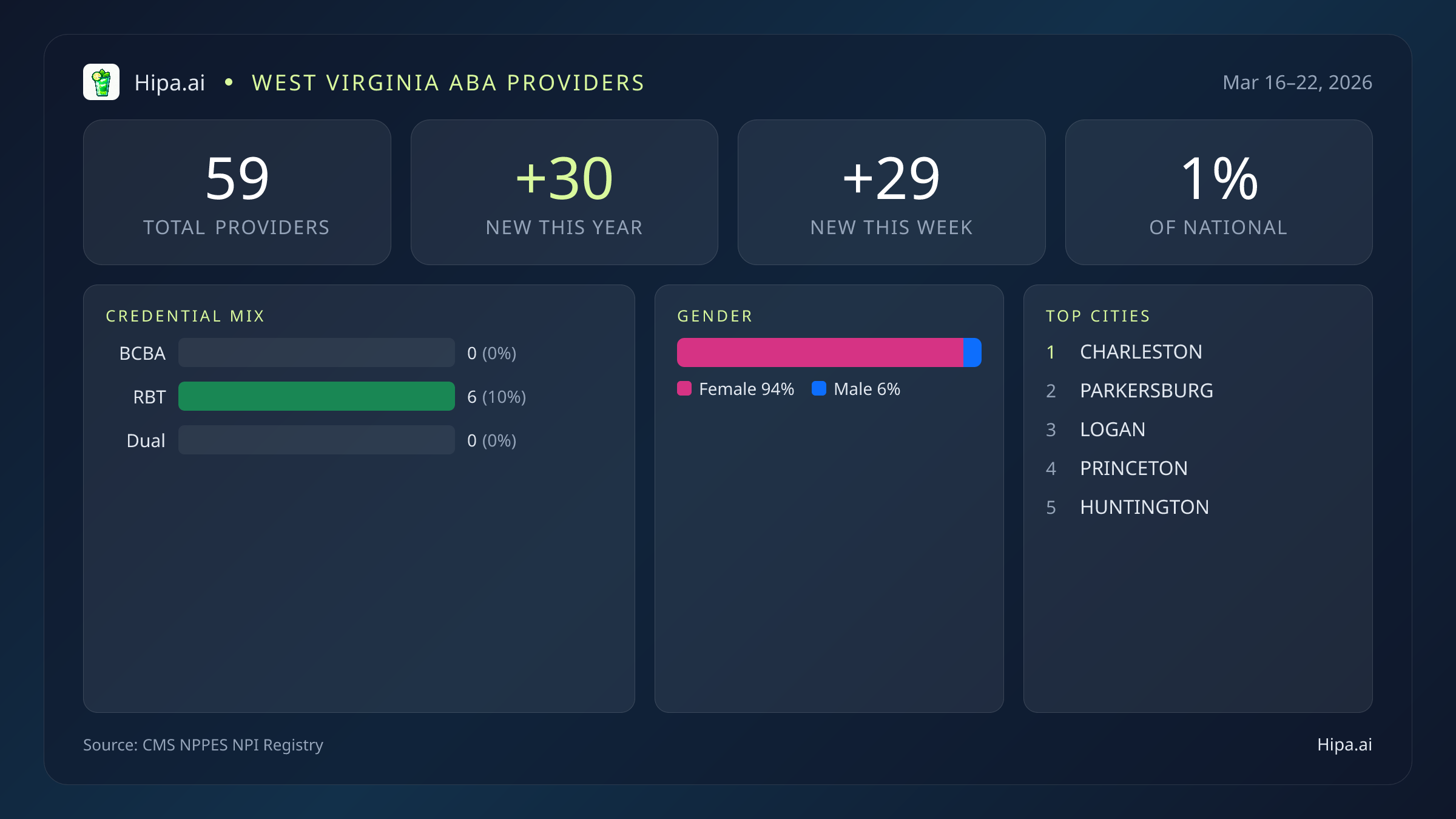
West Virginia's behavioral health provider registry holds 59 total providers, representing 1% of the national weekly total reported to CMS. This modest concentration reflects both the state's smaller population and limited penetration of formalized ABA services—a pattern common in rural and mid-Atlantic states where PE-backed national chains have slower foothold and independent practices dominate.
The credential mix reveals a workforce constraint: West Virginia has 6 RBTs registered but 0 BCBAs and 0 dual BCBA-RBTs in this registry snapshot. This absence of board-certified behavior analysts is striking and suggests that either BCBAs operating in the state are registered under different taxonomy codes, or supervision capacity for RBT-level work is severely limited. The remaining 53 individuals hold a diverse array of credentials—6 Master's of Arts, 4 LICSWs, and scattered behavioral technicians—indicating a mixed clinical workforce leaning toward social work and general mental health rather than behavior analysis specialization.
The workforce is heavily female, with 50 women (94%) compared to 3 men (6%)5 key cities: Charleston, Parkersburg, Logan, Princeton, and Huntington, with 6 organizations operating alongside 53 individuals. Year-to-date growth stands at 30 new providers, suggesting modest but steady workforce expansion.
The near-total absence of credentialed BCBAs in West Virginia's CMS registry signals either a documentation gap or a genuine supervision bottleneck that could limit RBT deployment and ABA service availability across the state.