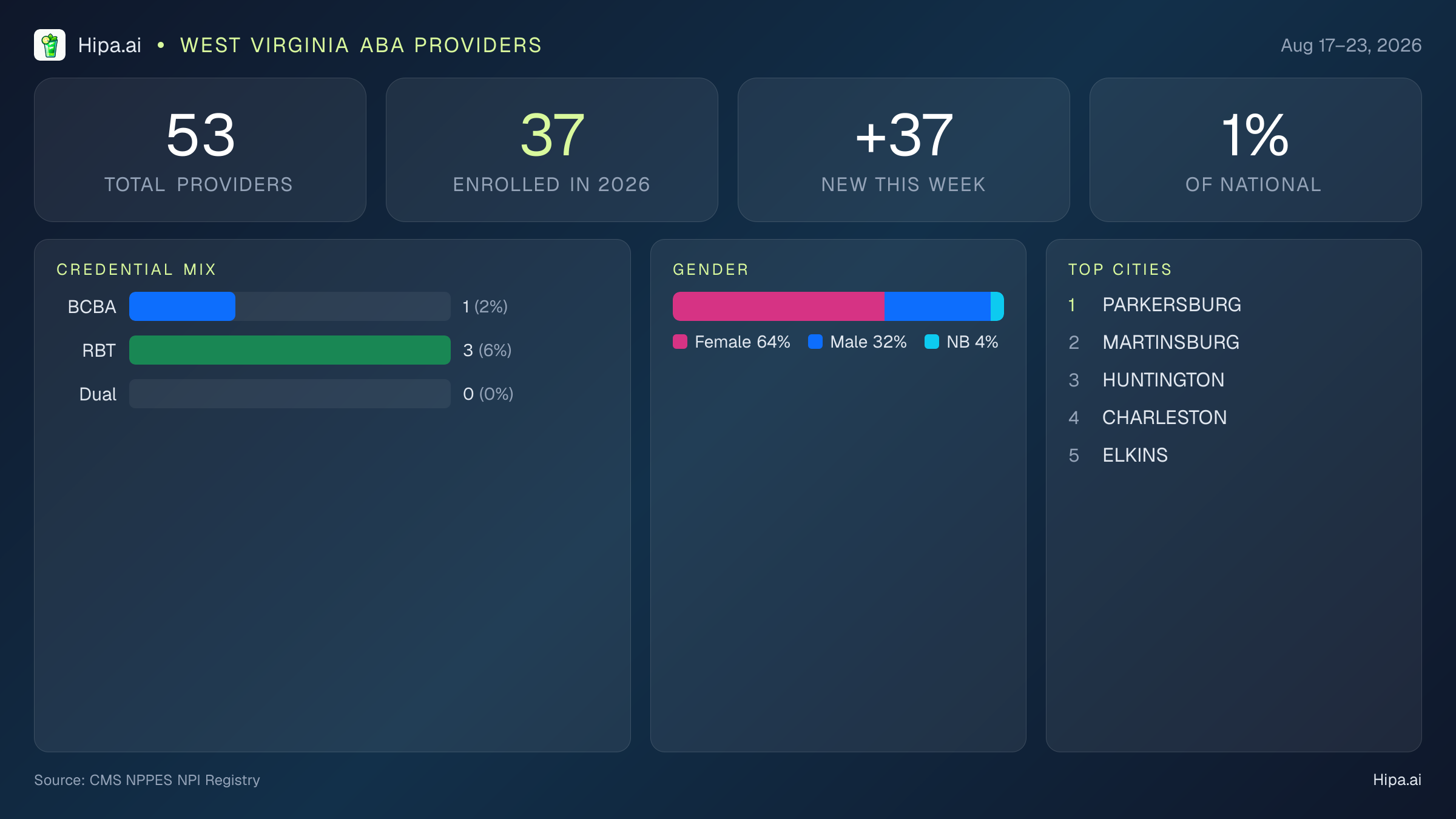
West Virginia recorded 53 providers in the latest CMS NPI registry weekly update, representing 1% of the national weekly total. The state added 37 new providers this week, all 37 new this year. The registry lists 47 individuals and 6 organizations. While the update is not a measure of active clinical capacity, the relatively small share and rapid weekly additions point to a developing, geographically dispersed behavioral health market rather than a large concentration of providers.
ABA Workforce Mix
The registry identifies 1 BCBA and 3 RBTs, with no dual BCBA-RBT credentials reported. The credential fields also include an M.A.BCBA entry, while the taxonomy field identifies one provider as a BCBA. These counts overlap with other credential and taxonomy descriptions and should not be treated as mutually exclusive shares of the provider total. Even so, the pattern shows a small RBT workforce alongside a very limited clearly identified BCBA pool. Because BCBAs supervise RBTs, assess clients and oversee treatment quality, that ratio suggests limited supervisory capacity for ABA expansion. Ten providers have multiple taxonomies, adding further complexity to interpreting the registry as a count of distinct ABA roles.
Demographics and Activity
Among individual providers, 30 are female, 15 are male and 2 are nonbinary, corresponding to 64%, 32% and 4%. The listed activity is spread across Parkersburg, Martinsburg, Huntington, Charleston and Elkins, with no notable organization appearing multiple times in the update. The broader mix includes counselors, case managers, speech-language pathologists and behavioral health agencies, indicating that this registry activity extends beyond ABA-specific care.
West Virginia’s update suggests incremental behavioral health growth, but ABA access will depend on building a stronger BCBA supervisory base alongside RBT recruitment.