Delaware Clinical Trials Report — March 2026
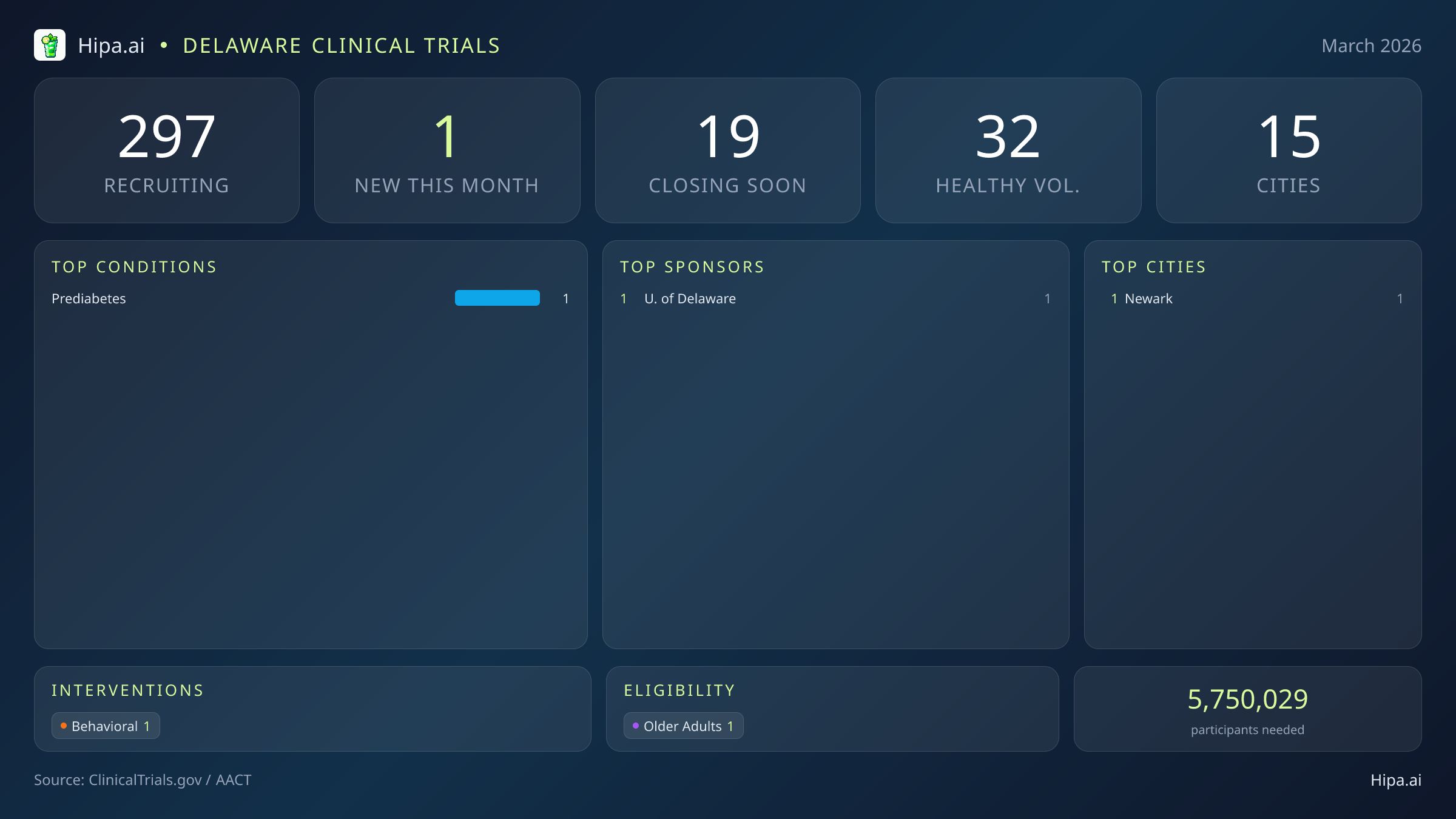
1 New Studies, 19 Closing Soon
Hipa.ai Research - March 1, 2026 - Source: Research Data
Monthly Clinical Trials Infographic
Immediate Deadlines for Oncology and Rare Disease Research
Time is strictly limited for Delaware residents seeking access to several critical medical research initiatives. Over the next ninety days, 19 clinical trials will permanently close their enrollment windows across the state. This impending deadline creates a distinct urgency for patients managing specific chronic conditions, rare diseases, and complex cancers. When a trial closes, it marks the end of patient intake and the beginning of data analysis, meaning the window to access these specific experimental therapies and interventions is rapidly shutting.
Among these closing studies, one protocol is actively seeking healthy volunteers, offering a rare chance for individuals without underlying conditions to contribute to medical science before the deadline passes. For patients currently managing specific diagnoses, final enrollment phases are approaching quickly for studies focused on the following conditions:
- Focal segmental glomerulosclerosis
- Anatomic stage II breast cancer (AJCC v8)
- Anatomic stage III breast cancer (AJCC v8)
- Chronic total occlusion of artery of the extremities
- Developmental language disorder and language impairment
- Dravet syndrome
- Hematopoietic and lymphatic system neoplasms
- HER2-negative breast carcinoma
- Hormone receptor-positive breast carcinoma
- Aging
The closure of these trials represents a significant shift in the local research landscape, particularly for oncology patients. The breast cancer studies, encompassing both HER2-negative and hormone receptor-positive carcinomas, as well as specific anatomical stages, highlight a concentrated effort to finalize data collection on targeted cancer therapies. Similarly, the impending closure of research for Dravet syndrome—a severe form of pediatric epilepsy—and focal segmental glomerulosclerosis underscores the narrowing timeframe for patients with rare and complex conditions to participate in these specific scientific evaluations.
Academic Focus on Behavioral Interventions for Prediabetes
March brings a highly targeted addition to Delaware's clinical research portfolio, with 1 new trial opening this month. This matches the deliberate pace seen at the start of the year, mirroring the single study launched in both January and February. While major pharmaceutical companies often dominate the national research space, this month's addition is driven entirely by academic initiative.
The University of Delaware is sponsoring this newly launched protocol, focusing its resources on metabolic health and preventative care. Specifically, researchers are recruiting participants diagnosed with prediabetes. Rather than testing a new pharmaceutical compound or surgical device, this study is categorized as a behavioral intervention. Behavioral trials are crucial for understanding how lifestyle modifications, educational programs, dietary adjustments, or psychological interventions can alter the trajectory of metabolic conditions before they progress to full-onset type 2 diabetes.
Because there are no large-scale Phase 2 or Phase 3 drug trials launching this month, the spotlight remains firmly on this academic endeavor. The University of Delaware's commitment to localized, non-pharmacological research provides a distinct avenue for patients who prefer exploring behavioral modifications over experimental medications. This approach is particularly relevant for prediabetes, a condition where early behavioral intervention can significantly impact long-term patient outcomes.
Targeting Older Adults in Preventative Health
Eligibility criteria for March's new study are specifically tailored to adult populations, with a distinct focus on older adults. The protocol is designed to include senior participants, ensuring that aging demographics have a direct role in prediabetes research. As metabolic rates, mobility, and lifestyle factors shift with age, gathering behavioral data specifically from older adults is essential for developing effective, age-appropriate health interventions.
This month's trial does not include pediatric patients, nor does it restrict participation based on sex; both men and women are welcome to enroll provided they meet the prediabetes criteria. For individuals without a prediabetes diagnosis, this specific study is not an option, as it currently requires participants to have the condition. Consequently, 0 of the newly launched trials this month are accepting healthy volunteers.
Delaware's Statewide Clinical Trial Infrastructure
Despite the modest number of new launches this month, Delaware maintains a robust and highly accessible clinical research infrastructure. There are currently 297 active, recruiting trials distributed across the state. This network spans 15 different cities and encompasses 122 individual research sites, ensuring that residents have multiple access points to advanced medical care and scientific studies.
Geographically, the newest research opportunity is anchored in Newark, leveraging the academic and medical facilities associated with the University of Delaware. Newark frequently serves as a central hub for academic research in the state, providing a dense concentration of scientific expertise and specialized equipment. However, the broader network of nearly three hundred active trials ensures that residents in other municipalities still have viable options for participation. Because Delaware is geographically compact, patients often have the unique advantage of living within a short driving distance of multiple research sites, reducing the travel burden that often deters participation in larger states.
The six-month trend indicates a stabilization in trial launches following a highly active winter. After seeing two trials in September, four in October, and one in November, the state experienced a peak of six new trials in December. Since then, the first-quarter volume has leveled out to a consistent rate of one new trial per month. This stabilization often precedes a spring renewal in grant funding and protocol approvals.
Ongoing Opportunities for Healthy Participants
While the newest study requires a prediabetes diagnosis, individuals without underlying health conditions still have substantial opportunities to engage in clinical research. Statewide, there are 32 active trials currently recruiting healthy volunteers. These participants are vital to the scientific process, providing the baseline physiological and behavioral data that researchers use to measure the efficacy and safety of new interventions. Those interested in contributing to medical science should act quickly, especially regarding the single healthy volunteer spot among the trials closing within the next ninety days.
As the academic semester progresses and federal grant cycles renew, Delaware's research institutions are positioned to expand their focus on preventative metabolic therapies, while the broader statewide network will likely see a resurgence in late-stage oncology and rare disease protocols heading into the summer months.
Data Highlights
Conditions Closing Soon
- focal segmental glomerulosclerosis (2)
- anatomic stage ii breast cancer ajcc v8 (1)
- anatomic stage iii breast cancer ajcc v8 (1)
- chronic total occlusion of artery of the extremities (1)
- developmental language disorder and language impairment (1)
- dravet syndrome (1)
- aging (1)
- hematopoietic and lymphatic system neoplasm (1)
Most Common New Trial Conditions
- prediabetes (1)
Cities With the Most New Trials
- Newark (1)
Leading Sponsors
- University of Delaware (1)
| Month | New Trials | Closing Soon |
|---|---|---|
| October 2025 | 4 | 1 |
| November 2025 | 1 | 2 |
| December 2025 | 6 | 2 |
| January 2026 | 1 | 3 |
| February 2026 | 1 | 2 |
| March 2026 | 1 | 1 |
New Studies This Month (1)
| NCT ID | Title | Phase | Enrollment | Sponsor | Condition | City |
|---|---|---|---|---|---|---|
| NCT07450118 | Nested Pilot Study Comparing Two Treatments to Reduce Type 2 Diabetes Risk in At-Risk Delawareans | NA | 40 | University of Delaware | Prediabetes | Newark |