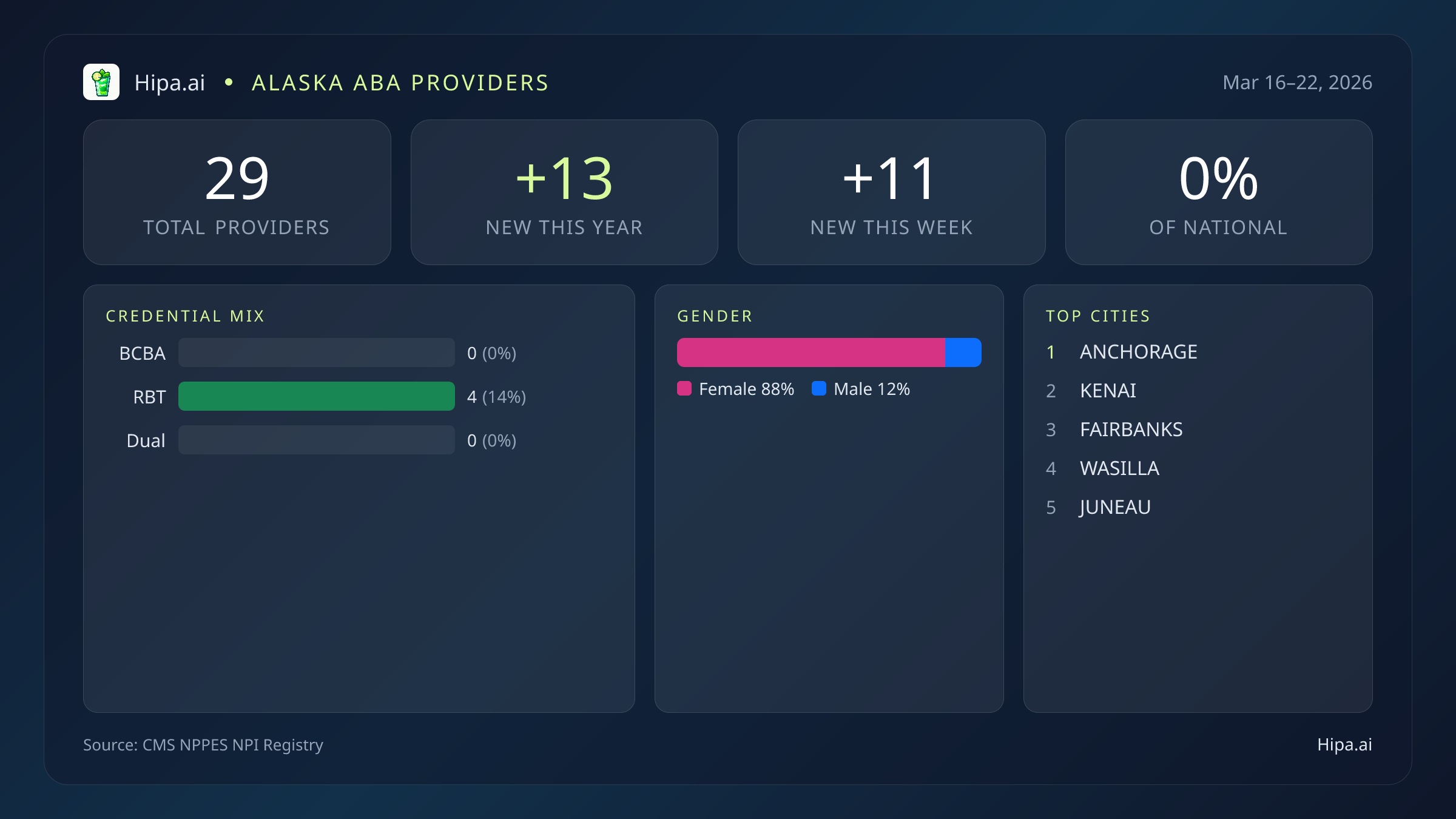
Alaska's behavioral health provider registry shows 29 total providers active in the CMS NPI system, with 1 new entry this week and 13 additions since the start of the year. The state's share of national weekly activity is minimal, reflecting Alaska's small and geographically dispersed population—a structural reality that shapes workforce dynamics across the region.
The credential mix reveals a significant gap in ABA-specific licensing. Alaska has 0 BCBAs and 0 dual BCBA+RBT credentials in the registry, alongside just 4 RBTs. Instead, the 29 providers consist largely of 25 individuals holding clinical credentials outside the ABA track: 2 LCSWs, 1 MSW, 1 PsyD, 1 LPC, and others. This absence of board-certified behavior analysts suggests Alaska either sources BCBA supervision from out-of-state or relies on non-ABA clinicians to deliver behavioral services. Either pathway complicates the traditional RBT-BCBA supervisory relationship and may indicate limited local capacity for credential-specific growth.
The workforce skews heavily female: 22 female providers account for 88% of the total, compared to 3 males. Services cluster in urban and regional hubs—Anchorage, Fairbanks, Wasilla, Kenai, and Juneau—typical of Alaska's settlement patterns but leaving vast rural areas underserved.
The absence of board-certified behavior analysts in Alaska's registry, despite steady annual growth, signals either a critical supervisory bottleneck or a reliance on out-of-state BCBA oversight that may limit in-person clinical availability.