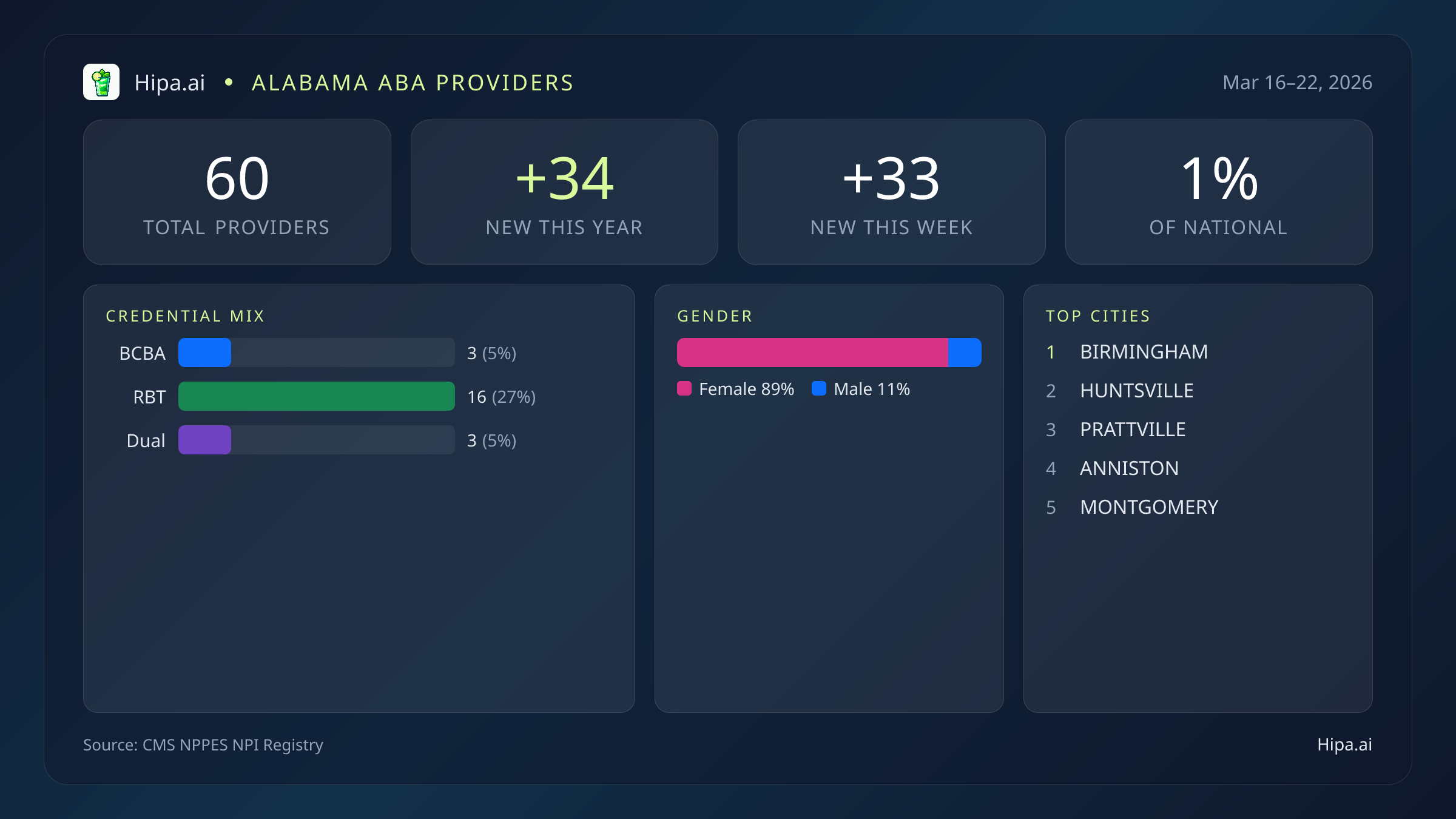
Alabama's behavioral health provider registry grew by 1 provider this week as part of a broader state expansion—34 new providers have registered year-to-date. The state accounts for 1% of the national weekly total, a modest concentration that reflects Alabama's position as a mid-sized market for ABA and related behavioral services.
The credential mix reveals structural constraints on supervision capacity. Alabama has only 3 BCBAs in the registry against 16 RBTs, a ratio of roughly 1 supervisor to 5 technicians—below the ideal span for quality oversight. The presence of 3 dual BCBA-RBT credentials suggests some providers are pursuing upward mobility, but the small absolute numbers indicate limited career progression pathways. Beyond ABA core credentials, 4 LPCs, 3 LICSW professionals, and a single MD round out the roster, pointing to integrated or co-located behavioral health models rather than pure-play ABA clinics.
Workforce demographics skew heavily female: 41 of 60 providers (89%) identify as female, while only 5 are male. This gender imbalance mirrors national ABA trends but may constrain hiring flexibility in conservative markets. The 46 individuals and 14 organizations split suggests a fragmented provider landscape with limited multi-location chains—no dominant PE-backed operators appear in the data—though 13 providers carry multiple taxonomies, indicating some clinical scope expansion within individual practices.
With year-to-date growth running at 34 new registrants against a base of 60, Alabama is building workforce supply, yet the BCBA shortage and lack of visible chain consolidation may limit service scaling across rural and underserved regions.