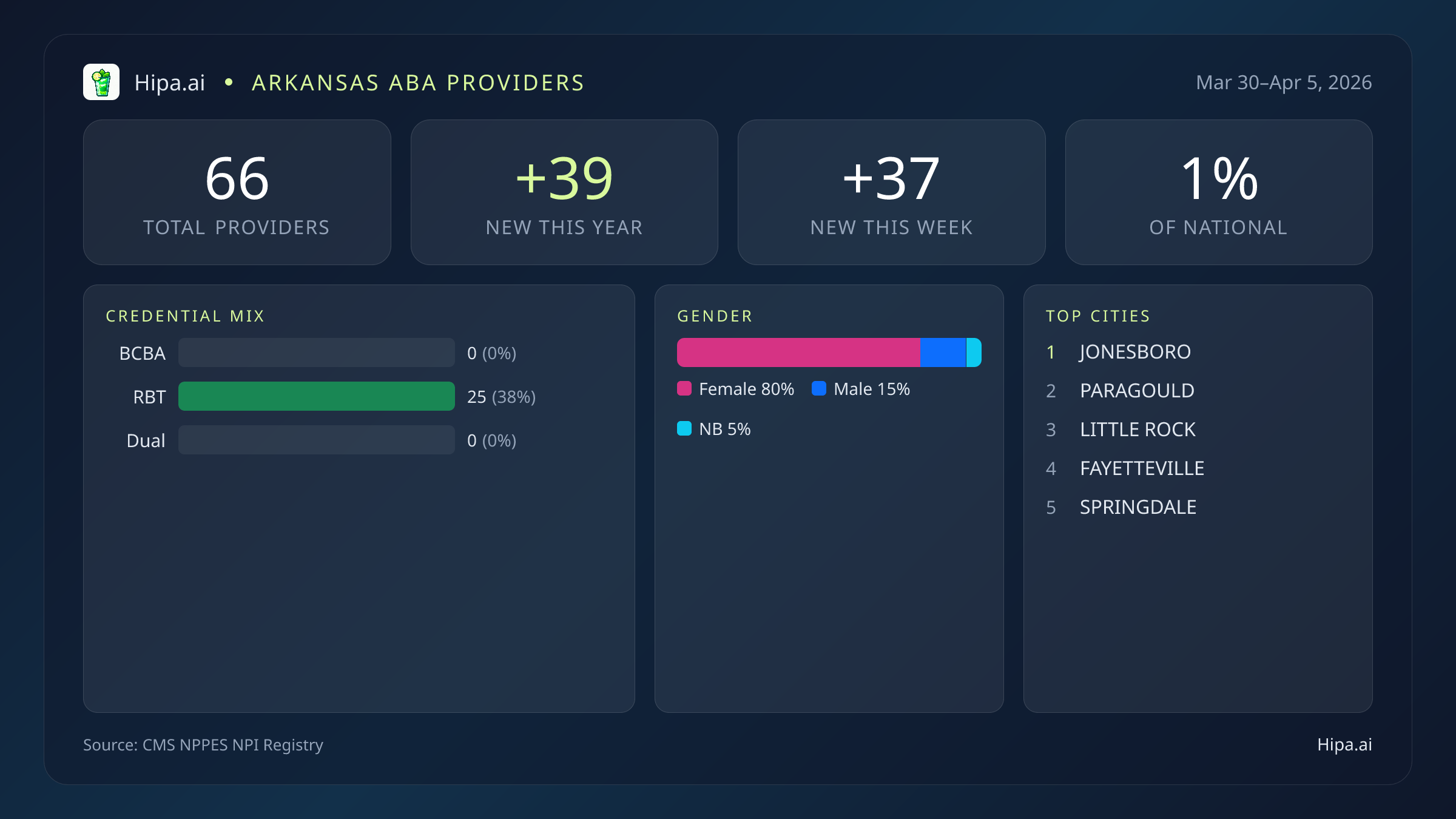
Arkansas registered a total of 66 behavioral health providers in the latest CMS NPI registry update, representing a modest 1% of the national weekly total. Of these, 37 providers were new this week, accounting for nearly all of the 39 new providers added to the registry for the year, indicating a significant recent surge in NPI registrations within the state. The new additions comprise 59 individuals and 7 organizations, reflecting a mix of solo practitioners and clinic formations.
Credential Mix and Supervision Capacity
A critical observation for the ABA industry is the credential mix: the data shows 25 Registered Behavior Technicians (RBTs) but 0 Board Certified Behavior Analysts (BCBAs), with no providers holding dual BCBA+RBT credentials. This absence of BCBAs presents a significant challenge for ABA service delivery in Arkansas, as RBTs require supervision from BCBAs to provide care. Despite the growth in RBTs, the lack of supervising BCBAs severely limits the state's capacity to deliver supervised ABA services. Beyond ABA-specific credentials, the registry also includes other mental health professionals, with 7 providers holding an LCSW credential, 6 providers with an LAC, and 5 providers with an LPC, indicating a broader behavioral health workforce.
Workforce Demographics and Geographic Concentration
The individual provider demographic data reveals a predominantly female workforce, with 47 female providers making up 80% of individuals. Male providers total 9 (15%), and 3 providers identify as nonbinary (5%). Provider activity is concentrated in key cities, including JONESBORO, PARAGOULD, LITTLE ROCK, FAYETTEVILLE, and SPRINGDALE. Additionally, 12 providers reported holding multiple taxonomies, suggesting a diverse range of services offered by some practitioners. The organizational entries, such as "EYEZ ON YOUR LOVED ONES, LLC." and "CHIPGANG CHOSEN HEIRS INTENTIONALLY PURE," highlight the emergence of new entities in the state's behavioral health landscape.
This data suggests a burgeoning RBT workforce in Arkansas, but the severe deficit of BCBAs poses a substantial barrier to expanding access to quality, supervised ABA services, underscoring a critical need for increased BCBA training and recruitment within the state.