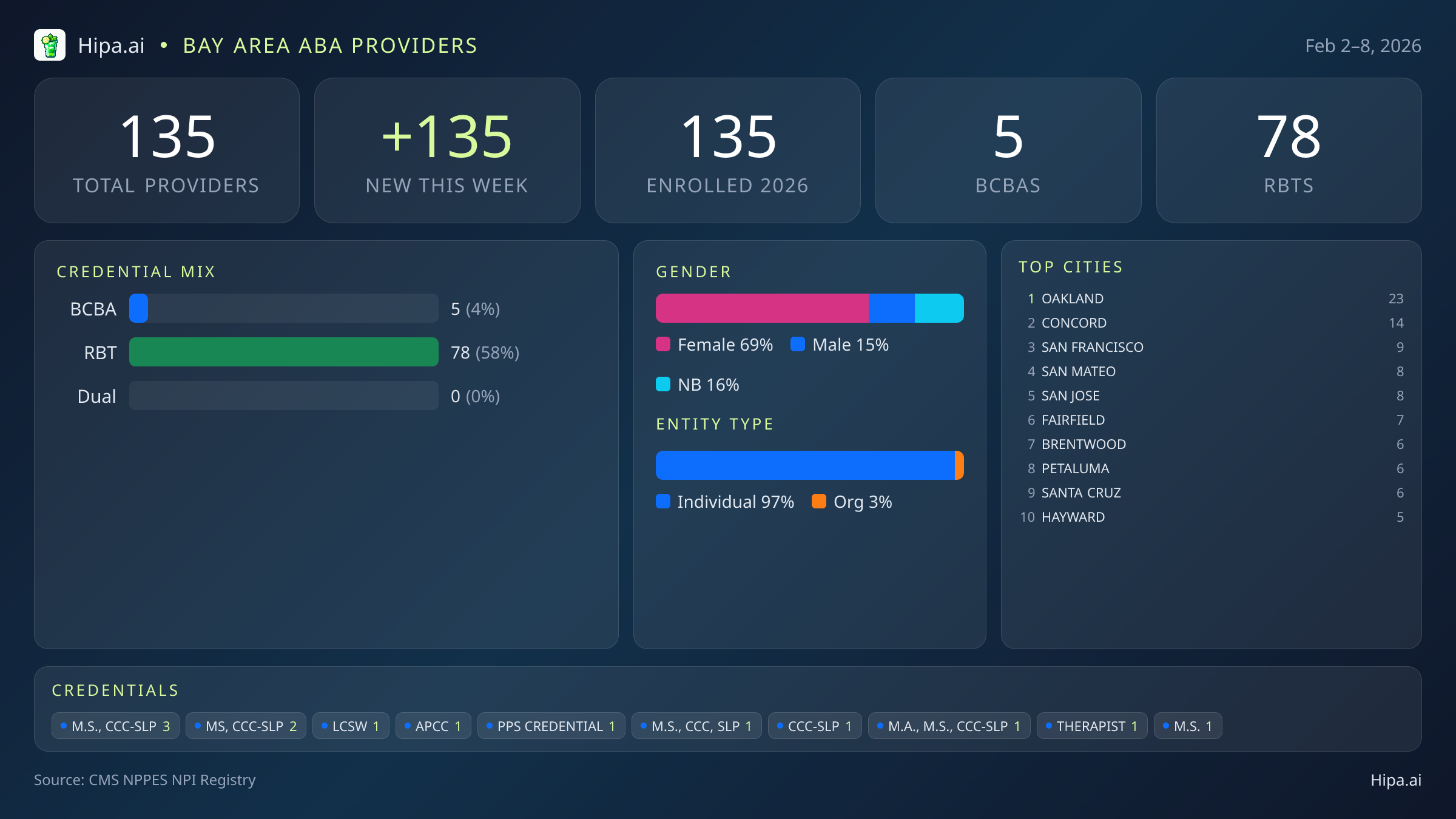
The Bay Area's behavioral health sector saw 135 new providers in the latest CMS update, representing 3% of the national weekly total. This significant influx highlights the region's ongoing demand for behavioral health services. Of these, 131 are individual practitioners and 4 are organizations, indicating a mix of independent and clinic-based growth.
ABA Workforce Composition
Within the individual providers, the data reveals a substantial number of direct service professionals. There are 78 RBTs and 5 BCBAs. No providers reported holding both BCBA and RBT credentials in this update. The ratio of RBTs to BCBAs is approximately 15.6 RBTs per BCBA, which is higher than ideal for direct supervision in ABA, suggesting potential challenges for BCBAs in managing caseloads and RBT training. Beyond ABA, the update also includes other specialists such as Speech-Language Pathologists and Clinical Social Workers.
Local Demographics and Hotspots
The individual workforce is predominantly female, with 91 female providers accounting for 69%. 19 male providers make up 15%, and 21 nonbinary providers represent 16%. No single organization appeared multiple times in this week's update. Provider registrations are concentrated in key Bay Area cities, with Oakland leading at 23 new providers, followed by Concord with 14, and San Francisco, San Mateo, and San Jose each adding 9 or 8 providers. This distribution points to widespread growth across the region.
This data suggests a robust, though potentially supervision-strained, expansion of the behavioral health workforce in the Bay Area, particularly within direct ABA services, which could improve access to care for local families.