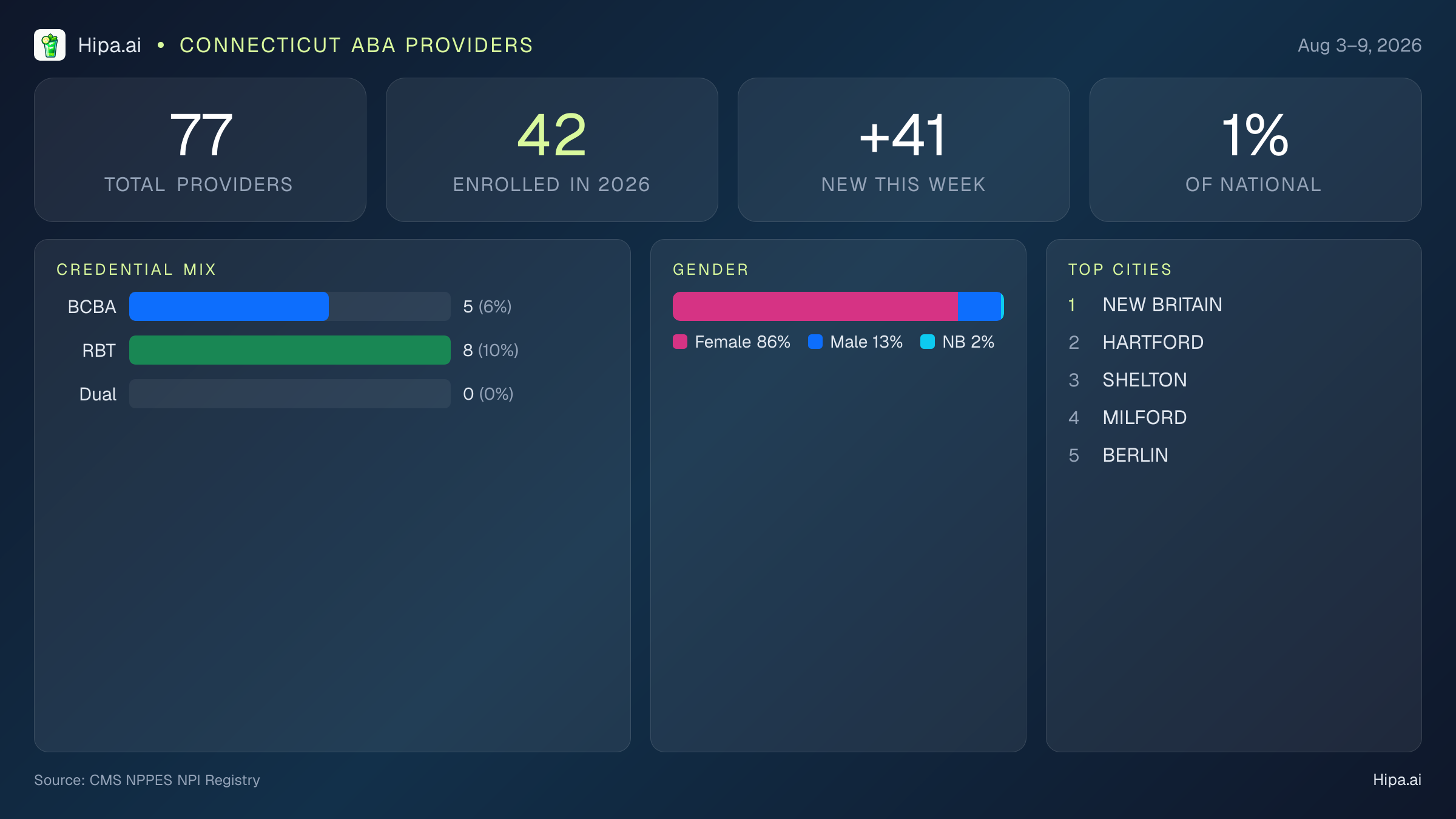
Connecticut recorded 77 providers in the latest CMS NPI registry weekly update, representing 1% of the national weekly total. With 41 new providers added this week, the state’s activity signals continued expansion across a relatively compact behavioral health market rather than a concentration dominated by large provider organizations.
ABA Workforce Mix
The registry lists 5 BCBA credentials and 8 RBT credentials, with no providers identified as holding dual BCBA-RBT credentials. Because credential and taxonomy fields can overlap, these counts should not be treated as mutually exclusive shares of the full provider total. The RBT-to-BCBA balance points to a direct-service workforce that is larger than the identified supervisory pool. Since BCBAs design treatment plans and supervise RBTs, the pattern may create supervision constraints as ABA capacity grows. Two providers also list BCBA and LBA credentials, reflecting Connecticut’s state-level licensing layer on top of BCBA certification.
Demographics and Provider Structure
Among the state’s providers, 55 female providers account for 86% of the reported gender distribution. The registry also records 8 male providers, or 13%, and 1 nonbinary provider, or 2%; these categories may not sum perfectly because of rounding. Connecticut lists 64 individuals and 13 organizations, while all 13 providers are flagged with multiple taxonomies. No organization appears repeatedly in the notable-organization field, so the update does not identify a dominant employer.
Overall, the mix suggests Connecticut is adding a broad behavioral health workforce, but ABA access may depend on expanding BCBA supervision capacity alongside RBT growth.