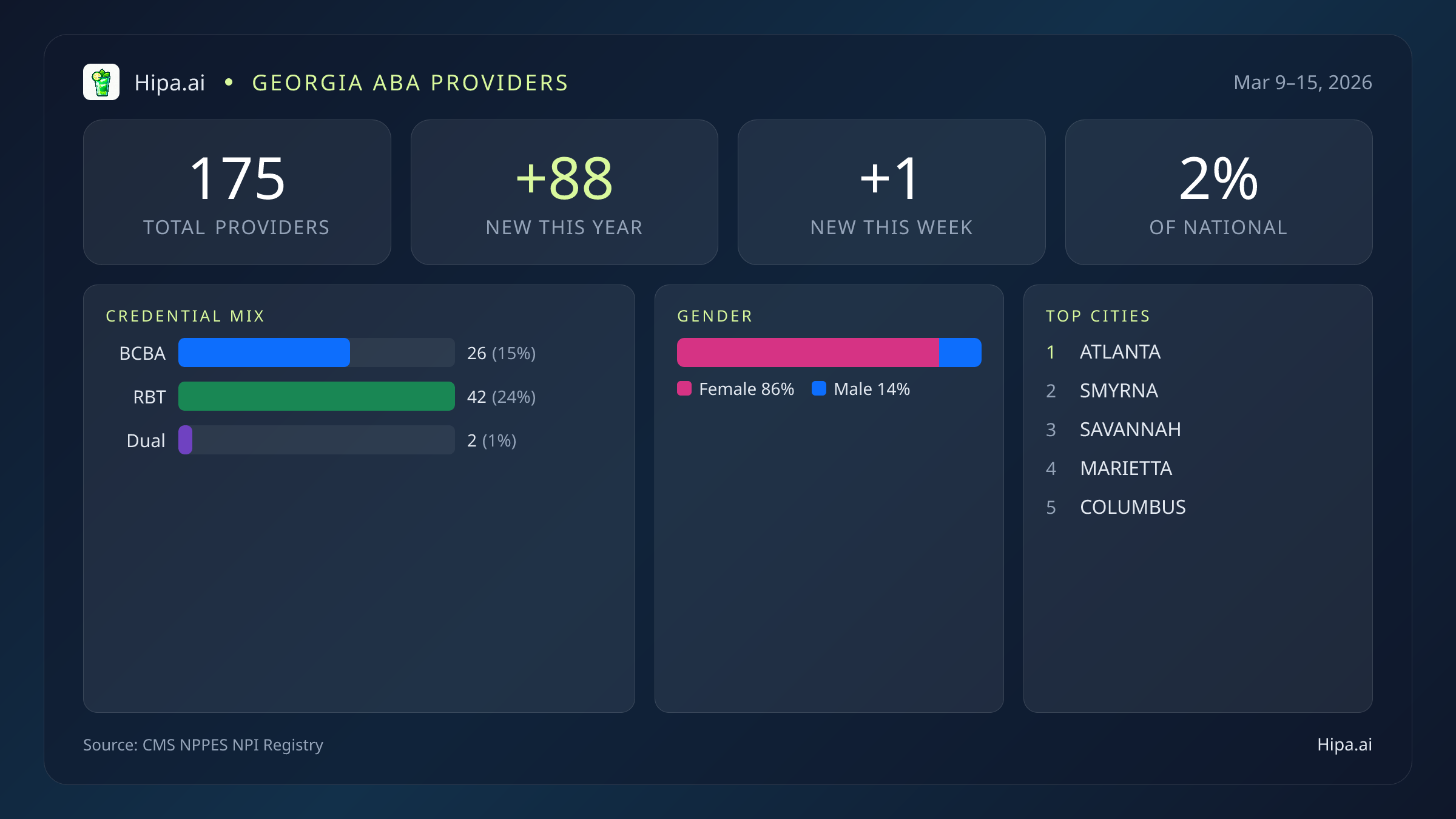
Georgia added 175 behavioral health providers this week, accounting for 2% of the national total. This concentration of new providers indicates significant growth in the state's behavioral health sector, potentially driven by increasing demand for services across the region. Of these, 83 providers were new this week, contributing to 88 new providers year-to-date.
Credential Mix and Capacity
Among individual practitioners, the state saw 26 Board Certified Behavior Analysts (BCBAs) and 42 Registered Behavior Technicians (RBTs). It is important to note that 2 individuals hold both BCBA and RBT credentials, meaning these individuals are counted in both categories. The ratio of RBTs to BCBAs is approximately 1.6:1. This lower ratio, compared to the typical 5-8 RBTs per BCBA in some ABA settings, suggests a potential bottleneck in supervisory capacity, as BCBAs are required to oversee RBTs for effective service delivery.
Workforce Demographics
The workforce demographics for individual providers show a notable gender distribution, with 119 female providers comprising 86% of the individual practitioner pool, while 20 male providers make up 14%. The update also includes 36 organizations. No specific multi-state ABA chains or other notable organizations appeared multiple times in this week's data for Georgia.
This influx of new professionals, particularly RBTs, points to a growing workforce, but the current BCBA-to-RBT ratio highlights a continued need for more supervisory-level clinicians to meet the demand for ABA services in Georgia.