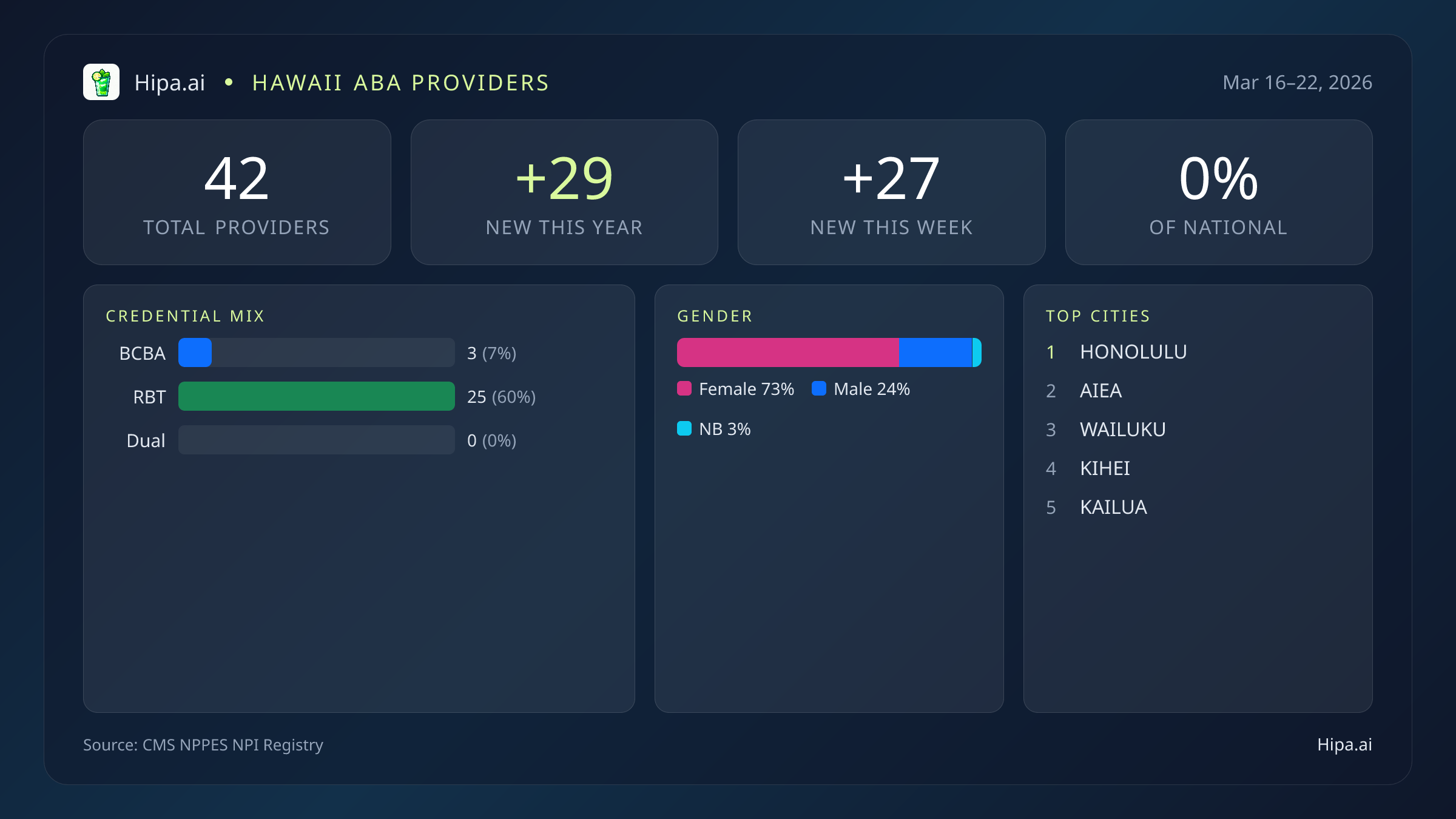
Hawaii's behavioral health provider registry grew by 1 provider this week, bringing the state total to 42 individuals and organizations combined. Year-to-date, the state has added 29 new providers, reflecting sustained workforce expansion in a geographically isolated market where access constraints are acute. This modest absolute count underscores the structural challenge of ABA service delivery across the islands: Hawaii's provider base remains concentrated and limited compared to continental hubs.
The credential mix reveals a critical supervision bottleneck. Hawaii has only 3 BCBAs supervising 25 RBTs—a ratio of roughly 8-to-1 that strains compliance with BACB supervision requirements. Notably, there are 0 providers holding dual BCBA+RBT credentials, meaning no practitioners have explicitly signaled the career progression pathway that typically strengthens a regional workforce. Instead, 11 providers hold multi-taxonomy credentials spanning social work, marriage and family therapy, and speech-language pathology, suggesting Hawaii's behavioral health market may rely more heavily on integrated mental health clinics than dedicated ABA operations.
The workforce skews heavily female at 73%, with 27 female providers compared to 9 male and 1 nonbinary. Mental Health Kokua is the only organization appearing twice in the registry, indicating minimal organizational consolidation. Providers concentrate in Honolulu and secondary cities on Oahu and Maui, leaving rural and outer-island residents with limited local capacity.
Hawaii's small BCBA base and lack of dual-credential depth suggest the state's ABA access depends heavily on telehealth supervision and may face headroom constraints as demand grows.