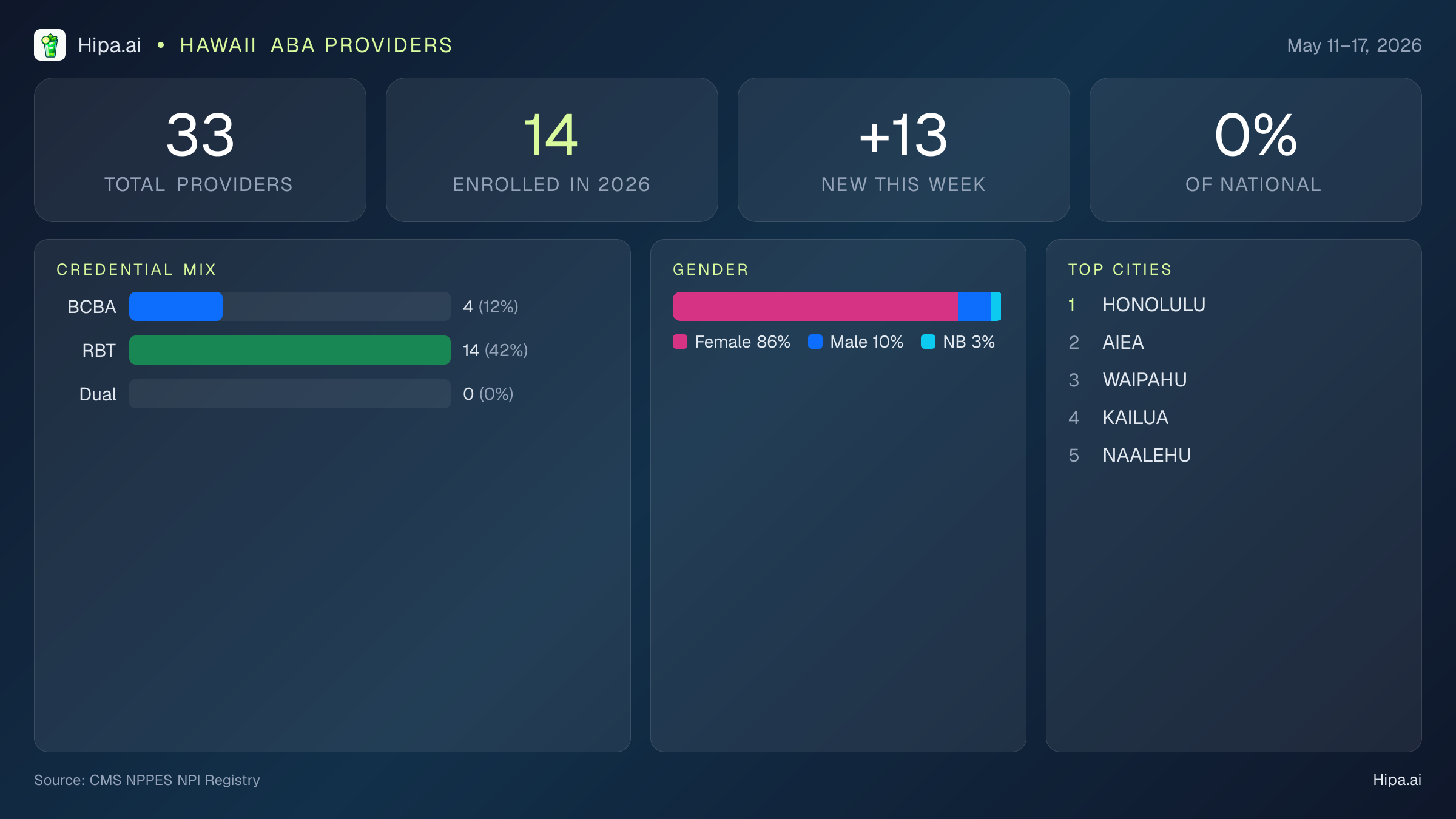
Hawaii added 33 behavioral health providers in the latest CMS NPI registry weekly update. This represents 0% of the national total, a negligible share reflecting the state's smaller population and workforce compared to larger states. Of these, 29 are individuals and 4 are organizations, indicating a mix of independent practitioners and clinic expansions.
ABA Workforce Composition
Focusing on the applied behavior analysis sector, the update shows 4 providers holding BCBA credentials and 14 providers with RBT credentials. It is important to note that no individuals reported holding both BCBA and RBT credentials in this period. The resulting 3.5-to-1 ratio of RBTs to BCBAs is relatively low compared to national averages, suggesting that while there is a foundational workforce for direct service delivery, the limited number of BCBA supervisors could pose a challenge for scaling ABA services and ensuring adequate oversight, a critical component for quality care.
Provider Demographics and Trends
Among the 29 individual providers, the workforce shows a significant gender imbalance: 25 (86%) are female, 3 (10%) are male, and 1 (3%) identifies as nonbinary. This aligns with broader trends in the behavioral health field, which is predominantly female. No specific organizations were notably repeated in this week's registrations. The majority of new providers are concentrated in cities like Honolulu, Aiea, and Waipahu.
Overall, this week's NPI data for Hawaii indicates a steady, albeit small, expansion of its behavioral health workforce. The state's continued growth in RBTs, coupled with the need for more BCBA supervisors, will be crucial for improving access to ABA services across the islands.