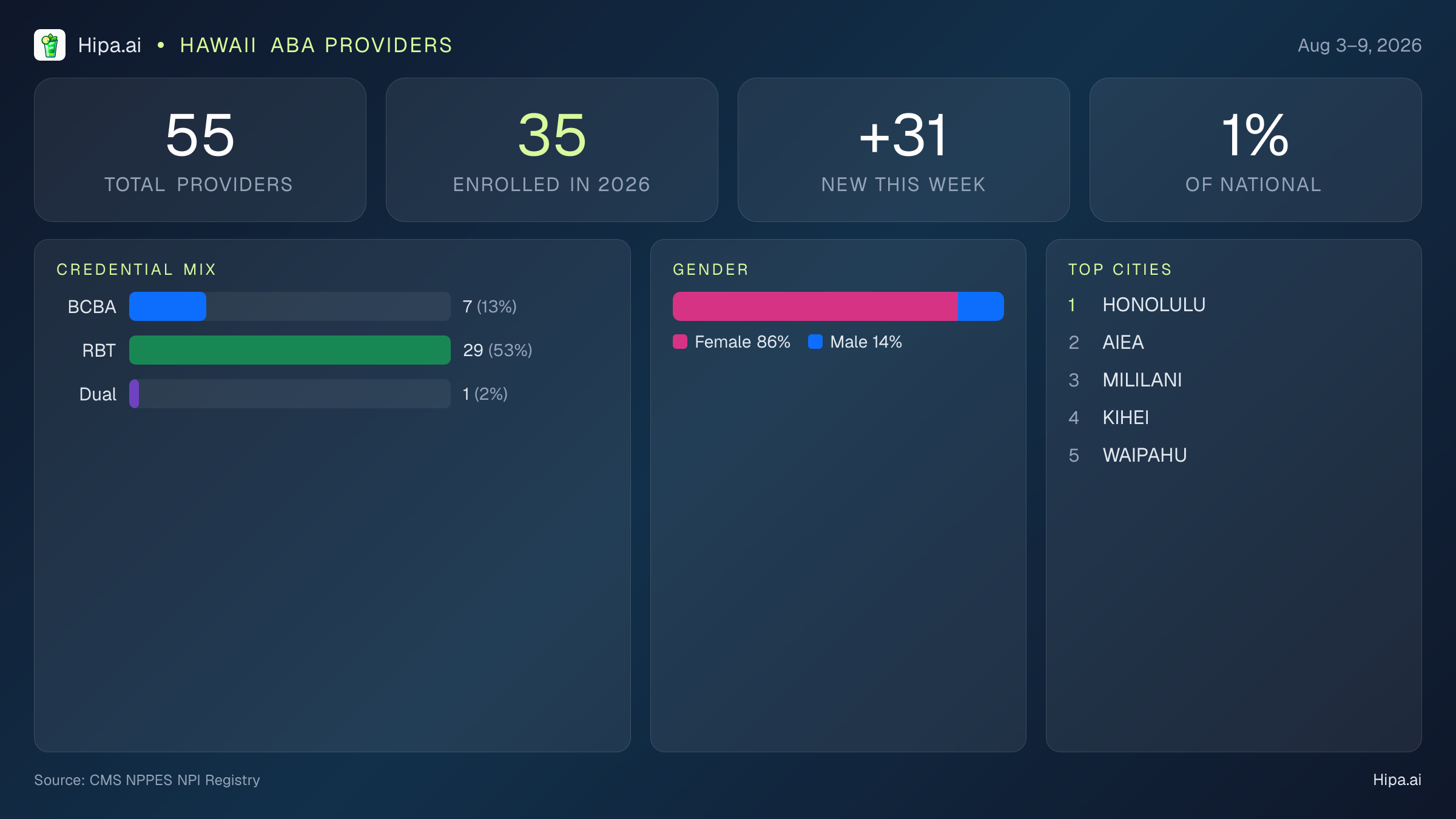
Hawaii recorded 55 providers in the latest CMS NPI registry weekly update, representing 1% of the national weekly total. The registry added 31 providers this week, bringing the state to 35 new providers this year. Hawaii’s modest national share reflects its smaller provider base and geographic isolation, factors that can make workforce growth especially important for local access.
ABA Workforce Dynamics
The registry lists 7 BCBA credentials and 29 RBT credentials. One provider is counted as holding dual BCBA and RBT credentials. These credential and taxonomy counts overlap: the dual-credentialed provider is included in both categories, and the counts should not be read as mutually exclusive shares of the 55 providers. Even with that caveat, the roughly four-to-one RBT-to-BCBA relationship points to a sizable direct-service workforce relative to the state’s supervisory capacity. Because BCBAs design treatment and supervise RBTs, limited BCBA availability can constrain how quickly RBT growth translates into expanded ABA capacity.
Provider Demographics
Individuals account for 50 providers, compared with 5 organizations. The gender breakdown is 43 female providers, or 86%, and 7 male providers, or 14%; no providers were identified as nonbinary. Two providers have multiple taxonomies, another overlapping category that does not represent separate people. No organization appeared multiple times among the notable organizations, although Trudy Narikiyo Guo is listed both individually and through an organization bearing her name.
Hawaii’s influx of RBT registrations, alongside a smaller BCBA pool and concentrated activity in Honolulu-area communities, suggests growing ABA workforce participation but continuing pressure to expand supervision and improve access across the islands.