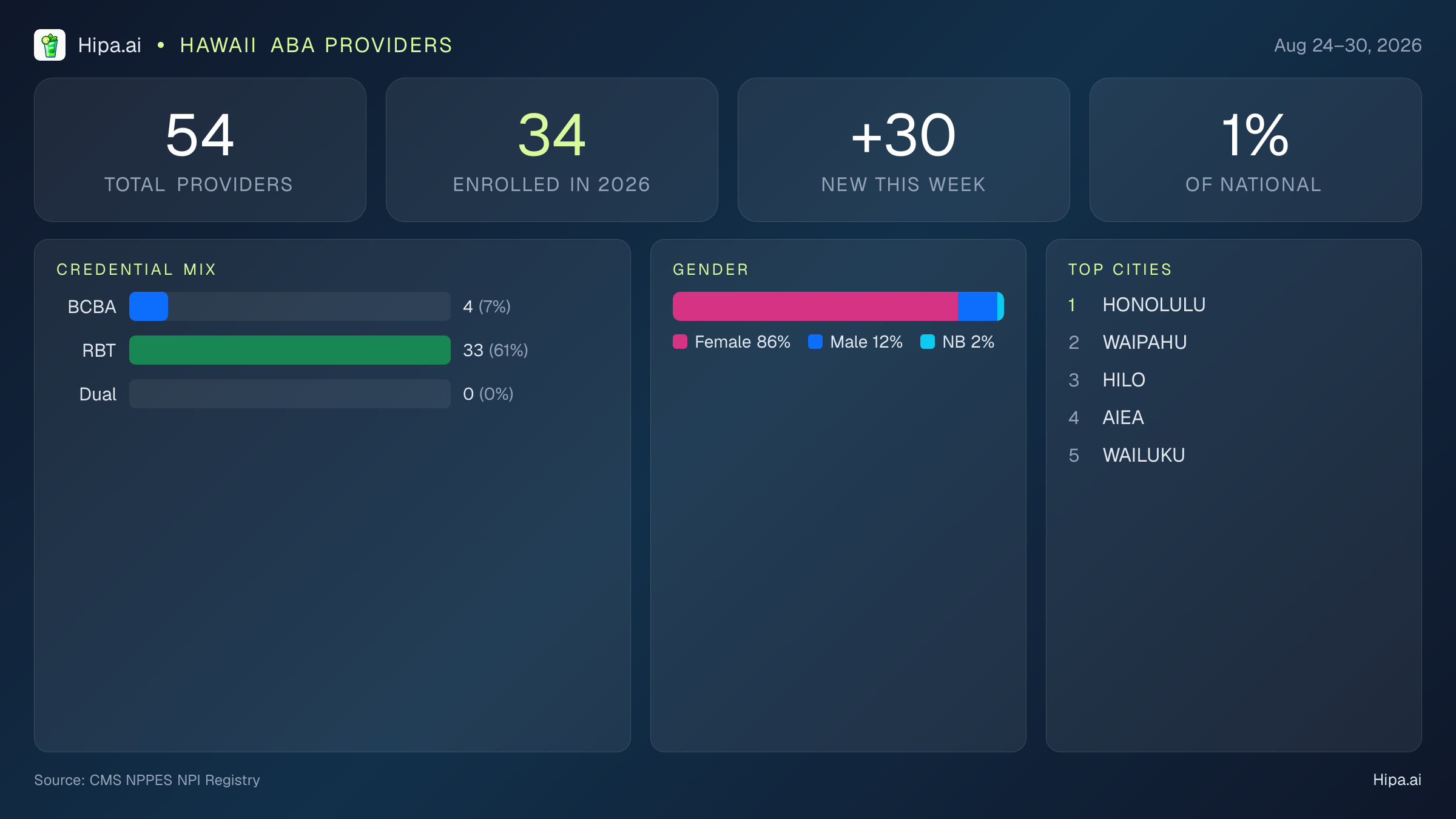
Hawaii recorded 54 providers in the latest CMS NPI registry weekly update, representing 1% of the national weekly total. The registry added 30 providers this week, bringing the year-to-date count to 34. The file includes 51 individuals and 3 organizations. Hawaii’s small share of national activity reflects its smaller provider market and geographic isolation, where workforce growth can have an outsized effect on access across islands. NPI activity does not confirm active caseloads, contracting status or available appointments.
ABA Workforce Mix
The registry identifies 4 BCBAs and 33 RBTs, with no dual BCBA-RBT records. These counts overlap with other registry fields and are not mutually exclusive shares of the 54-provider total; a provider can have a credential and a taxonomy that describe the same person. The roughly eight-to-one RBT-to-BCBA pattern points to a workforce weighted toward direct implementation rather than clinical supervision. Because BCBAs supervise RBTs, design treatment and monitor outcomes, the small BCBA pool may limit how quickly Hawaii can expand or sustain technician-led ABA services. The absence of dual credentials also shows no notable signal of RBTs simultaneously holding BCBA credentials in this update.
Demographics and Geography
Gender data lists 44 female providers, 6 male providers and 1 nonbinary provider, corresponding to 86%, 12% and 2%. The remaining provider record is not represented in those gender categories. Listed activity spans Honolulu, Waipahu, Hilo, Aiea and Wailuku, suggesting concentration in major population centers but some reach beyond Oahu. No notable organization appears multiple times in the registry.
Hawaii’s strong RBT presence alongside limited BCBA supervision suggests that expanding clinical leadership, especially outside the largest population centers, will be central to improving ABA access.