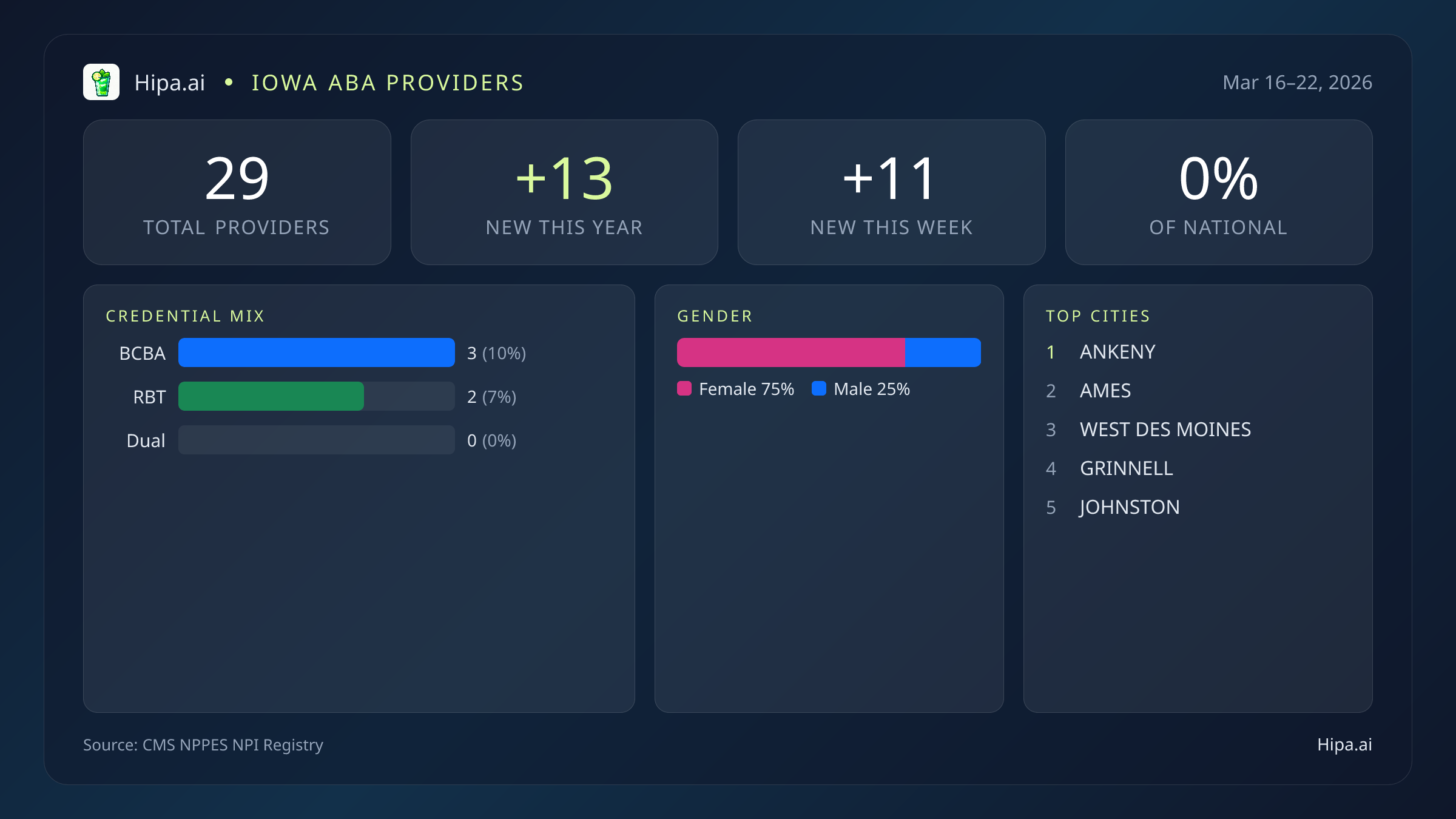
Iowa's behavioral health provider registry shows 29 total providers as of this week's CMS NPI update, with 1 new entry added in the past seven days. Year-to-date growth stands at 13 new providers, suggesting steady but modest workforce expansion in a state where ABA services remain concentrated in a small network. The provider base splits between 20 individuals and 9 organizations, indicating a mix of solo practitioners and clinic-based staffing models typical of emerging regional ABA markets.
The credential composition reveals a critical supervision gap. Iowa has only 3 BCBAs and 2 RBTs on the registry, with zero dual BCBA-RBT credentials—a credential pathway that typically signals career progression and local retention of experienced supervisors. Instead, 4 providers hold LMHC licenses, suggesting behavioral health services in Iowa are often delivered through a mental health rather than pure-play ABA lens. The single provider holding the stacked LBA-BCBA-MA credential represents rare state-level licensure integration. This credential scarcity raises questions about whether Iowa can scale ABA capacity without importing supervision from neighboring states.
The workforce skews heavily female, with 75% of providers identifying as women compared to 25% male—a gap wider than national ABA demographics, possibly reflecting Iowa's smaller pool of male entry-level RBTs. Providers cluster around the Des Moines metro corridor and Ames, with no presence in rural regions despite their healthcare workforce needs.
The lack of multi-state PE-backed operators and thin BCBA-RBT credentials suggest Iowa's ABA market remains fragmented and undersupervised.