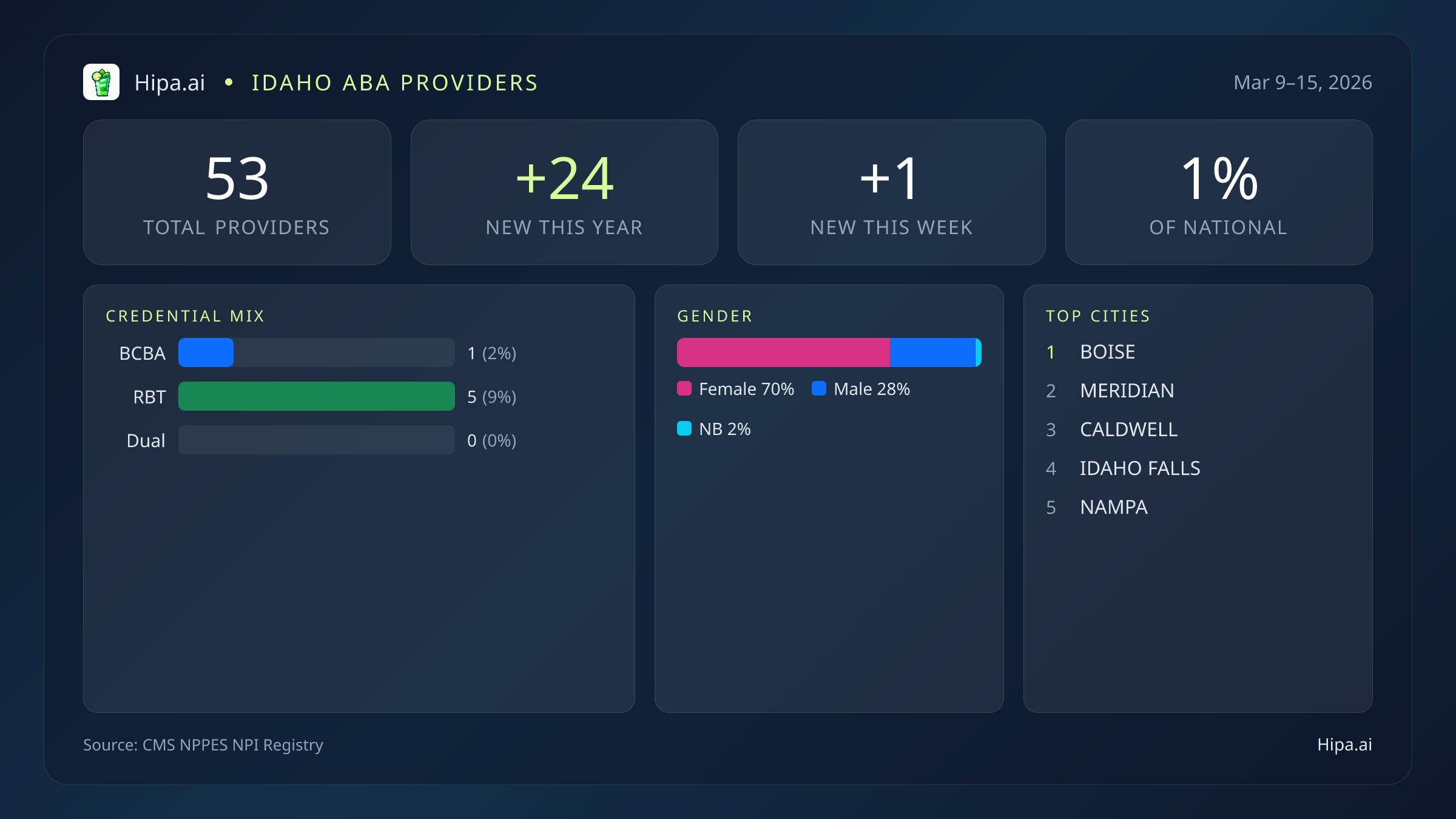
Idaho's behavioral health sector saw a modest yet consistent presence in the latest CMS NPI registry weekly update, with a total of 53 providers. This represents 1% of the national weekly total, suggesting a smaller, perhaps more localized, growth trajectory compared to more populous states. Notably, one provider was newly added this week, contributing to 24 new providers this year, indicating ongoing, albeit gradual, expansion within the state’s behavioral health workforce. Of the total, 43 are individuals and 10 are organizations, reflecting a mix of private practitioners and clinic-based services.
ABA Credential Landscape and Supervision
For ABA professionals, the credential mix reveals a lean structure. The data shows one BCBA (Board Certified Behavior Analyst) and five RBTs (Registered Behavior Technicians) among the individuals. Crucially, there are no reported dual BCBA and RBT credentials, meaning no single individual holds both certifications to directly provide and supervise ABA services simultaneously. The ratio of RBTs to BCBAs is 5:1. While this ratio is manageable, it highlights a limited supervisory capacity, which is a critical factor for ABA clinics expanding services and ensuring RBTs receive adequate oversight. Beyond ABA-specific credentials, the registry lists a broader behavioral health workforce, including six LCSWs (Licensed Clinical Social Workers), three LPCs (Licensed Professional Counselors), and two LMSWs (Licensed Master Social Workers), among others, indicating a diverse, though not heavily ABA-focused, provider base.
Workforce Demographics and Local Activity
The individual provider workforce in Idaho demonstrates a clear gender distribution, with 30 female providers accounting for 70% of the total. Male providers number 12, representing 28%, and one provider identifies as nonbinary, making up 2%. The data does not identify any specific organizations appearing multiple times, suggesting a fragmented market rather than dominance by large multi-state chains. Boise, Meridian, Caldwell, Idaho Falls, and Nampa are noted as top cities for provider activity, indicating these urban centers are key hubs for behavioral health services. Additionally, 18 providers hold multiple taxonomies, showcasing a versatility in practice areas among a significant portion of the workforce.
Overall, Idaho’s behavioral health data suggests a growing but capacity-constrained ABA workforce, where the limited number of BCBAs could present challenges for scaling services and meeting demand for quality ABA care across the state.