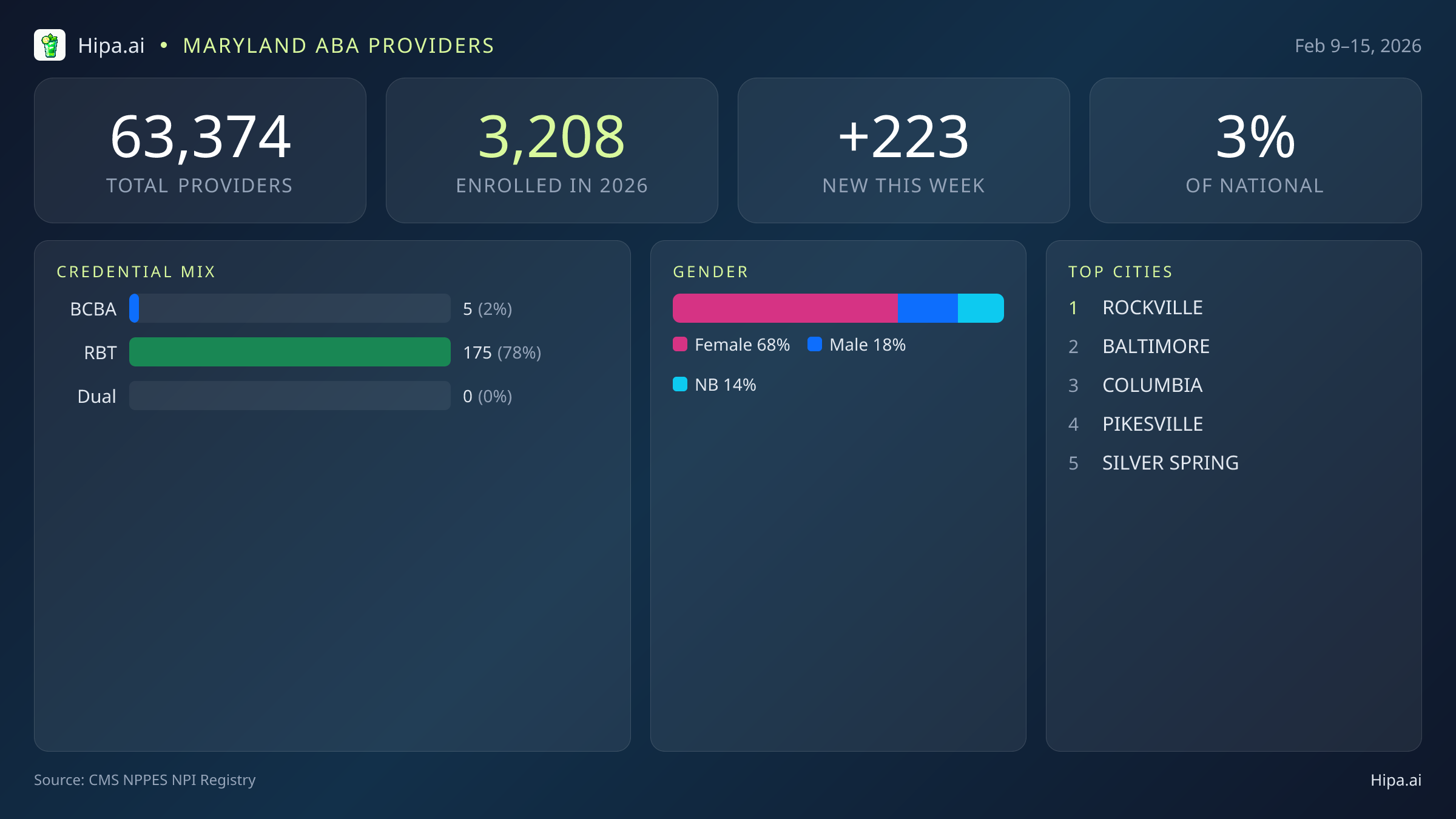
Maryland's behavioral health sector saw 223 new providers in the latest CMS NPI registry update, representing 5% of the national weekly total. This consistent influx indicates steady growth in the state's behavioral health workforce, signaling an active response to the ongoing demand for services.
ABA Workforce Composition
Within the applied behavior analysis (ABA) field, the data shows 175 Registered Behavior Technicians (RBTs) and 5 Board Certified Behavior Analysts (BCBAs). These counts are based on primary taxonomy or credential and may not capture all instances where a provider holds multiple roles; for example, one individual explicitly listed "RBT" as a credential text. There were no providers explicitly listed with dual BCBA and RBT credentials in this update. The significant ratio of RBTs to BCBAs, at 35:1, highlights a robust pipeline of direct service providers but also points to a potential need for more BCBA-level supervision capacity to support this growing RBT workforce.
Provider Demographics
Of the 223 total providers, 196 are individuals and 27 are organizations. Among individual providers, women constitute the majority at 133 individuals (68%), while men account for 35 individuals (18%), and 28 individuals (14%) identify as nonbinary. Notable organizations appearing multiple times in this update include Johns Hopkins University and Sisters in Action, each with two entries, suggesting their active role in the state's behavioral health landscape.
The strong growth in RBTs, coupled with a smaller increase in BCBAs, suggests Maryland is expanding its direct ABA service capacity, but continued focus on developing supervisory roles will be crucial for sustained access to quality care.