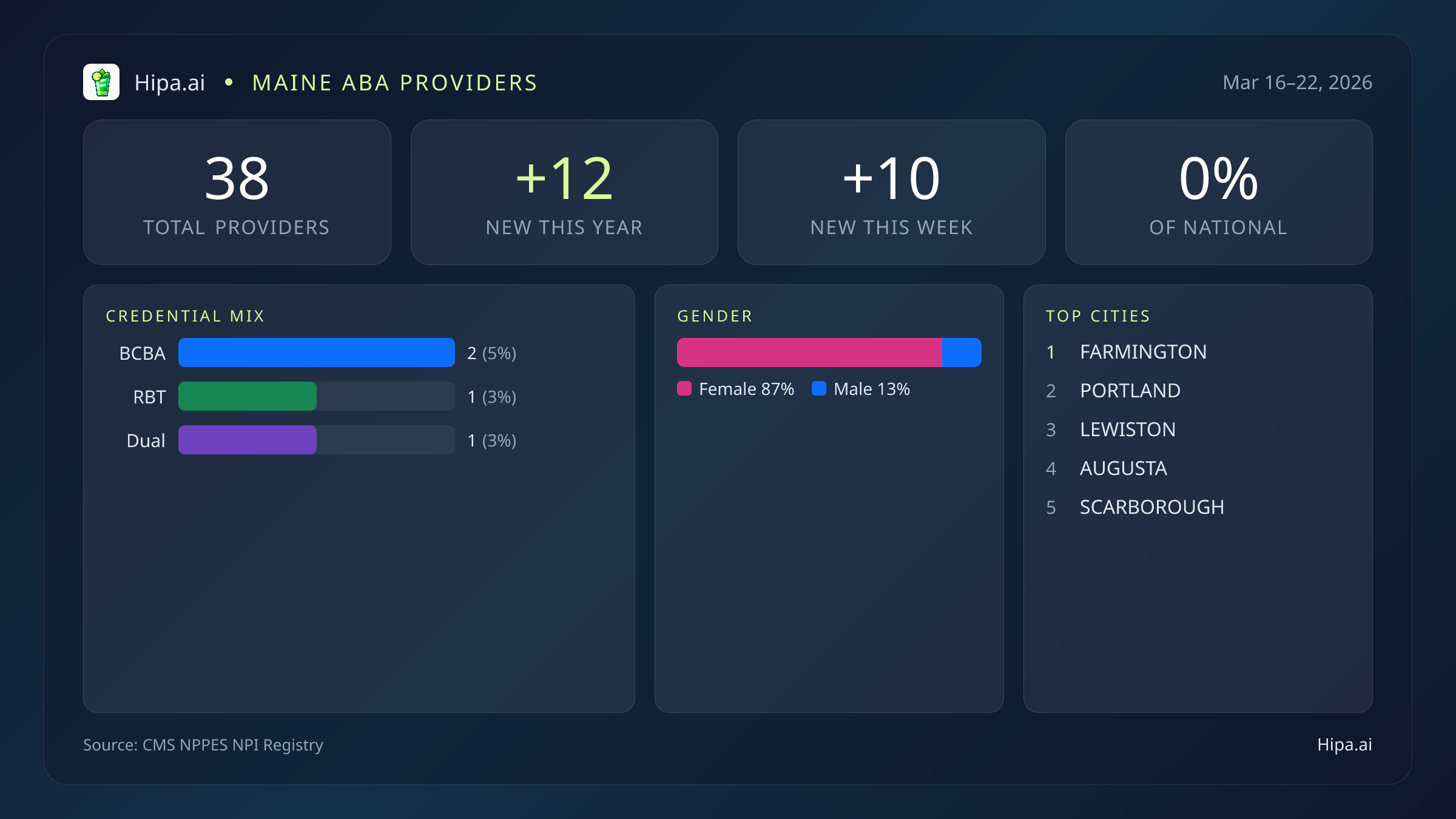
Maine's behavioral health workforce registered 38 total providers in this week's CMS NPI update, with 1 new entry bringing the year-to-date total to 12 new registrations. The state's provider base remains small, reflecting Maine's rural geography and limited population density—a structural challenge for ABA service delivery across the state's dispersed communities.
The credential composition reveals a critical gap in Maine's ABA capacity. The state lists only 2 BCBAs, 1 RBT, and 1 dual BCBA+RBT credential holder, totaling just 4 ABA-specific providers. This sparse clinical infrastructure contrasts sharply with Maine's broader mental health workforce: 17 LCSWs dominate the registry, followed by 2 CADCs and 2 LCPCs. The absence of meaningful RBT depth signals supervision bottlenecks and suggests that ABA services, where available, depend heavily on external oversight or are underutilized relative to clinical need.
Gender representation skews heavily female, with 26 women (87%) versus 4 men (13%) registered. No single organization dominates; OHI appears twice, but most providers operate as solo practitioners or small teams. Portland, Farmington, Lewiston, Augusta, and Scarborough cluster the workforce in southern and central corridors, leaving rural northern Maine underserved.
Maine's minimal BCBA and RBT presence relative to its LCSW-heavy registry suggests that autism and behavior disorder treatment remains fragmented across general mental health rather than concentrated in specialized ABA clinics, likely limiting access to evidence-based intensive behavioral intervention.