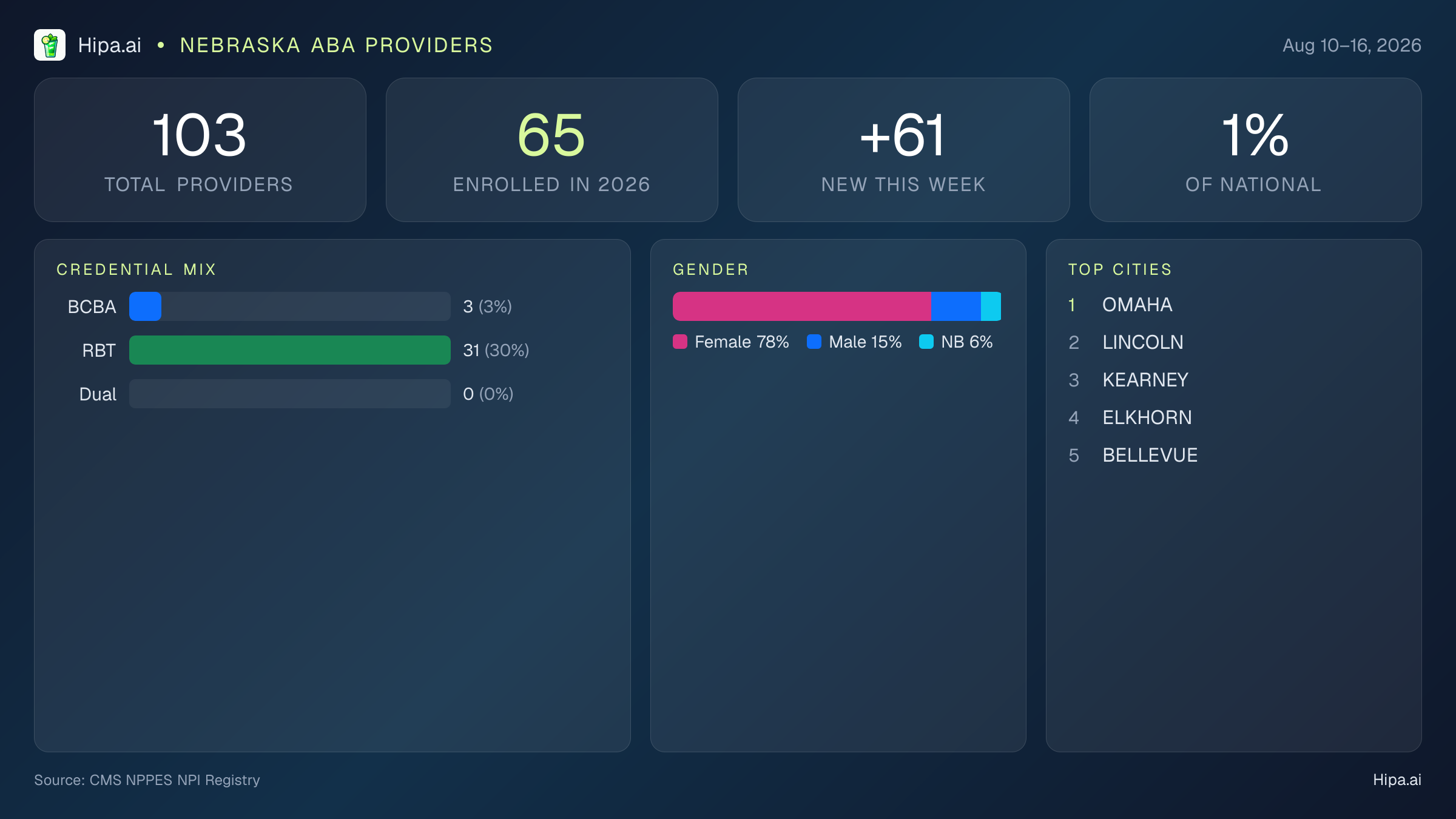
Nebraska recorded 103 providers in the latest CMS NPI registry weekly update, representing 1% of the national weekly total. The registry added 61 new providers this week, indicating a concentrated burst of behavioral health enrollment even as Nebraska remains a small portion of national activity. The provider base includes 93 individuals and 10 organizations, suggesting growth is occurring primarily through individual practitioners rather than new agency entities.
ABA Workforce Mix
The registry reports 3 BCBA credentials and 31 RBT credentials, with no dual BCBA-RBT credentials. These categories are not mutually exclusive: credential and taxonomy fields can overlap, and the broader provider count includes counselors, speech-language pathologists, social workers and other professionals. One provider lists BCBA and LBA credentials together, illustrating that state licensure can appear alongside national certification. The RBT-to-BCBA pattern points to a much larger direct-service workforce than supervisory workforce. Because BCBAs oversee RBTs, treatment planning and clinical quality, the mix suggests that supervision capacity could limit how quickly Nebraska converts workforce growth into expanded ABA service capacity.
Demographics and Provider Activity
Gender data identifies 73 female providers, 14 male providers and 6 nonbinary providers, corresponding to 78%, 15% and 6%. The gender counts total 93, matching the number of individual providers. Omaha and Lincoln lead the listed city activity, followed by Kearney, Elkhorn and Bellevue. No notable organization appears in the registry’s repeated-organization field. The data also identifies 18 providers with multiple taxonomies, reinforcing that provider roles and credential categories may overlap rather than represent separate workforce segments.
Nebraska’s strong RBT activity relative to its BCBA count suggests potential direct-service growth, but limited supervisory representation may constrain ABA access as demand develops.