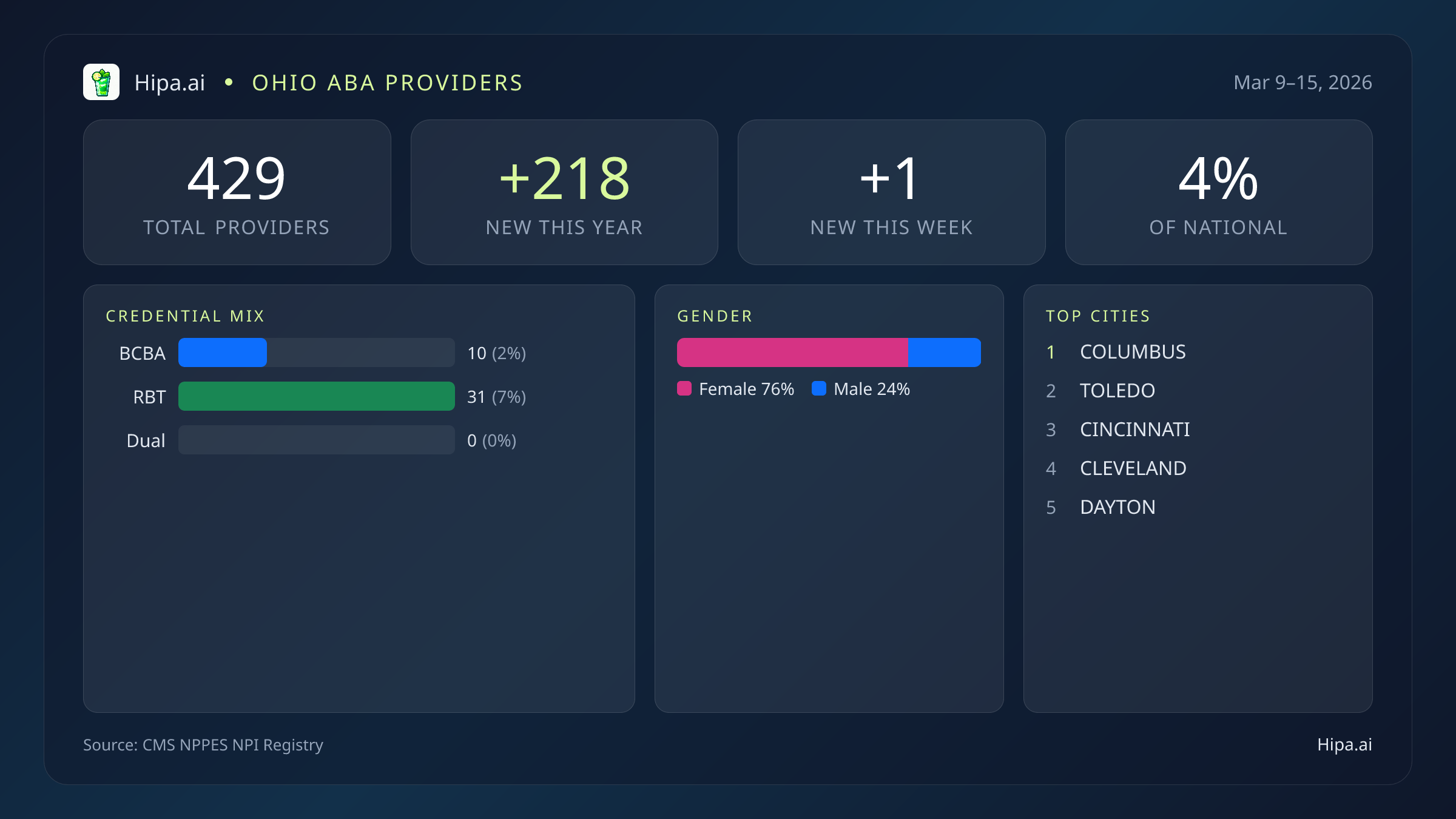
| A FATHER'S OPTIONORG | TOLEDO, OH | - | 177F00000X | 03/10/2026 |
| AAEC COMMUNITY CARE LLCORG | LEBANON, OH | - | 251C00000X | 03/09/2026 |
| ABA CENTERS OF OHIO, LLCORG | WESTERVILLE, OH | - | BCBA | 12/15/2025 |
| ABDIRAHMAN, MURTAH | COLUMBUS, OH | - | Acupuncturist | 03/11/2026 |
| ADAMS, SARAH | FRANKLIN FURNACE, OH | PRS | 175T00000X | 08/24/2018 |
| ADE HEALTH AND WELLNESS LIMITED LIABILITY COMPANYORG | LAKEWOOD, OH | - | 332U00000X | 05/23/2025 |
| AGAPE SUPPORT LLCORG | COLUMBUS, OH | - | 175T00000X | 10/12/2024 |
| ALL ABOUT FAMILYORG | CINCINNATI, OH | - | 174200000X | 03/11/2026 |
| ALLEN, TAYLOR | COLUMBUS, OH | - | Addiction Counselor | 03/09/2026 |
| ALLISON, ZOE | CHARDON, OH | - | Acupuncturist | 08/18/2025 |
| AMERIGETIC SERVICESORG | COLUMBUS, OH | - | 261QM0850X | 07/09/2025 |
| ANDERSON, CARA | RAVENNA, OH | LPC | Pastoral Counselor | 10/22/2018 |
| ANDERSON, WILLIAM | TOLEDO, OH | - | Acupuncturist | 03/12/2026 |
| ANTHONY, BARBARA | CLEVELAND, OH | LISW-S | Clinical Social Worker | 03/10/2026 |
| ARNOLD, E'SHAE | CLEVELAND, OH | - | Acupuncturist | 08/07/2020 |
| ARRAS, AMY | PERRYSBURG, OH | LPCC | Pastoral Counselor | 09/21/2022 |
| ASH, STEPHANIE | SHAKER HEIGHTS, OH | LISW | Clinical Social Worker | 03/03/2026 |
| ASSENT BEHAVIORAL GROUP LLCORG | CINCINNATI, OH | - | BCBA | 02/26/2026 |
| AUTUMN TREATMENT CENTER LLCORG | WASHINGTON COURT HOUSE, OH | - | Clinic/Center | 04/02/2021 |
| BABCOCK, KIMBERLY | PERRYSBURG, OH | LISW-S | 104100000X | 06/20/2024 |
| BAPTISTA, MARISSA | CLEVELAND, OH | - | Acupuncturist | 03/11/2026 |
| BARAILI, REEKU | COLUMBUS, OH | - | 175T00000X | 12/08/2025 |
| BATES, NICHOLE | PORTSMOUTH, OH | LISW | Clinical Social Worker | 04/02/2020 |
| BEAVERS, ANDREA | COLUMBUS, OH | MS, LPC | Mental Health Counselor | 01/12/2018 |
| BELL, JALAH | WICKLIFFE, OH | BCBA | BCBA | 03/10/2026 |
| BELL, NIQUILLE | COLUMBUS, OH | - | Mental Health Counselor | 10/28/2022 |
| BELLENOCH HEALTHCARE LLCORG | COLUMBUS, OH | - | 374U00000X | 05/06/2024 |
| BENTON /, KRISTIANNA | CINCINNATI, OH | - | Counselor | 03/04/2026 |
| BENZ, MICHELLE | CHARDON, OH | LPC | Mental Health Counselor | 12/05/2018 |
| BERMAN, YULIA | SOLON, OH | LPC | Mental Health Counselor | 03/11/2026 |
| BERRIOS, KRISTINA | COLUMBUS, OH | - | Acupuncturist | 03/13/2026 |
| BLALARK, DA'NA | TOLEDO, OH | - | Acupuncturist | 03/09/2026 |
| BLAND-BRADY, SHARON | GROVE CITY, OH | MSW LSW PH.D. | Clinical Social Worker | 11/06/2014 |
| BLOSSOM WELLNESS SUPPORTORG | TOLEDO, OH | - | 376J00000X | 02/23/2026 |
| BOARD, EULALIA | YOUNGSTOWN, OH | LPC | Pastoral Counselor | 08/10/2017 |
| BOHOVICH, JAMES | COLUMBUS, OH | QMHS BA CM | Community/Behavioral Health Org | 11/21/2018 |
| BOMKAMP, WILLIAM | CINCINNATI, OH | - | 104100000X | 11/08/2017 |
| BOND, ALISHA | MIDDLETOWN, OH | - | Acupuncturist | 01/14/2026 |
| BOOSE, DOUGLAS | BEACHWOOD, OH | - | Pastoral Counselor | 12/08/2017 |
| BOROVOY, HOPE | CENTERVILLE, OH | LPCC | Pastoral Counselor | 07/29/2019 |
| BORTMAS, AMANDA | NILES, OH | - | Pastoral Counselor | 05/16/2024 |
| BRASHEAR, CHLOE | PORTSMOUTH, OH | - | Addiction Counselor | 12/26/2024 |
| BRAUN, ALEXANDER | ORRVILLE, OH | - | Acupuncturist | 03/16/2018 |
| BREWER, TANIA | TOLEDO, OH | - | Acupuncturist | 03/11/2026 |
| BROWN, CARLEY | PORTSMOUTH, OH | - | Acupuncturist | 03/11/2026 |
| BRUMLEY, CORTNEE | CINCINNATI, OH | - | Acupuncturist | 04/13/2023 |
| BULLARD, KIERAH | GREENVILLE, OH | - | Acupuncturist | 03/10/2026 |
| BURGE, JERMAINE | CLEVELAND, OH | - | Acupuncturist | 03/14/2026 |
| BURNS, ZOEY | TROY, OH | - | RBT | 03/14/2026 |
| CABRERA, JENNIFER | YOUNGSTOWN, OH | - | 175T00000X | 03/12/2026 |
| CALLAHAN, LIBERTY | PICKERINGTON, OH | - | Acupuncturist | 01/03/2025 |
| CANTER, ERIN | THE PLAINS, OH | - | Clinical Social Worker | 09/18/2023 |
| CARDWELL, CARLZO | AKRON, OH | - | Acupuncturist | 02/17/2026 |
| CARIDI, ANN MARIE | LYNDHURST, OH | MA, LPCC, SUPV | Mental Health Counselor | 01/08/2007 |
| CARING HOUSE HEALTH AND RECOVERYORG | CANTON, OH | - | Mental Health Counselor | 03/09/2026 |
| CARTER, KAYTLYN | SPRINGDALE, OH | - | Counselor | 01/06/2020 |
| CASTELLI, LARISSA | PORTSMOUTH, OH | - | Mental Health Counselor | 02/26/2020 |
| CAUDILL, BRANDON | AKRON, OH | - | Addiction Counselor | 03/12/2026 |
| CAUDILL, MELINDA | CINCINNATI, OH | PRS, CDCA | Addiction Counselor | 03/11/2026 |
| CENTRAL CINCY KIDS OPERATING CO LLCORG | BLUE ASH, OH | - | Community/Behavioral Health Org | 03/09/2026 |
| CENTRAL OHIO COUNSELING INC.ORG | WORTHINGTON, OH | - | Clinical Social Worker | 07/09/2006 |
| CHANN, WILLIAM | MARION, OH | - | Addiction Counselor | 03/11/2026 |
| CHISOM, KATHERINE | TERRACE PARK, OH | M.A. | 171400000X | 04/19/2011 |
| CISCO, CRYSTAL | LIMA, OH | CDCA | Addiction Counselor | 08/08/2024 |
| CLAGGETT, KIMBERLY | PICKERINGTON, OH | - | Acupuncturist | 03/10/2026 |
| CLEARVIEW WELLNESSORG | DUBLIN, OH | - | Clinical Social Worker | 08/01/2024 |
| CLEVELAND UROLOGY ASSOCIATES, INCORG | MIDDLEBURG HEIGHTS, OH | - | Specialist/Technologist | 11/29/2006 |
| COLBERT, MAURICE | BLACKLICK, OH | - | Community/Behavioral Health Org | 03/09/2026 |
| CONNECTED THERAPY SERVICES LLCORG | UNIVERSITY HEIGHTS, OH | - | Speech-Language Pathologist | 03/12/2026 |
| COOPER-HARRIS, CHERYL | CLEVELAND, OH | - | 172V00000X | 07/20/2022 |
| COOPER, THOMAS | AMELIA, OH | - | RBT | 03/09/2026 |
| COUNTS, HOLLY | WHITEHALL, OH | - | Acupuncturist | 04/26/2023 |
| COVARRUBIAS, OLGA | WINTERSVILLE, OH | - | Pastoral Counselor | 03/09/2020 |
| COWMAN, HEATHER | WASHINGTON COURT HOUSE, OH | - | Addiction Counselor | 03/11/2026 |
| CRAFT, ROBY | COLUMBUS, OH | - | Acupuncturist | 05/02/2025 |
| CRAIG, CANDICE | CINCINNATI, OH | - | Acupuncturist | 03/09/2026 |
| CRANDALL, LACONIA | DUBLIN, OH | - | Acupuncturist | 03/13/2026 |
| CRAWFORD, TANIKA | CINCINNATI, OH | - | Case Management Org | 03/12/2026 |
| CRAY, SAVANNAH-MARIE | COLUMBUS, OH | - | Acupuncturist | 03/12/2026 |
| CREAMER, MCKENZIE | CINCINNATI, OH | - | Acupuncturist | 03/10/2026 |
| CRIST, TIFFANY ANN NACOLE | LANCASTER, OH | - | Acupuncturist | 03/13/2026 |
| CRUZ, KATHLINE | COLUMBUS, OH | - | Pastoral Counselor | 03/09/2026 |
| DALEY, ALYSSIA | SHAKER HTS, OH | LISW | Clinical Social Worker | 08/29/2018 |
| DARKS, JADE | CINCINNATI, OH | - | Mental Health Counselor | 05/11/2022 |
| DAVIS-STUCKEY, TERRI | COLUMBUS, OH | - | Acupuncturist | 10/15/2025 |
| DAVIS, DARRITA | AKRON, OH | - | 1041S0200X | 02/08/2024 |
| DAVIS, SHAKEEMA | TOLEDO, OH | - | Acupuncturist | 03/11/2026 |
| DAWSON, ALISA | CLEVELAND, OH | - | Acupuncturist | 03/11/2026 |
| DAWSON, SAMANTHA | WEST CHESTER, OH | CDCA | Addiction Counselor | 01/26/2024 |
| DEMORY, KRISTIN | IRONTON, OH | - | Addiction Counselor | 09/12/2019 |
| DENISE A. FERREEORG | WILLIAMSBURG, OH | - | Clinical Social Worker | 03/09/2026 |
| DIETZEL, ERIN | MEDINA, OH | - | Acupuncturist | 03/12/2026 |
| DITMER, ANGELA | DAYTON, OH | - | RBT | 06/24/2025 |
| DOLINAR, MARLENE | SYLVANIA, OH | LPC | Community/Behavioral Health Org | 09/19/2016 |
| DOUGHTY, SARAH | WILLARD, OH | - | Clinical Social Worker | 09/11/2020 |
| DOWDY, CHRISTIAN | TOLEDO, OH | - | Acupuncturist | 03/11/2026 |
| DUBIN, ALEX | COLUMBUS, OH | M.D. | Specialist/Technologist | 03/31/2006 |
| DUGAN, LISA | ATHENS, OH | - | 172V00000X | 03/09/2026 |
| DUNCAN, ADRIAN | DAYTON, OH | - | Acupuncturist | 03/09/2026 |
| DUNCAN, BRANDIE | TOLEDO, OH | - | Acupuncturist | 03/10/2026 |
| DUNN, AUTUMN | COLUMBUS, OH | - | Clinical Social Worker | 09/08/2025 |
| DURGANS, KAREN | FAIRFIELD, OH | LPCC | Pastoral Counselor | 11/15/2019 |
| DURRETT, KAILYN | CINCINNATI, OH | - | RBT | 03/13/2026 |
| DVORIN-FREMONT, VANESSA | UNIVERSITY HEIGHTS, OH | MA, MSSA, LISW-S | 104100000X | 12/27/2012 |
| DYSON, STORM | DUBLIN, OH | - | Acupuncturist | 03/13/2026 |
| EAST JENKINS KIDS OPERATING CO LLCORG | BLUE ASH, OH | - | Community/Behavioral Health Org | 03/09/2026 |
| EASTERDAY, DANIELLE | NORTH CANTON, OH | - | Pastoral Counselor | 03/13/2026 |
| ESTLE, JEANIE | DAYTON, OH | - | Acupuncturist | 02/19/2024 |
| EVES, LADRINA | CINCINNATI, OH | LPCC | Pastoral Counselor | 06/18/2018 |
| FACIANA, DAVID | STRONGSVILLE, OH | CSCM | Acupuncturist | 11/01/2016 |
| FADIS, CAROLYN | CLEVELAND, OH | - | Acupuncturist | 03/11/2026 |
| FALLS, MELANIE | NORTH OLMSTED, OH | LISW-S | Clinical Social Worker | 06/04/2006 |
| FARMING WITH FRIENDSORG | AKRON, OH | - | Nursing Facility | 03/09/2026 |
| FEHN, MAUREEN | CINCINNATI, OH | - | Acupuncturist | 03/10/2026 |
| FELLENSTEIN, CATHERINE | CASTALIA, OH | QMHS | Acupuncturist | 03/13/2026 |
| FELTS, NATASHA | COLUMBUS, OH | - | Acupuncturist | 03/11/2026 |
| FENKER, ANNA | MILFORD, OH | - | RBT | 03/10/2026 |
| FERGUSON, RAMONA | CINCINNATI, OH | - | Pastoral Counselor | 03/13/2026 |
| FINDING YOU PSYCHOTHERAPY & YOGAORG | SYLVANIA, OH | - | Clinical Social Worker | 03/12/2026 |
| FITZPATRICK, KAITLIN | COLUMBUS, OH | - | Addiction Counselor | 02/27/2023 |
| FOERSTNER, STACEY | WILLOUGHBY HILLS, OH | PH.D. | Psychologist | 07/20/2006 |
| FOSTER, JAMES | TOLEDO, OH | QMHS | Acupuncturist | 03/09/2026 |
| FOY, KAELIE | CINCINNATI, OH | - | Pastoral Counselor | 03/09/2026 |
| FRANKS, JENNIFER | CINCINNATI, OH | - | Clinical Social Worker | 12/14/2022 |
| FRAZIER, LESLEY | ASHTABULA, OH | - | Acupuncturist | 05/29/2018 |
| FREDENBURG, ERICA | WARREN, OH | LPC | Mental Health Counselor | 03/09/2026 |
| FREY, AUBREY | TOLEDO, OH | - | 104100000X | 01/19/2024 |
| GEE, KELSEY | ONTARIO, OH | - | RBT | 01/29/2022 |
| GERMAN, CHERYL | YOUNGSTOWN, OH | LCDC II | Addiction Counselor | 01/07/2025 |
| GHEE, MICHAEL | TOLEDO, OH | - | Acupuncturist | 03/11/2026 |
| GLENN, DANIELLE | COLUMBUS, OH | - | Acupuncturist | 03/11/2026 |
| GLENN, KENNETH | CINCINNATI, OH | - | Acupuncturist | 10/10/2025 |
| GOINS, ANDREA | COLUMBUS, OH | - | RBT | 03/13/2026 |
| GORMAN, MATTHEW | WAVERLY, OH | - | Addiction Counselor | 03/10/2026 |
| GRANGER, TREVON | SHAKER HEIGHTS, OH | - | Acupuncturist | 03/12/2026 |
| GRAVES, ALTHEA | KENT, OH | - | Acupuncturist | 01/16/2026 |
| GRAY, SHELBY | BROOKFIELD, OH | - | Acupuncturist | 03/12/2026 |
| GREENE-HOWARD, ALEXUS | PORTSMOUTH, OH | - | 261QM0801X | 05/13/2019 |
| GREENE, SHERRY | CENTERVILLE, OH | LISW | Community/Behavioral Health Org | 08/22/2017 |
| GREENSPAN, AMANDA | WARRENSVILLE HEIGHTS, OH | SLP | Speech-Language Pathologist | 03/11/2026 |
| GRIFFIN, IESHA | CLEVELAND, OH | - | Acupuncturist | 03/14/2026 |
| GROSS, KAYLA | BEAVERCREEK, OH | LPC | Pastoral Counselor | 06/20/2018 |
| GUIDRY, ROBERT | TOLEDO, OH | - | Acupuncturist | 03/10/2026 |
| HADLEY, WHITNEY | INDEPENDENCE, OH | LCSW | Clinical Social Worker | 05/13/2025 |
| HAIRSTON, CHARNITA | CLEVELAND HEIGHTS, OH | - | Acupuncturist | 05/22/2023 |
| HAMILTON, ZACHARY | WHEELERSBURG, OH | LISW | Clinical Social Worker | 06/26/2020 |
| HANKE, VINCENT | WOOSTER, OH | - | Acupuncturist | 03/13/2026 |
| HARDAWAY, LATITIA | CLEVELAND, OH | - | 247000000X | 04/02/2019 |
| HARRIS, DAVION | WARRENSVILLE HEIGHTS, OH | - | Mental Health Counselor | 03/09/2026 |
| HARRIS, DISHON | TOLEDO, OH | - | Acupuncturist | 03/11/2026 |
| HAWK, ADAM | TWINSBURG, OH | LPCC | Mental Health Counselor | 10/19/2020 |
| HAYES, NICHOLE | CHARDON, OH | - | Acupuncturist | 03/12/2026 |
| HAYSLIP, CINDY | LANCASTER, OH | - | Mental Health Counselor | 03/11/2026 |
| HEALING STEPS RECOVERY LLCORG | WARREN, OH | - | Case Management Org | 03/09/2026 |
| HEALING TOUCH CENTER FOR DEVELOPMENTAL DISABILITIESORG | CINCINNATI, OH | - | 251K00000X | 11/25/2024 |
| HEARD, CIARA | COLUMBUS, OH | - | RBT | 03/09/2026 |
| HEMPSTEAD, TERRELL | TOLEDO, OH | - | Acupuncturist | 03/11/2026 |
| HENRY, SOFIA | MIDDLETOWN, OH | - | RBT | 03/12/2026 |
| HENSLEY, SARAH | DAYTON, OH | - | Acupuncturist | 03/09/2026 |
| HERMILLER, AARON | LIMA, OH | LPCC | Pastoral Counselor | 03/25/2016 |
| HIBBARD, SARAH | KETTERING, OH | - | 175T00000X | 03/08/2024 |
| HIDY, JESSICA | FAIRBORN, OH | - | RBT | 03/10/2026 |
| HILL, ARVESHA | BEACHWOOD, OH | MSW, LISW | Clinical Social Worker | 11/10/2021 |
| HILL, SARAH | GROVE CITY, OH | M.S., BCBA, COBA | 390200000X | 02/12/2015 |
| HOLCOMB, JEFFERY | AVON, OH | LPCC | Counselor | 04/25/2011 |
| HOLCOMBE BEHAVIORAL HEALTH LLCORG | PICKERINGTON, OH | - | Addiction Counselor | 03/09/2026 |
| HOLLINS, SHADELL | TOLEDO, OH | - | Acupuncturist | 03/11/2026 |
| HOOKS, JEANEEN | COLUMBUS, OH | - | Acupuncturist | 03/11/2026 |
| HOPSON, TREMAINE | TOLEDO, OH | - | Acupuncturist | 12/17/2025 |
| HORTON, CHRISTINA | WOOSTER, OH | LSW | 104100000X | 06/21/2021 |
| HOWARD, MARANDA | ATHENS, OH | - | 172V00000X | 03/09/2026 |
| HOWARD, STEVEN | PAINESVILLE, OH | - | Acupuncturist | 03/12/2026 |
| HUDGINS, BRIANA | CLEVELAND, OH | - | Acupuncturist | 03/11/2026 |
| HUNT PSYCHOLOGICAL SERVICES LLCORG | GRANVILLE, OH | - | Psychologist | 03/13/2026 |
| HUPP, MIRANDA | ASHTABULA, OH | CDCA | Addiction Counselor | 12/02/2025 |
| HURST, SAVANNAH | TOLEDO, OH | - | Acupuncturist | 03/10/2026 |
| HURTT, ALLYSON | CINCINNATI, OH | - | RBT | 03/11/2026 |
| ICARE THERAPY OH LLCORG | UNIVERSITY HEIGHTS, OH | - | BCBA | 07/10/2025 |
| IISEE, LLCORG | UNIVERSITY HEIGHTS, OH | - | Clinical Social Worker | 04/16/2021 |
| IMPACT RESOLUTION LLCORG | BEACHWOOD, OH | - | Clinical Social Worker | 01/27/2026 |
| INCARNATO, MADISON | NEW PHILADELPHIA, OH | - | 104100000X | 02/01/2023 |
| IVEY, TESSA | WALNUT HILLS, OH | LISW-S | Clinical Social Worker | 01/03/2018 |
| JACKSON-CHRISTIAN, YOLUNDRA | COLUMBUS, OH | QMHS; LMT | 225700000X | 09/28/2018 |
| JACKSON, BRANDY | WAVERLY, OH | - | Addiction Counselor | 03/10/2026 |
| JACKSON, HUNTER | STRUTHERS, OH | - | Community/Behavioral Health Org | 03/09/2026 |
| JACKSON, MAKYIA | TOLEDO, OH | - | Acupuncturist | 03/11/2026 |
| JACKSON, TYLER | XENIA, OH | - | Acupuncturist | 03/09/2026 |
| JAMES, KAYNEICHA | TOLEDO, OH | - | 164W00000X | 09/22/2025 |
| JEFFERSON, TIFFANY | ONTARIO, OH | - | RBT | 03/12/2026 |
| JENKINS, MICHEL'LE | DAYTON, OH | M.ED | 171W00000X | 06/12/2023 |
| JENNINGS, CHERISH | CLEVELAND, OH | - | Acupuncturist | 03/11/2026 |
| JENSEN, ALYCIA | WORTHINGTON, OH | - | RBT | 03/10/2026 |
| JOHANSEN, SHERREE | WHITEHALL, OH | - | Acupuncturist | 03/12/2026 |
| JOHNSON, DANELL | DAYTON, OH | - | Mental Health Counselor | 08/20/2024 |
| JOHNSON, JAMIE | TOLEDO, OH | - | Acupuncturist | 03/12/2026 |
| JOHNSON, JENNIFER | COLUMBUS, OH | - | RBT | 09/25/2025 |
| JOHNSON, JEROME | TOLEDO, OH | - | Acupuncturist | 03/27/2025 |
| JOHNSON, WHITNEY | PICKERINGTON, OH | QBHS | Acupuncturist | 03/12/2026 |
| JONES, ALYSHA | TOLEDO, OH | QMHSIII | Acupuncturist | 06/20/2018 |
| JONES, AMIRAH | MARION, OH | - | RBT | 03/13/2026 |
| JONES, CHEYENNE | ZANESVILLE, OH | - | Acupuncturist | 03/09/2026 |
| JONES, DANIELLE | AUSTINTOWN, OH | MA,CPR | Acupuncturist | 03/10/2026 |
| JONES, GARRICK | INDEPENDENCE, OH | - | Acupuncturist | 03/13/2026 |
| JONES, NATASHA | CINCINNATI, OH | - | 104100000X | 05/13/2021 |
| JONES, RAMSEY | HAMILTON, OH | - | Acupuncturist | 03/12/2026 |
| JOYE, LEANNA | WARREN, OH | - | Acupuncturist | 05/01/2023 |
| KEEFER, MATTHEW | CENTERVILLE, OH | LPC | Addiction Counselor | 03/10/2026 |
| KEEN, LIBERTY | WILMINGTON, OH | - | Addiction Counselor | 03/09/2026 |
| KEENAN, LAURA | IRONTON, OH | - | Acupuncturist | 03/10/2026 |
| KELLY, KRISTIN | BROOKLYN, OH | - | RBT | 03/12/2026 |
| KENNAUGH, AMY | NORTH CANTON, OH | - | Mental Health Counselor | 10/13/2020 |
| KILBARGER, KAITLYN | LOGAN, OH | - | Mental Health Counselor | 09/01/2022 |
| KING, RONNAE | DAYTON, OH | - | BCBA | 03/09/2026 |
| KINKADE, MONIQUE | CINCINNATI, OH | - | Nursing Facility | 03/12/2026 |
| KOBAYASHI SHERROD, TOMOKO | MT. GILEAD, OH | LPCC-S | Addiction Counselor | 04/08/2013 |
| KOONCE, DANIELLE | TOLEDO, OH | - | Acupuncturist | 03/10/2026 |
| KOROMA, ALISHA | COLUMBUS, OH | - | Acupuncturist | 03/11/2026 |
| KREMPASKY, ANGELA | WOOSTER, OH | M.ED., LPC, PCCS | Pastoral Counselor | 02/07/2007 |
| KRESE, KIMBERLY | MAUMEE, OH | - | Community/Behavioral Health Org | 02/16/2018 |
| KUBITZ, KATLYN | WOOSTER, OH | - | Acupuncturist | 03/10/2026 |
| KUSI, KIMITRA | COLUMBUS, OH | - | Acupuncturist | 03/09/2026 |
| LAIB, STEVEN | CINCINNATI, OH | CPRS | Addiction Counselor | 03/11/2026 |
| LAIRSON, TAYLOR | HAMILTON, OH | - | Addiction Counselor | 05/30/2023 |
| LANDIN, COURTNEY | COLUMBUS, OH | - | 104100000X | 03/10/2025 |
| LAVAN, NICOLE | CLEVELAND, OH | - | Acupuncturist | 05/27/2018 |
| LEE, TENIA | CLEVELAND, OH | - | 172V00000X | 08/17/2023 |
| LONG, JASMINE | COLUMBUS, OH | - | Mental Health Counselor | 11/27/2017 |
| LULI, ASHLEY | CANTON, OH | CT | Counselor | 10/07/2024 |
| LUMPP, KIMBERLY | AUSTINTOWN, OH | CPR | Acupuncturist | 03/10/2026 |
| LUNSFORD, ALISA | IRONTON, OH | - | Addiction Counselor | 10/17/2024 |
| LUOMA, KESLINA | HUBER HEIGHTS, OH | - | Clinical Social Worker | 07/14/2023 |
| LUTZ, LYDIA | SHAKER HEIGHTS, OH | MS, CCC-SLP | Speech-Language Pathologist | 05/08/2023 |
| MACK, SARA | WOOSTER, OH | CT | Counselor | 04/09/2018 |
| MADDEN, KEVIN | COLUMBUS, OH | CPRS, QMHS | Community/Behavioral Health Org | 08/31/2024 |
| MADEJ THEUS, SAMANTHA | CLEVELAND, OH | - | Clinical Social Worker | 09/29/2020 |
| MAHON, MICHAEL | WEST UNION, OH | - | Mental Health Counselor | 03/29/2023 |
| MANFREDI, AUTUMN | NILES, OH | - | BCBA | 08/20/2019 |
| MARIETTA MEMORIAL HOSPITALORG | MARIETTA, OH | - | Clinic/Center | 03/06/2026 |
| MARIETTA MEMORIAL HOSPITALORG | MARIETTA, OH | - | Clinic/Center | 03/06/2026 |
| MARIETTA MEMORIAL HOSPITALORG | MARIETTA, OH | - | Clinic/Center | 03/06/2026 |
| MARIETTA MEMORIAL HOSPITALORG | MARIETTA, OH | - | Clinic/Center | 03/06/2026 |
| MARROW, CARTHELL | WARREN, OH | CDCA, QMHS | Acupuncturist | 11/30/2020 |
| MARTINEZ, CARYN | TOLEDO, OH | - | Acupuncturist | 03/11/2026 |
| MCBRIDE, JA'NEA | DAYTON, OH | - | RBT | 07/09/2021 |
| MCCALL, SARAH | GRAFTON, OH | LISW | Clinical Social Worker | 02/24/2020 |
| MCCAUSLAND, KATHERINE | CINCINNATI, OH | MSW, QMHS | Counselor | 11/14/2019 |
| MCCLURG, COURTNEY | PORTSMOUTH, OH | - | Addiction Counselor | 03/11/2026 |
| MCCORD, NARDIA | FAIRLAWN, OH | - | Acupuncturist | 03/12/2026 |
| MCCORKLE, MICHAEL | DAYTON, OH | CDCA | Acupuncturist | 12/26/2024 |
| MCDANIEL, JOSHUA | EUCLID, OH | - | Acupuncturist | 06/30/2020 |
| MCFADDEN, WC | GREENVILLE, OH | - | Acupuncturist | 03/10/2026 |
| MCGLOTHIN, KATHLEEN | HAMILTON, OH | - | RBT | 03/10/2026 |
| MCINTIRE, AMANDA | ATHENS, OH | - | Acupuncturist | 05/05/2022 |
| MCKIRGAN, KELLY | BROOKFIELD, OH | - | Acupuncturist | 03/10/2026 |
| MCKISSIC, SAMONE | CLEVELAND, OH | - | Acupuncturist | 03/11/2026 |
| MCMANUS, MELISSA | LANCASTER, OH | - | Acupuncturist | 09/07/2023 |
| MCMULLEN, ANNIKA | TOLEDO, OH | - | Acupuncturist | 03/12/2026 |
| MCQUATER, SHABREE | CLEVELAND, OH | - | Acupuncturist | 03/11/2026 |
| MEKELBURG, JASMINE | WHITEHALL, OH | - | Acupuncturist | 05/21/2025 |
| MENDEZ, LORENZO | TOLEDO, OH | LPC | Mental Health Counselor | 05/01/2023 |
| MENDING HEARTS COUNSELING CENTER, LLCORG | SYLVANIA, OH | - | Mental Health Counselor | 04/11/2023 |
| MERCY HEALTH PHYSICIANS YOUNGSTOWN SPECIALTY CARE LLCORG | WARREN, OH | - | Speech-Language Pathologist | 09/01/2021 |
| MICHAELS, KIMBERLY | YELLOW SPRINGS, OH | - | Acupuncturist | 01/09/2023 |
| MIDDLEBROOK, JAVAUGHN | DUBLIN, OH | - | Acupuncturist | 03/10/2026 |
| MIND OVER MATTER COUNSELINGORG | COLUMBUS, OH | - | Community/Behavioral Health Org | 02/05/2019 |
| MITCHELL, CASSANDRA | DAYTON, OH | - | Acupuncturist | 03/10/2026 |
| MITTON, DELANEY | AKRON, OH | - | Mental Health Counselor | 08/11/2021 |
| MOCK, ARIANNA | CINCINNATI, OH | - | Acupuncturist | 03/10/2026 |
| MODEN, MERCEDES | PIQUA, OH | CDCA | Addiction Counselor | 05/29/2020 |
| MONTGOMERY, ELLIE | IRONTON, OH | - | Pastoral Counselor | 03/11/2026 |
| MOORE, BROOKLYN | WORTHINGTON, OH | - | Acupuncturist | 03/12/2026 |
| MOORE, ERICA | PORTSMOUTH, OH | - | Clinical Social Worker | 04/25/2018 |
| MOORE, ERICA | IRONTON, OH | - | Acupuncturist | 03/11/2026 |
| MOORE, TEDDY | COAL GROVE, OH | CDCA.183837 | Mental Health Counselor | 07/25/2022 |
| MORALES, ALYSSA | WOOSTER, OH | - | Acupuncturist | 03/09/2026 |
| MOROVIA, FODAY | COLUMBUS, OH | - | 376J00000X | 10/08/2024 |
| MORRISON, JILL | RAVENNA, OH | - | Pastoral Counselor | 09/24/2015 |
| MORRISSEY, CHLOE | CLEVELAND, OH | - | Clinical Social Worker | 09/26/2022 |
| MORROW, BRYNDEN | YOUNGSTOWN, OH | RMA,CPT | Acupuncturist | 03/10/2026 |
| MORTON, THAILIA | MAPLE HEIGHTS, OH | LPCC | Mental Health Counselor | 08/14/2019 |
| MOSES, KATY | CINCINNATI, OH | - | Speech-Language Pathologist | 03/10/2026 |
| NASH, MICHELLE | COLUMBUS, OH | - | Acupuncturist | 03/12/2026 |
| NEW HARBOR HEALTH CENTER LLCORG | PIQUA, OH | - | Counselor | 03/11/2026 |
| NEWTON, WALI | CINCINNATI, OH | - | Addiction Counselor | 09/20/2025 |
| NICHOLSON, DEVAUNTE | TOLEDO, OH | - | Acupuncturist | 03/12/2026 |
| NIMON, TINA | WOOSTER, OH | CPRS, CDCA | Addiction Counselor | 04/05/2021 |
| NKWAINGWA, HERBERT | COLUMBUS, OH | - | Acupuncturist | 03/11/2026 |
| NOVOTNY, CHARLES | ASHLAND, OH | MA-LPC | Counselor | 03/10/2026 |
| NTIRAMPEBA, SIFA | BROOKLYN, OH | - | RBT | 03/13/2026 |
| O'CONNOR, ABIGAIL | WESTERVILLE, OH | LPC | Mental Health Counselor | 01/17/2023 |
| OHIO AUTISM TREATMENT LLCORG | COLUMBUS, OH | - | Case Management Org | 03/09/2026 |
| OHIO BEHAVIORORG | CINCINNATI, OH | - | Community/Behavioral Health Org | 12/26/2024 |
| ONE STEP AT A TIME BY KIMBERLY BABCOCK LLCORG | PERRYSBURG, OH | - | Clinical Social Worker | 08/20/2024 |
| OTERO, MILAGROS | COLUMBUS, OH | - | RBT | 03/12/2026 |
| OUEDRAOGO, SARAH | COLUMBUS, OH | RN | Mental Health Counselor | 03/09/2026 |
| OURS, MAEVE | CLEVELAND, OH | PC | Pastoral Counselor | 09/03/2019 |
| PADGETT, BENJAMIN | CINCINNATI, OH | - | Acupuncturist | 05/04/2023 |
| PARIS, CHEYENNE | YOUNGSTOWN, OH | CDCA | Addiction Counselor | 03/11/2026 |
| PARKS, STEVEN | TOLEDO, OH | - | Acupuncturist | 01/04/2024 |
| PAVELEK, DAKOTAH | BEACHWOOD, OH | - | Acupuncturist | 06/06/2023 |
| PAXTON, JULIA | COLUMBUS, OH | MSW, LISW | 104100000X | 09/08/2020 |
| PENFOUND, KIM | DUBLIN, OH | - | Mental Health Counselor | 02/24/2016 |
| PERDUE, BRANDON | PORTSMOUTH, OH | - | Addiction Counselor | 01/31/2023 |
| PERRY, IRINA | REYNOLDSBURG, OH | - | Mental Health Counselor | 03/10/2026 |
| PETERSON, JAVAN | COLUMBUS, OH | QMHS | Acupuncturist | 03/13/2026 |
| PFANDER, KATRINA | COSHOCTON, OH | MS, CCC-SLP | Speech-Language Pathologist | 11/01/2017 |
| PHILLIPS, LANDY | CINCINNATI, OH | - | Acupuncturist | 02/16/2026 |
| PLEASANT, ANGELA | IRONTON, OH | - | Addiction Counselor | 03/11/2024 |
| PORTER, ERICA | BOWLING GREEN, OH | LPCC | Pastoral Counselor | 09/05/2019 |
| POSTLETHWAIT, JOANNE | YOUNGSTOWN, OH | - | Acupuncturist | 09/30/2025 |
| POWELL, VALERIE | TOLEDO, OH | QMHS | Acupuncturist | 10/03/2022 |
| PRICHARD, JENNIFER | DAYTON, OH | LPCC | Pastoral Counselor | 08/27/2021 |
| RATLEY, LORREN | CINCINNATI, OH | SLISW | Clinical Social Worker | 10/22/2008 |
| RAYFORD, BRIANNA | MAUMEE, OH | - | Acupuncturist | 03/09/2026 |
| REDMAN, LATASHA | MARION, OH | - | Mental Health Counselor | 03/13/2026 |
| REED, TODD | HAMILTON, OH | - | Addiction Counselor | 01/03/2025 |
| REFUGE MINISTRIES DEVELOPMENTORG | CLEVELAND, OH | - | 251E00000X | 08/26/2015 |
| REVERMAN, ELLIE | CINCINNATI, OH | - | Acupuncturist | 03/09/2026 |
| REYNOLDS, GEORGETTE | TOLEDO, OH | - | Acupuncturist | 03/10/2026 |
| RIVER ROCKS RECOVERY LLCORG | MIDDLETOWN, OH | - | Community/Behavioral Health Org | 10/07/2024 |
| RIVERA STEVENS, IVONNE | CLEVELAND, OH | LPC | Mental Health Counselor | 03/04/2016 |
| ROBERTS, MADISON | COLUMBUS, OH | - | Acupuncturist | 03/11/2026 |
| ROBERTS, PHILLIP | CLEVELAND, OH | - | 172V00000X | 06/21/2023 |
| ROBINSON, LAQUETTA | DUBLIN, OH | - | Acupuncturist | 02/07/2023 |
| ROELL, MADELYNN | EATON, OH | - | Clinical Social Worker | 09/06/2018 |
| ROGALSKI, ALLISON | BEREA, OH | - | Clinical Social Worker | 06/21/2023 |
| ROGERS, BRYANN | TOLEDO, OH | - | Acupuncturist | 03/09/2026 |
| ROOT, DAVID | COLUMBUS, OH | LISW-S | Clinical Social Worker | 02/16/2012 |
| ROPER, WANIQUE | DAYTON, OH | LPN | Mental Health Counselor | 09/16/2024 |
| ROTH, MARY | CHARDON, OH | LPCC-S | Pastoral Counselor | 07/01/2011 |
| RUIZ, MIA | BROOKFIELD, OH | - | Acupuncturist | 07/19/2021 |
| RUPERT, CHRISTINA | CANTON, OH | CDCA | Addiction Counselor | 03/10/2026 |
| RUSSELL, MAKENZIE | NILES, OH | - | Acupuncturist | 03/11/2026 |
| RUTLAND, JACARI | CLEVELAND, OH | - | Acupuncturist | 03/11/2026 |
| SAFE SPACEORG | AKRON, OH | - | Counselor | 03/12/2026 |
| SAHLI, JUSTIN | BROOKFIELD, OH | - | Acupuncturist | 03/10/2026 |
| SALOMON, JARED | MENTOR, OH | - | Acupuncturist | 03/05/2026 |
| SANTIAGO VEGA, DEBORAH | CINCINNATI, OH | - | RBT | 03/12/2026 |
| SANTORO, ALEXANDRA | ONTARIO, OH | - | RBT | 07/01/2024 |
| SARAH HILL LLCORG | GROVE CITY, OH | - | BCBA | 03/12/2026 |
| SATTERFIELD, ZACHARY | PORTSMOUTH, OH | - | Addiction Counselor | 03/12/2026 |
| SCHROECK, STEVEN | BLUE ASH, OH | LPC | Mental Health Counselor | 08/24/2021 |
| SERENITY HOMEHEALTH LLCORG | PATASKALA, OH | - | Mental Health Counselor | 03/11/2026 |
| SHAHGALDIYEVA, JEYRAN | WESTLAKE, OH | LISW-S | Clinical Social Worker | 11/03/2022 |
| SHARP, SHALON | CLEVELAND, OH | - | Acupuncturist | 06/03/2024 |
| SHELTON, ASHLEY | DAYTON, OH | - | Addiction Counselor | 05/08/2025 |
| SHEPARD, CHARLES | COLUMBUS, OH | - | Acupuncturist | 03/06/2026 |
| SHERIDAN, JENNIFER | FAIRVIEW PARK, OH | M.A. CCC/SLP | Speech-Language Pathologist | 12/28/2011 |
| SHORELINE THERAPY AND WELLNESS LLCORG | DAYTON, OH | - | Clinical Social Worker | 03/11/2026 |
| SLOVER, AUTUMN | BLUE ASH, OH | M.A. E.D., LPCC | Pastoral Counselor | 08/02/2021 |
| SMITH- JOHNSON, MYHLON | COPLEY, OH | - | BCBA | 03/10/2026 |
| SMITH, LLOYD | CLEVELAND, OH | - | Acupuncturist | 03/09/2026 |
| SMITH, RENEE | IRONTON, OH | CDCA | Addiction Counselor | 07/16/2025 |
| SNELL, JENNIFER | WHEELERSBURG, OH | CDCA | Acupuncturist | 09/06/2022 |
| SNYDER, ANGELA | TOLEDO, OH | - | Acupuncturist | 03/12/2026 |
| SOLDANO-HERRLE, GINA | DAYTON, OH | - | Acupuncturist | 03/10/2026 |
| SOUTH SCHOOL KIDS OPERATING CO LLCORG | BLUE ASH, OH | - | Community/Behavioral Health Org | 03/09/2026 |
| SPANGENBERG, MICHELLE | CINCINNATI, OH | LISW-S | Clinical Social Worker | 06/07/2018 |
| STACEY B. FOERSTNER, PHD, LLCORG | WILLOUGHBY HILLS, OH | - | Psychologist | 06/20/2023 |
| STEELE, JASON | WHEELERSBURG, OH | - | Acupuncturist | 03/13/2026 |
| STEWART, DONNA | CLEVELAND, OH | CDCA | 251E00000X | 09/20/2022 |
| STILL WATERS COUNSELING SERVICES LLCORG | POLAND, OH | - | Pastoral Counselor | 04/25/2024 |
| STONEMAN, KOREY | ASHTABULA, OH | - | Acupuncturist | 01/19/2024 |
| STRONG, ASHLEY | CHESAPEAKE, OH | - | Acupuncturist | 09/19/2023 |
| STRUCK, GRACE | AKRON, OH | MS, SLP | Speech-Language Pathologist | 05/28/2025 |
| SURGEVITY, LLCORG | HILLIARD, OH | - | Community/Behavioral Health Org | 03/09/2026 |
| SUTTON, MARICA | CLEVELAND, OH | - | Acupuncturist | 03/11/2026 |
| SWARO, JULIA | WESTERVILLE, OH | - | Acupuncturist | 03/09/2026 |
| TATE, TANYA | CINCINNATI, OH | - | Mental Health Counselor | 03/12/2026 |
| TAYLOR, GENESIS | UNIVERSITY HEIGHTS, OH | LPC | Mental Health Counselor | 03/13/2026 |
| TAYLOR, JAMES | CINCINNATI, OH | - | 385H00000X | 02/03/2023 |
| TERRY, DAMONE | COLUMBUS, OH | - | Acupuncturist | 03/09/2026 |
| THE ANULIKA CIRCLEORG | REYNOLDSBURG, OH | - | Community/Behavioral Health Org | 03/11/2026 |
| THE PRIME AGENCYORG | BLACKLICK, OH | - | Case Management Org | 03/05/2026 |
| THOMAS, JESSEY | AKRON, OH | CDCA | Addiction Counselor | 03/10/2026 |
| THOMAS, SHAWNDALE | TOLEDO, OH | - | Acupuncturist | 03/09/2026 |
| THOME, AMANDA | WESTLAKE, OH | LISW-S | Clinical Social Worker | 12/01/2017 |
| THORNBERRY, HEATHER | MILFORD, OH | LPCC | Mental Health Counselor | 06/05/2013 |
| TOWNSEND, ZAIREN | MIDDLETOWN, OH | - | RBT | 03/12/2026 |
| TRAN, SEAN | TOLEDO, OH | - | Acupuncturist | 03/11/2026 |
| TRAYLOR, SANDRA | DUBLIN, OH | - | Acupuncturist | 03/10/2026 |
| TROLIO, VINCENT | YOUNGSTOWN, OH | BCABA | Behavior Technician | 03/12/2026 |
| TROUTMAN-GILLESPIE, SKYE | CINCINNATI, OH | - | Acupuncturist | 09/19/2022 |
| TROWBRIDGE, MARISSA | PORTSMOUTH, OH | - | Acupuncturist | 03/11/2026 |
| TURNER, BRANDON | BLACKLICK, OH | - | Mental Health Counselor | 12/30/2024 |
| TURNER, MELISSA | SALEM, OH | LPCC | Mental Health Counselor | 09/27/2018 |
| TWOHIG, MOLLY | MIAMISBURG, OH | - | BCBA | 09/07/2022 |
| VALENTINE, LAPRIA | DAYTON, OH | - | Acupuncturist | 03/12/2026 |
| VAUGHN, JILL | WHEELERSBURG, OH | - | Acupuncturist | 03/13/2026 |
| VICENCIO, KEELI | DELAWARE, OH | LPCC | Pastoral Counselor | 04/04/2017 |
| VIRTUOUS SERVICES & SUPPORT LLCORG | TOLEDO, OH | - | Case Management Org | 03/06/2026 |
| VISTA CONSTRUCTION LLCORG | UNIVERSITY HEIGHTS, OH | - | Community/Behavioral Health Org | 03/11/2026 |
| WALKER, CHA ' TAYVIA | KETTERING, OH | - | Acupuncturist | 03/11/2026 |
| WALKER, COURTNEY | MENTOR, OH | - | Pastoral Counselor | 03/11/2026 |
| WARREN, SETH | DAYTON, OH | LCDCII | Addiction Counselor | 06/03/2024 |
| WASHINGTON, CETAJAH | CLEVELAND, OH | - | Acupuncturist | 03/11/2026 |
| WATSON, RUSSELL | TOLEDO, OH | QMHS | Acupuncturist | 03/09/2026 |
| WEBER, ABIGAIL | HARRISON, OH | LCSW | Clinical Social Worker | 05/20/2019 |
| WERNER, PATRICK | AKRON, OH | - | 175T00000X | 04/22/2019 |
| WHITE, DOMINIQUE | CLEVELAND, OH | - | Acupuncturist | 03/11/2026 |
| WIGGINS, TALIAH | TOLEDO, OH | - | Acupuncturist | 03/11/2026 |
| WILLIAMS-BAACKE, ABIGAIL | HAMILTON, OH | MSW, LISW | 104100000X | 08/01/2019 |
| WILLIAMS, APRIL | WHITEHALL, OH | - | Acupuncturist | 12/21/2023 |
| WILLIAMS, BRANDI | WEST CHESTER, OH | - | RBT | 09/29/2020 |
| WILLIAMS, KYLA | CINCINNATI, OH | - | Acupuncturist | 07/24/2025 |
| WILSON, AUNDRE | CLEVELAND, OH | - | Acupuncturist | 03/11/2026 |
| WILSON, JENNIFER | DAYTON, OH | CCC-SLP | Speech-Language Pathologist | 11/10/2021 |
| WILSON, MIKEL | COLUMBUS, OH | LPC | Mental Health Counselor | 08/25/2022 |
| WILSON, TROY | ATHENS, OH | CDCAII | Addiction Counselor | 06/26/2023 |
| WILTSHIRE, HAILEY | FRANKLIN FURNACE, OH | - | Counselor | 03/09/2026 |
| WINBORN, TRACY | SOLON, OH | - | Acupuncturist | 04/10/2025 |
| WOCONISH, ANDREW | CLEVELAND HEIGHTS, OH | LPCC | Pastoral Counselor | 03/14/2026 |
| WOLF, LAUREN | ONTARIO, OH | CCC-SLP | Speech-Language Pathologist | 03/14/2026 |
| WOODFORK-DILLON, KAVINA | COLUMBUS, OH | - | Acupuncturist | 03/09/2026 |
| WOODMAN KIDS OPERATING CO LLCORG | BLUE ASH, OH | - | Community/Behavioral Health Org | 03/09/2026 |
| WOOTEN, MEGHAN | MIDDLETOWN, OH | - | RBT | 03/12/2026 |
| WRIGHT, ERIC | COLUMBUS, OH | - | RBT | 03/11/2026 |
| WRIGHT, ERICA | COLUMBUS, OH | - | Acupuncturist | 03/14/2026 |
| WRIGHT, KAYLEIGH | TOLEDO, OH | - | Acupuncturist | 07/15/2024 |
| WRIGHT, MICAH | SHELBY, OH | CT | Mental Health Counselor | 08/02/2024 |
| WULFHORST, WHITNEY | WEST CHESTER, OH | - | Addiction Counselor | 02/10/2025 |
| YISRAEL, AZARYAH | HAMILTON, OH | - | Acupuncturist | 12/18/2023 |
| YOCUM, AMY | SHELBY, OH | - | Addiction Counselor | 06/02/2025 |
| YOUNG, ROSA | CLEVELAND, OH | MSW,LISW | Clinical Social Worker | 03/13/2026 |
| YOUTH FORWARD COLLECTIVE LLCORG | CLEVELAND, OH | - | Counselor | 03/12/2026 |
| YURISKO, ROBERT | COLUMBUS, OH | LISW-S, LICDC-CS | Clinical Social Worker | 09/11/2018 |
| ZECHER, HAILEY | MIDDLETOWN, OH | - | RBT | 03/12/2026 |
| ZELL, ELLIOTT | COLUMBUS, OH | LISW-S | Clinical Social Worker | 08/20/2020 |
| ZINN, SARAH | KETTERING, OH | LISW-S | Clinical Social Worker | 08/10/2006 |