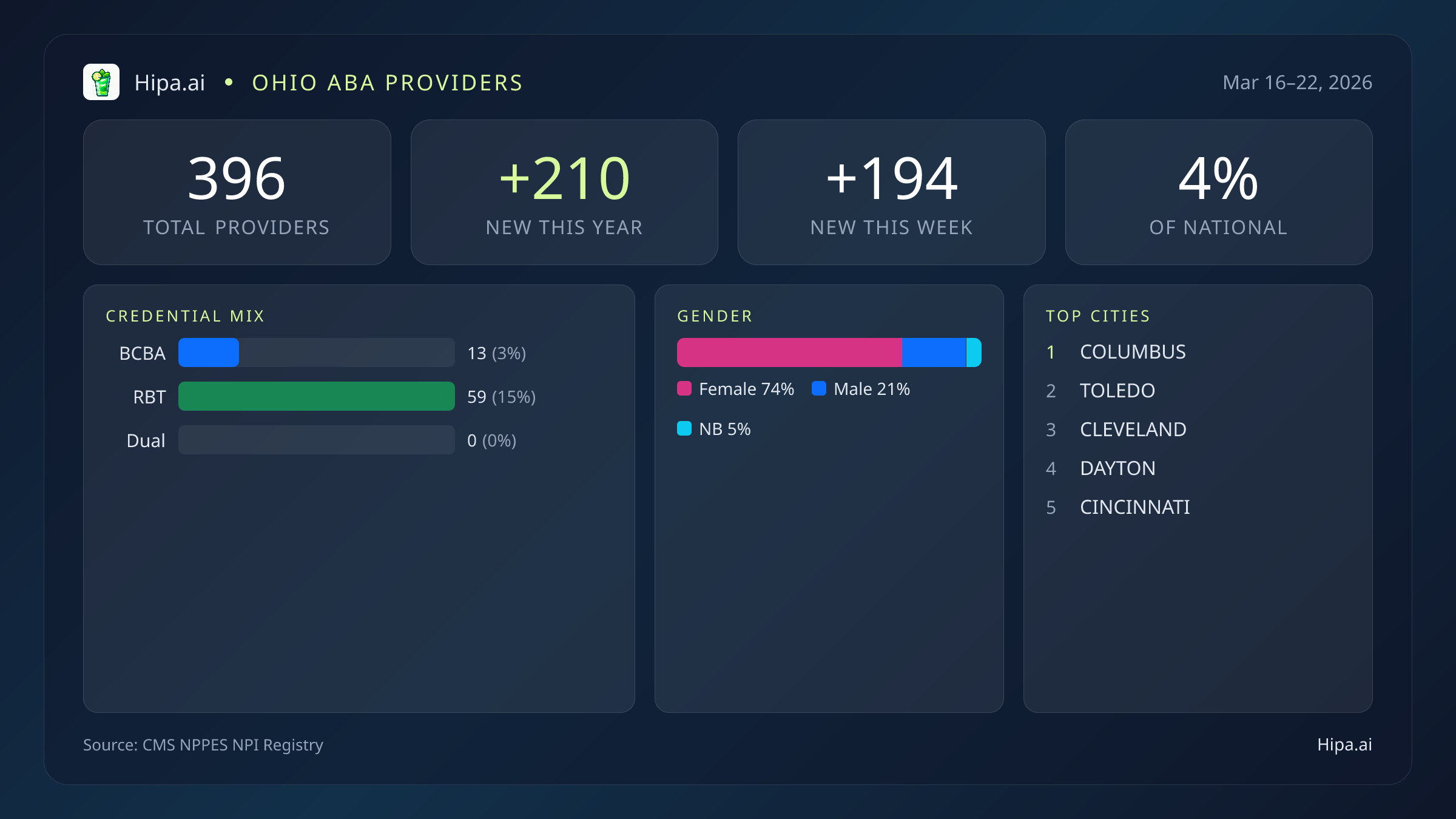
Ohio registered a substantial increase in behavioral health providers in the latest CMS NPI registry weekly update, adding a total of **396 providers**. This accounts for **4%** of the national weekly total, indicating Ohio's significant contribution to the growing national behavioral health workforce. A remarkable **194 providers** were new this week, comprising the vast majority of the **210 new providers** added for the entire year, underscoring a recent and rapid expansion in NPI registrations within the state. Of the total, **355 were individuals** and **41 were organizations**.
ABA Workforce Composition
Focusing on credentials critical for Applied Behavior Analysis (ABA) services, the data shows **13 BCBA professionals** and **59 RBT individuals**. There were no providers holding dual BCBA and RBT credentials in this update, which means the BCBA and RBT counts are distinct for this week's additions. This translates to a ratio of approximately 4.5 RBTs for every BCBA. In the broader ABA industry, a ratio of 8-10 RBTs per BCBA is often considered optimal for efficient supervision and service delivery. Ohio's current ratio suggests a potentially higher supervision capacity or a developing RBT workforce that has not yet reached the higher end of typical RBT-to-BCBA ratios seen in more mature markets. This could be beneficial for service quality but might limit overall client capacity if BCBAs are stretched thin by clinical demands beyond supervision.
Provider Demographics and Organizational Footprint
Among the individual providers, the workforce continues to be predominantly female, with **262 female providers** representing **74%** of individuals. Male providers totaled **76**, or **21%**, and **17 providers** identified as nonbinary, making up **5%**. This gender distribution is consistent with national trends in many behavioral health professions. While the data includes **41 organizations**, no specific multi-state ABA chains or other notable organizations appeared multiple times in this particular weekly update, indicating a diverse mix of newly registered entities rather than a concentrated expansion from a few large players.
This influx of new NPI registrations, particularly in RBTs, suggests a positive trend for increasing access to behavioral health, and specifically ABA, services across Ohio, though the RBT-to-BCBA ratio merits ongoing observation for optimal workforce utilization.