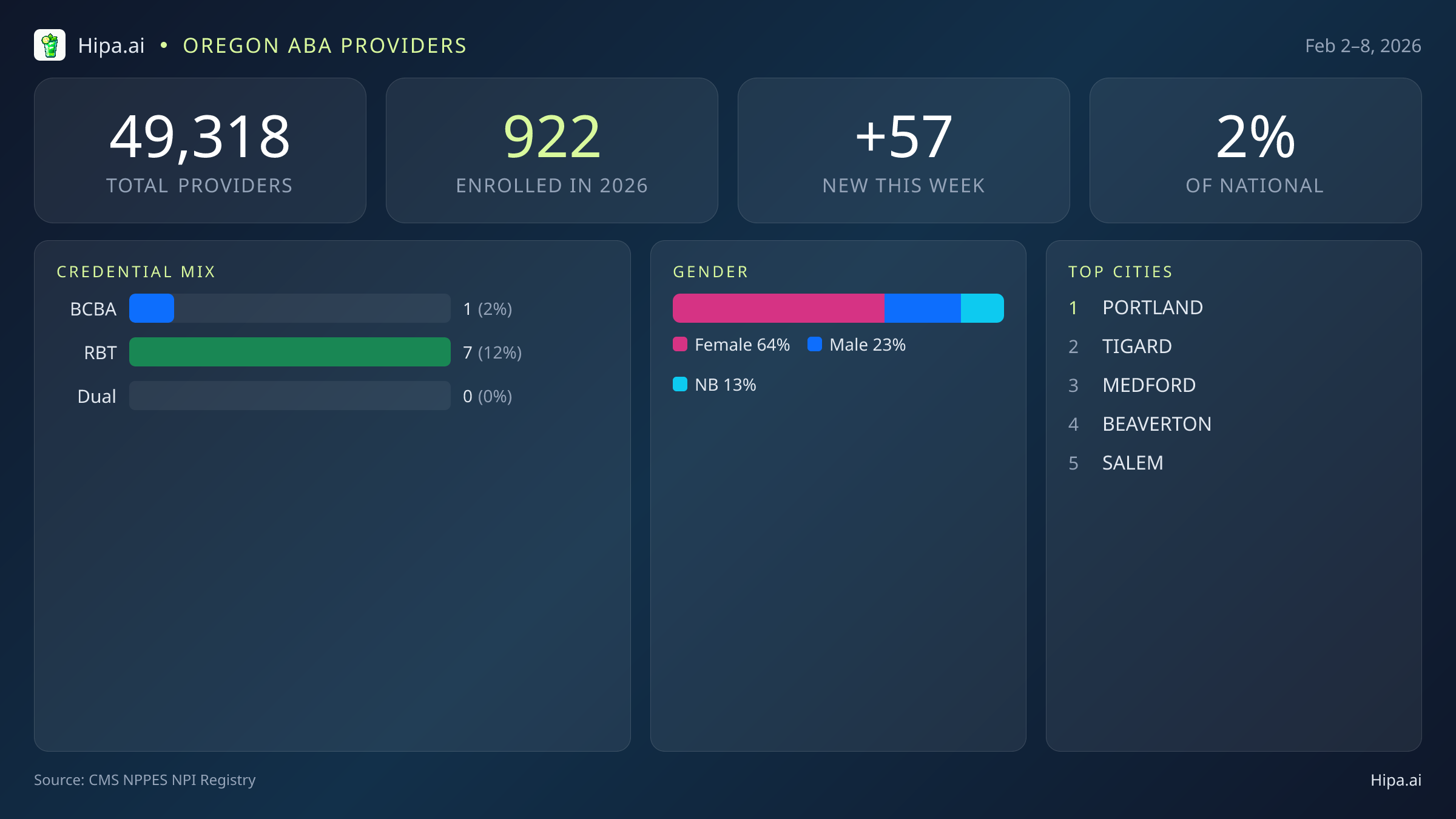
Oregon saw 57 new behavioral health providers in the latest CMS NPI registry update, representing 1% of the national weekly total. This relatively small share suggests a more localized or moderate growth in the state's behavioral health sector compared to larger, more rapidly expanding markets.
ABA Workforce Composition
Focusing on applied behavior analysis, the data includes one organization listed with a BCBA taxonomy and 7 individual RBTs (Registered Behavior Technicians) by credential. It's important to note that taxonomy and credential counts can overlap, though no individuals reported dual BCBA and RBT credentials in this update. The ratio of RBTs to the single BCBA-designated organization highlights a potential imbalance in direct service providers relative to supervisory capacity, which is crucial for quality ABA delivery.
Provider Demographics
Among the 47 individual providers added, women constitute the majority at 30 individuals, or 64%. Male providers account for 11 individuals (23%), while 6 individuals (13%) identify as nonbinary. No specific organizations appeared multiple times in this week's update, indicating a diverse range of smaller or independent practices rather than dominant multi-state chains.
The current influx of RBTs, alongside a limited number of BCBA-designated entities, suggests that while direct service capacity is growing, the availability of qualified supervision may be a critical factor influencing ABA access and workforce development in Oregon.