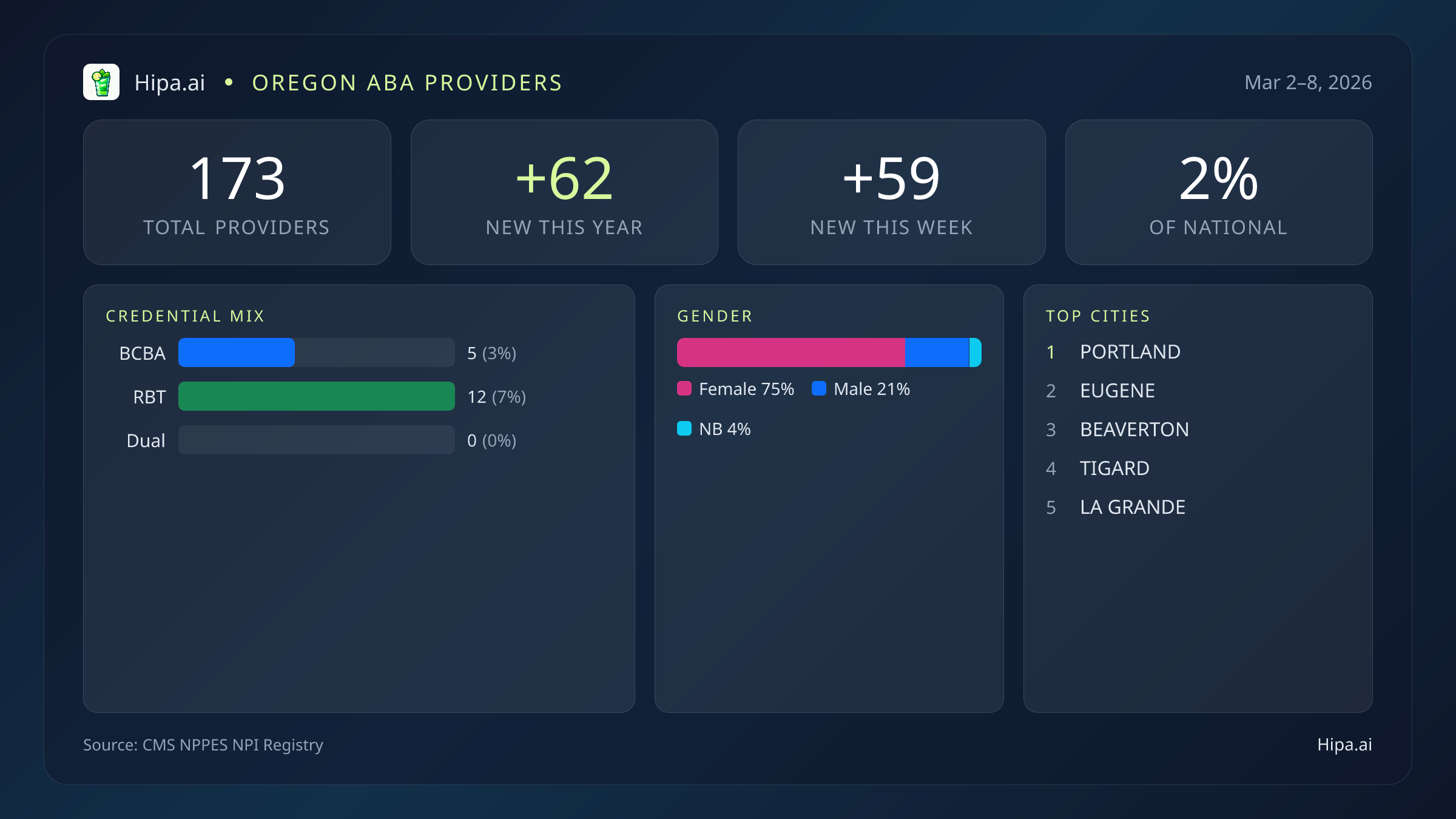
Oregon's behavioral health sector saw 173 new providers added in the latest CMS NPI registry weekly update, representing 2 of the national weekly total. This influx of professionals suggests a consistent demand for behavioral health services across the state, with new providers entering the workforce to meet community needs.
Credential Mix and Workforce Demographics
Within the new additions, the credential mix shows 5 BCBAs and 12 RBTs. This ratio indicates that for every BCBA, there are 2.4 RBTs, which is a healthy ratio for supervision capacity within Applied Behavior Analysis (ABA) service delivery. Notably, no providers reported having both BCBA and RBT credentials simultaneously. While not explicitly counted in the primary BCBA credential, one provider holds an "M.ED, BCBA, LBA" credential, highlighting the presence of state-level licensure for BCBAs in Oregon. Beyond ABA-specific credentials, the data also reflects a wide array of other behavioral health professionals, including LCSWs, CRMs, and LPCs, contributing to the diverse landscape of care.
Provider Characteristics and Key Employers
The demographic breakdown of individual providers reveals a workforce that is largely female, with 115 female providers making up 75% of the individual registrants. Male providers account for 33 individuals (21%), and 6 providers (4%) identify as nonbinary. This gender distribution is typical for many behavioral health professions. Among organizations, "WONDER WENDY" and "COMMUNITY MEDICAL SERVICES MONTANA-PRIVATE, LLC" each appeared 2 times in the listings, suggesting their active role as employers or service providers in the region.
Overall, this data points to a growing and predominantly female behavioral health workforce in Oregon, with a favorable BCBA-to-RBT ratio supporting ABA service delivery, and continued activity from diverse organizations.