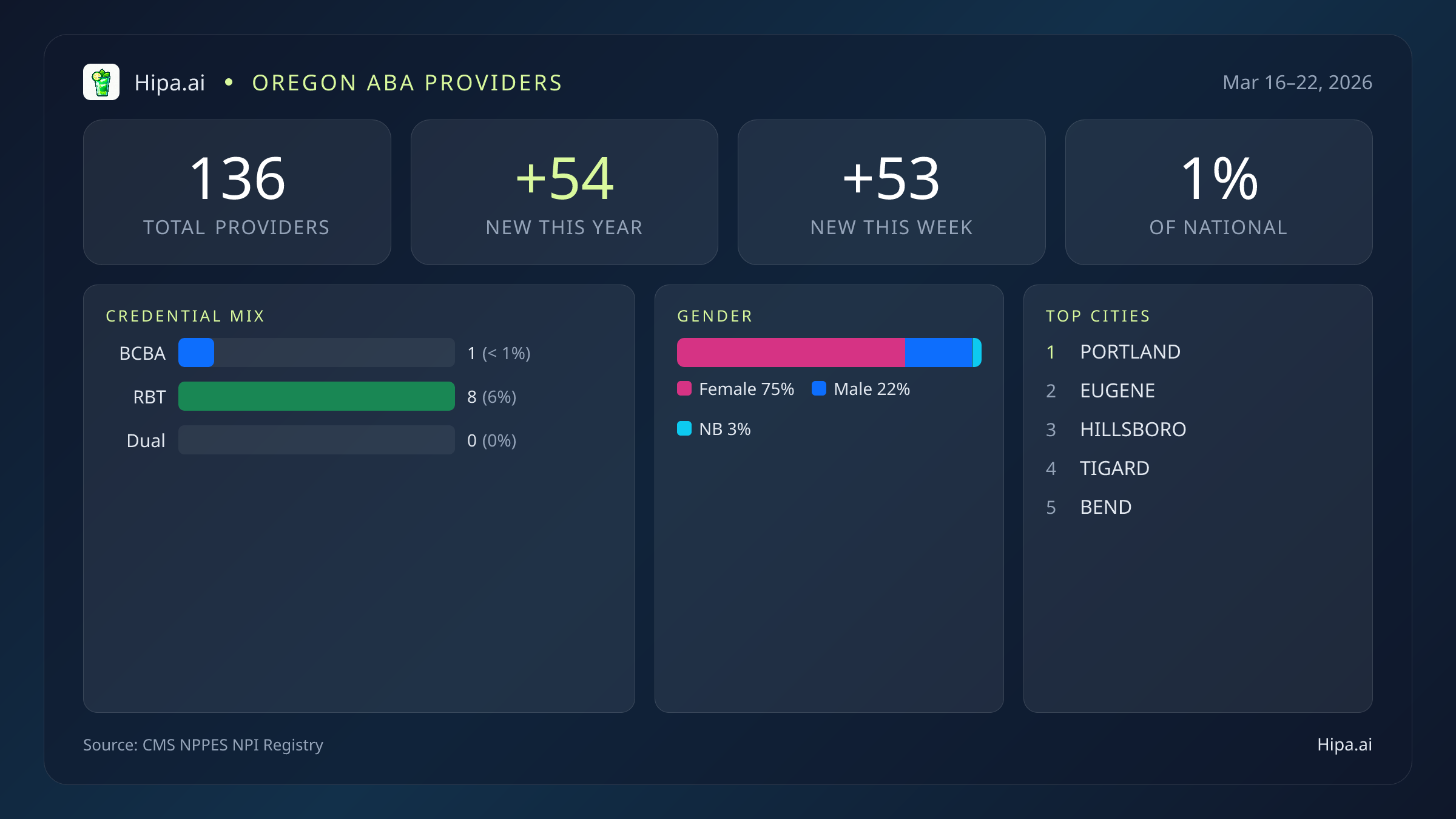
Oregon's behavioral health provider network registered 136 total providers in the latest CMS NPI registry weekly update, representing 1% of the national weekly addition. This modest concentration reflects Oregon's position as a mid-sized state market for behavioral health services, where growth has accelerated notably: 54 new providers joined the registry this year, with 1 added in the most recent week.
The credential mix reveals a fragmented ABA workforce. Oregon lists 1 BCBA and 8 RBTs in the registry, with zero dual BCBA+RBT credentials recorded. This 1:8 ratio signals potential supervision strain—one board-certified behavior analyst cannot adequately oversee eight technicians under BACB standards, which typically cap supervision at four RBTs per BCBA. The absence of dual credentials suggests limited mid-career advancement pathways, a common pattern in states where supervision capacity lags demand. The 34 providers holding multiple credentials span predominantly mental health disciplines: 13 LCSWs, 4 LPCs, and 3 MAs dominate the supplementary credentials, indicating Oregon's behavioral health workforce skews toward traditional counseling rather than applied behavior analysis.
The workforce is predominantly female, with 90 female providers representing 75% of the 120 individuals in the registry, while 26 males comprise 22%. No dominant organizations appeared in the data, suggesting a decentralized market structure without major PE-backed chain penetration. Oregon's ABA access challenges likely stem from a critical BCBA shortage relative to RBT demand, constraining the state's capacity to scale supervised services.