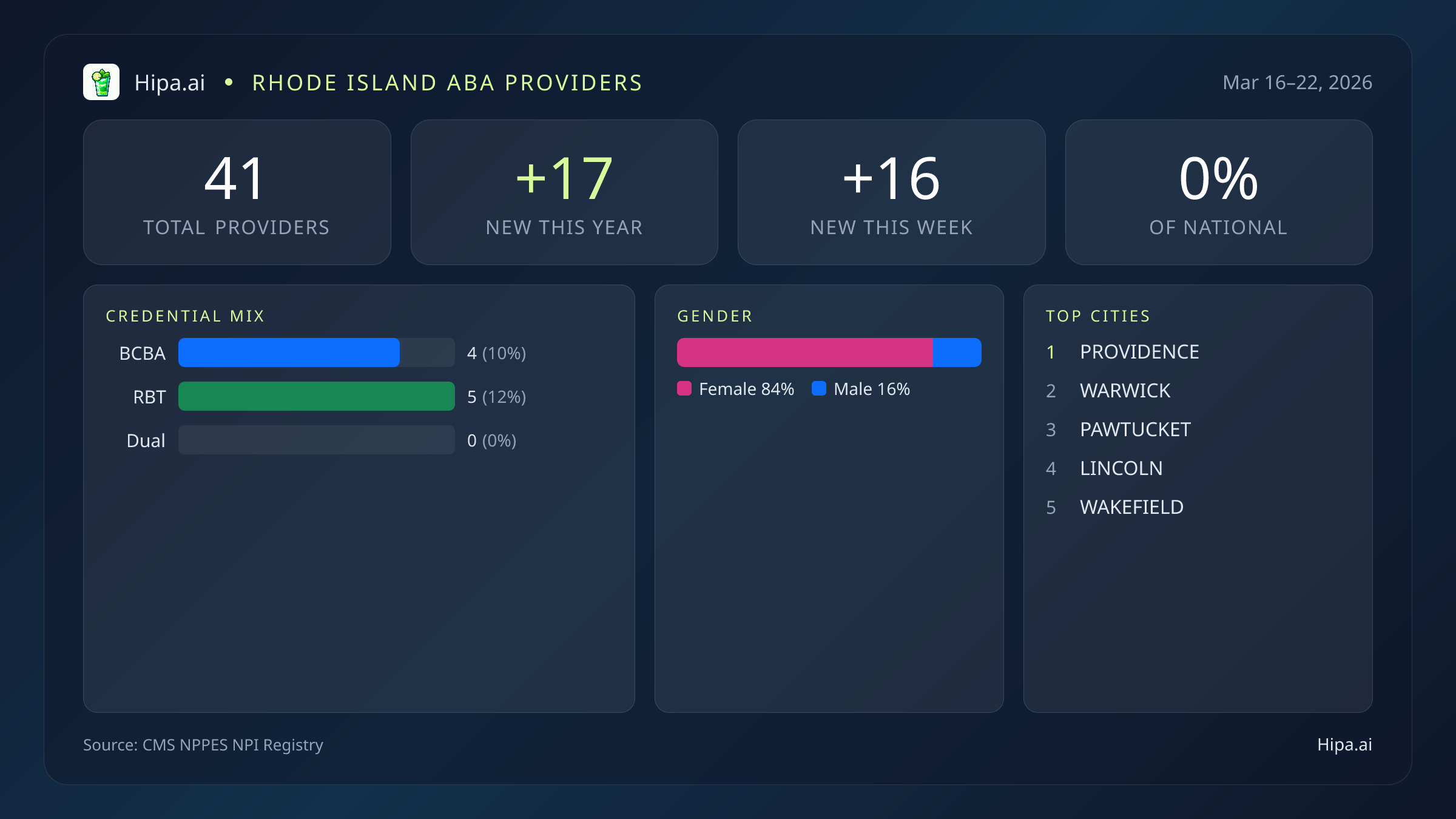
Rhode Island's behavioral health provider registry contains 41 total providers, with 1 new addition this week as part of a broader state trend: 17 new providers have registered year-to-date. The state's concentration reflects a small but active workforce responding to demand for ABA and allied mental health services in a densely populated region.
The credential mix reveals structural constraints typical of smaller states. Rhode Island has 4 BCBAs and 5 RBTs, but notably zero providers holding dual BCBA+RBT credentials—a credential pairing that often signals supervisors with direct clinical experience. The absence of dual-credentialed staff means supervision relationships depend entirely on separate practitioners, which can complicate continuity and knowledge transfer in clinic operations. The larger cohort consists of social workers and mental health counselors: 7 LICSWs, 4 LCSWs, and 3 LMHCs dominate the "other" category, suggesting Rhode Island's behavioral health system leans heavily on licensed mental health professionals rather than behavior analysts.
The workforce skews heavily female: 32 providers (84%) identify as female, compared to 6 male providers (16%). 38 of the 41 providers are individuals rather than organizations, and 3 organizational entities appear in the registry. No single organization dominates the data, indicating fragmented service delivery rather than PE-backed consolidation seen in larger states.
This provider density and credential distribution suggest Rhode Island relies on licensed clinicians outside the formal ABA pipeline to meet behavioral health demand, potentially limiting access to board-certified behavior analysis for families seeking specialized autism and developmental services.