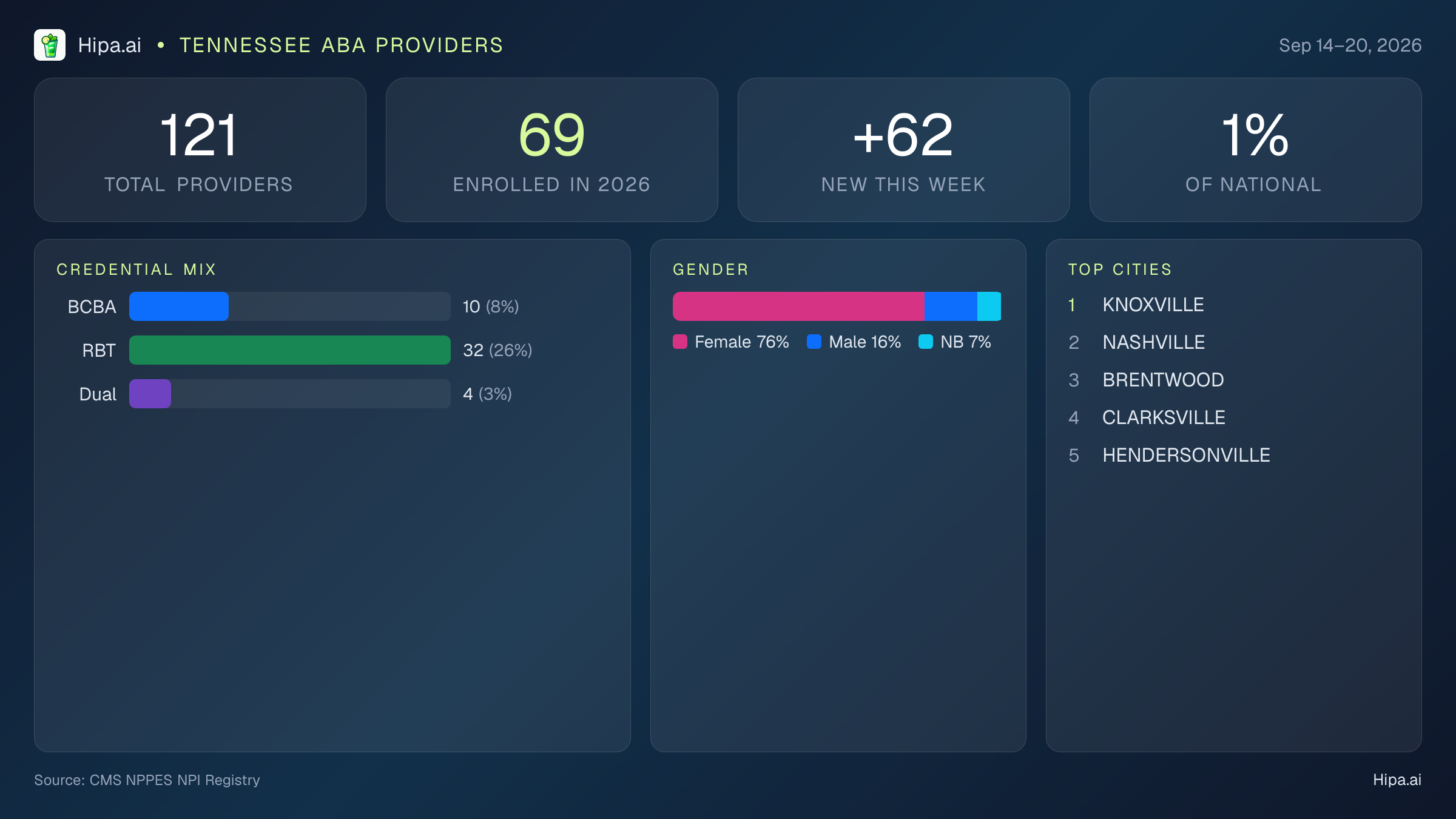
Tennessee had 121 providers in the latest CMS NPI registry weekly update, accounting for 1% of the national weekly total. The file lists 62 new this week and 69 this year; 97 are individuals and 24 organizations. That share signals a limited slice of national registry activity, not necessarily the state’s full behavioral health workforce: NPI updates do not establish hiring, staffing levels or service availability.
ABA Workforce Mix
The credential summary lists 10 BCBAs and 32 RBTs, alongside 4 dual BCBA-RBT credentials. These counts overlap: dual-credential providers may also appear in the BCBA and RBT totals, so the categories should not be added as separate groups. The larger RBT count points to a technician-heavy profile, while the smaller BCBA count highlights the importance of supervisory capacity. BCBAs supervise RBTs, so technician growth can translate into expanded ABA services only when enough qualified supervisors are available. The data also counts 27 providers with multiple taxonomies, further cautioning against treating registry categories as mutually exclusive.
Demographics and Organizations
The gender breakdown lists 74 women (76%), 16 men (16%) and 7 nonbinary providers (7%). Percentages are reported figures and do not total 100%. The update supplies no notable organization list, so it does not identify a repeated employer or organization pattern. Its leading cities are Knoxville, Nashville, Brentwood, Clarksville and Hendersonville, suggesting activity across several population centers rather than one listed city alone.
Tennessee’s update shows more RBTs than BCBAs in the credential summary, making supervisor recruitment and retention a key consideration as the state seeks to broaden ABA access.