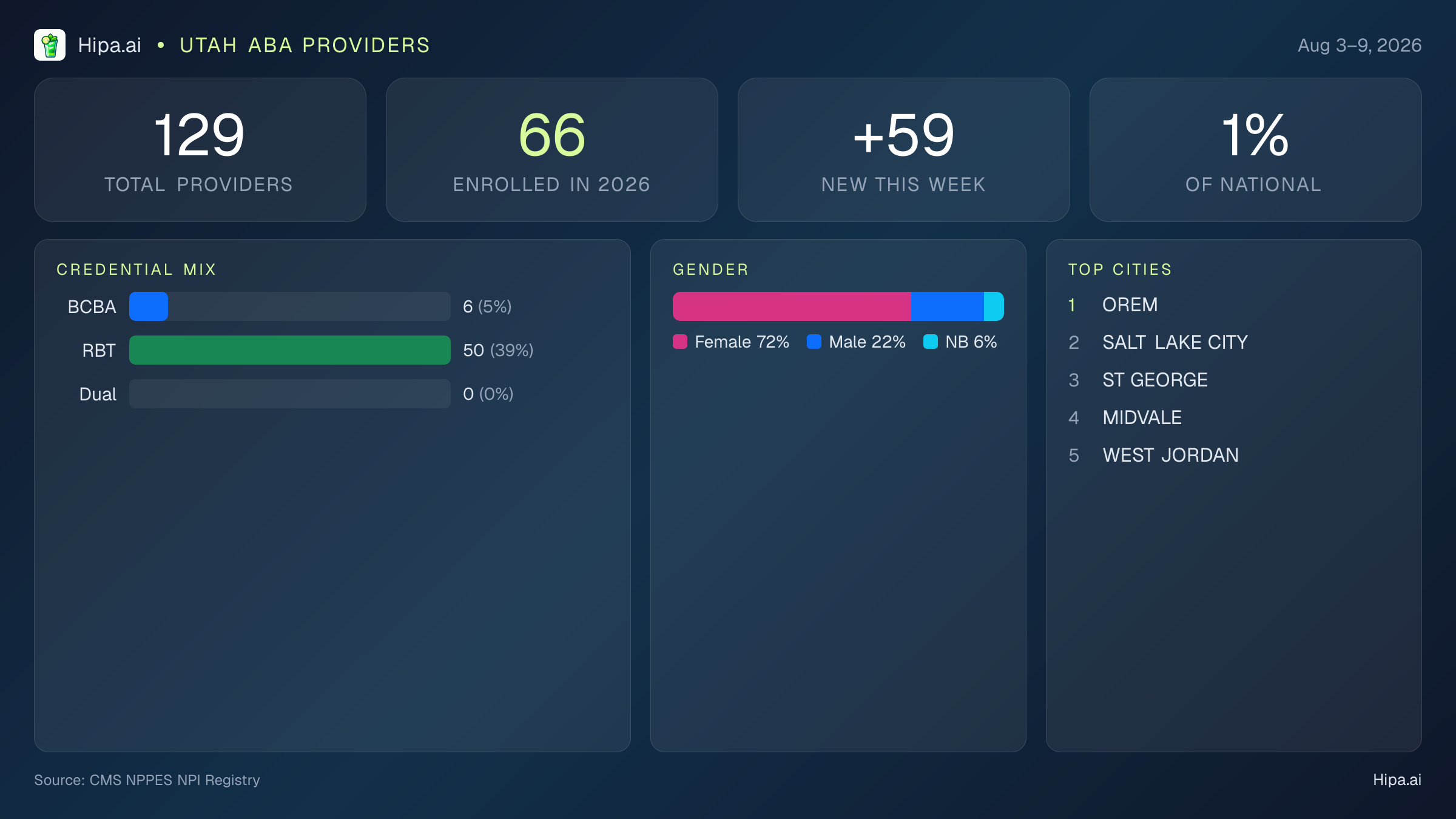
Utah had 129 providers in the latest CMS NPI registry weekly update, accounting for 1% of the national weekly total. With 59 new providers this week, Utah’s activity represents a concentrated addition to the national behavioral health workforce, although the registry includes both individuals and organizations and multiple behavioral health disciplines.
ABA Workforce Mix
The registry lists 6 BCBA credentials and 50 RBT credentials, with no dual BCBA-RBT credentials reported. These categories overlap with taxonomy-based counts and should not be treated as mutually exclusive shares. The pronounced RBT-to-BCBA imbalance points to a large direct-service layer relative to the listed supervisory workforce. Because BCBAs supervise RBTs and oversee treatment planning, the pattern may indicate demand for additional supervisory capacity as Utah’s ABA workforce expands.
Demographics and Provider Footprint
Of Utah’s 119 individuals, 86 female providers represented 72% of the individual workforce, compared with 26 male providers at 22% and 7 nonbinary providers at 6%. The registry also identifies 15 providers with multiple taxonomies, reinforcing that credential and taxonomy categories can overlap. No notable organization appeared multiple times in the supplied data. The listed cities—Orem, Salt Lake City, St. George, Midvale and West Jordan—show activity across both the Wasatch Front and southern Utah, while 10 organizations point to a mix of individual practitioners and agency-based delivery.
Utah’s registry profile suggests expanding ABA access is being driven more by RBT growth than by growth in the BCBA supervisory pipeline, making supervisor recruitment and geographic distribution important workforce priorities.