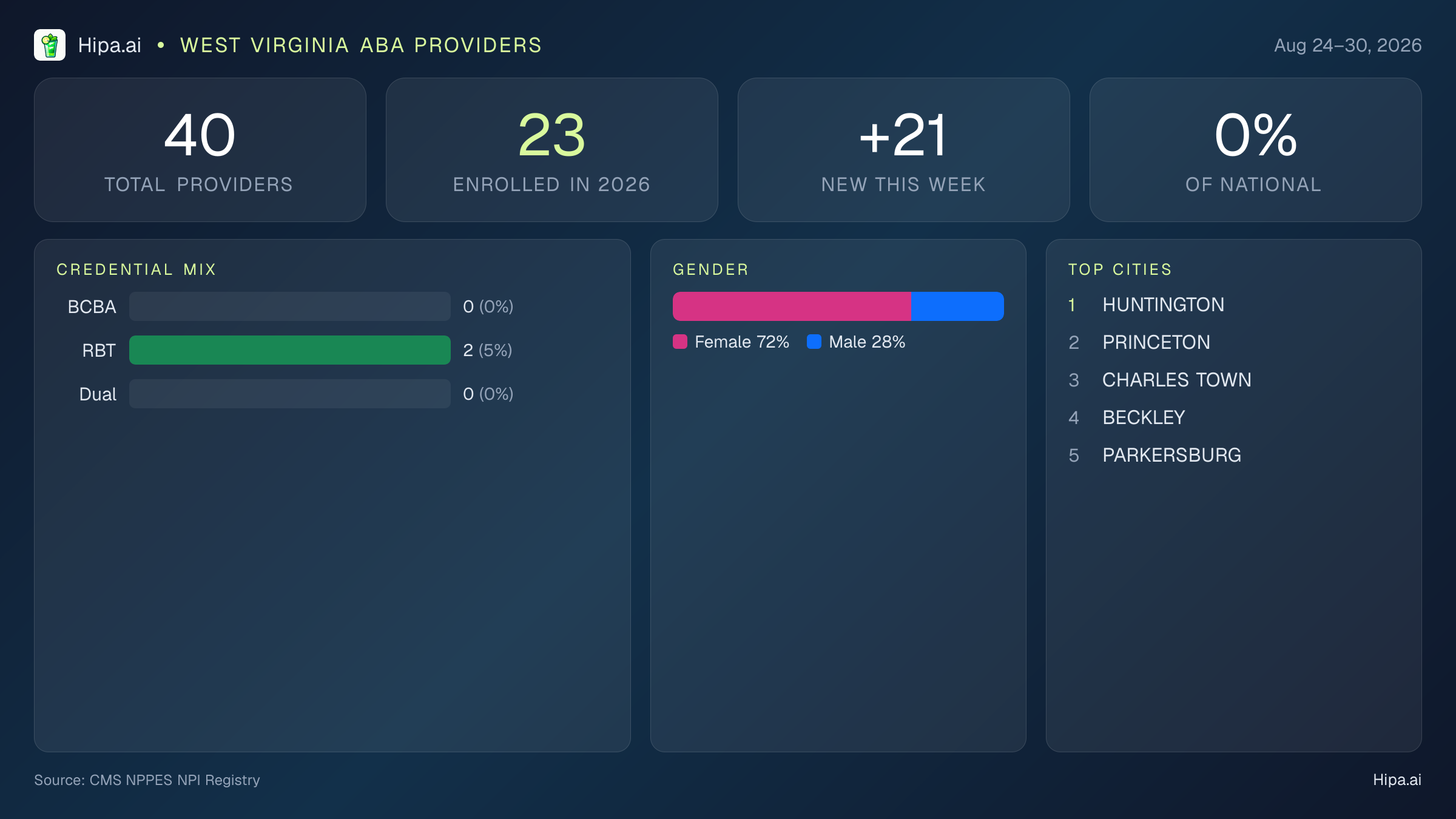
West Virginia recorded 40 providers in the latest CMS NPI registry weekly update, with a reported 0% share of the national weekly total. The registry lists 21 new providers this week, alongside 36 individuals and 4 organizations. The zero share reflects the supplied registry field; the data does not include the national denominator. Even so, the week’s activity suggests a small but active behavioral health market, with new entries spread across counseling, case management, social work, speech-language pathology and related services. NPI activity does not confirm active caseloads, hiring, or appointment availability.
ABA Workforce Mix
West Virginia has no listed BCBA credentials and 2 RBT credentials; no provider is identified with a dual BCBA-RBT credential. The credential and taxonomy fields can overlap or describe the same provider, so these figures are not mutually exclusive shares of the 40-provider total. The absence of a listed BCBA alongside two RBT taxonomies points to limited visible ABA supervision capacity in this update. Because BCBAs supervise RBTs, guide treatment planning and monitor clinical quality, a small or absent BCBA pool can constrain the expansion of technician-delivered services. The broader credential mix includes MA credentials, BS credentials and LPC credentials, as well as medical, social work and speech-language credentials, indicating that the registry activity is not concentrated in ABA.
Demographics and Organizations
Gender data identifies 26 female providers, 10 male providers and no nonbinary providers, corresponding to 72%, 28% and 0%. Huntington, Princeton, Charles Town, Beckley and Parkersburg are the listed leading cities. No notable organization appears multiple times in the update; the registry contains four organizations overall. Five providers have multiple taxonomies, another reason category counts should not be treated as separate workforce segments.
West Virginia’s update suggests broad behavioral health activity but a thin identifiable ABA supervision pipeline, which may limit access as RBT-based services grow.