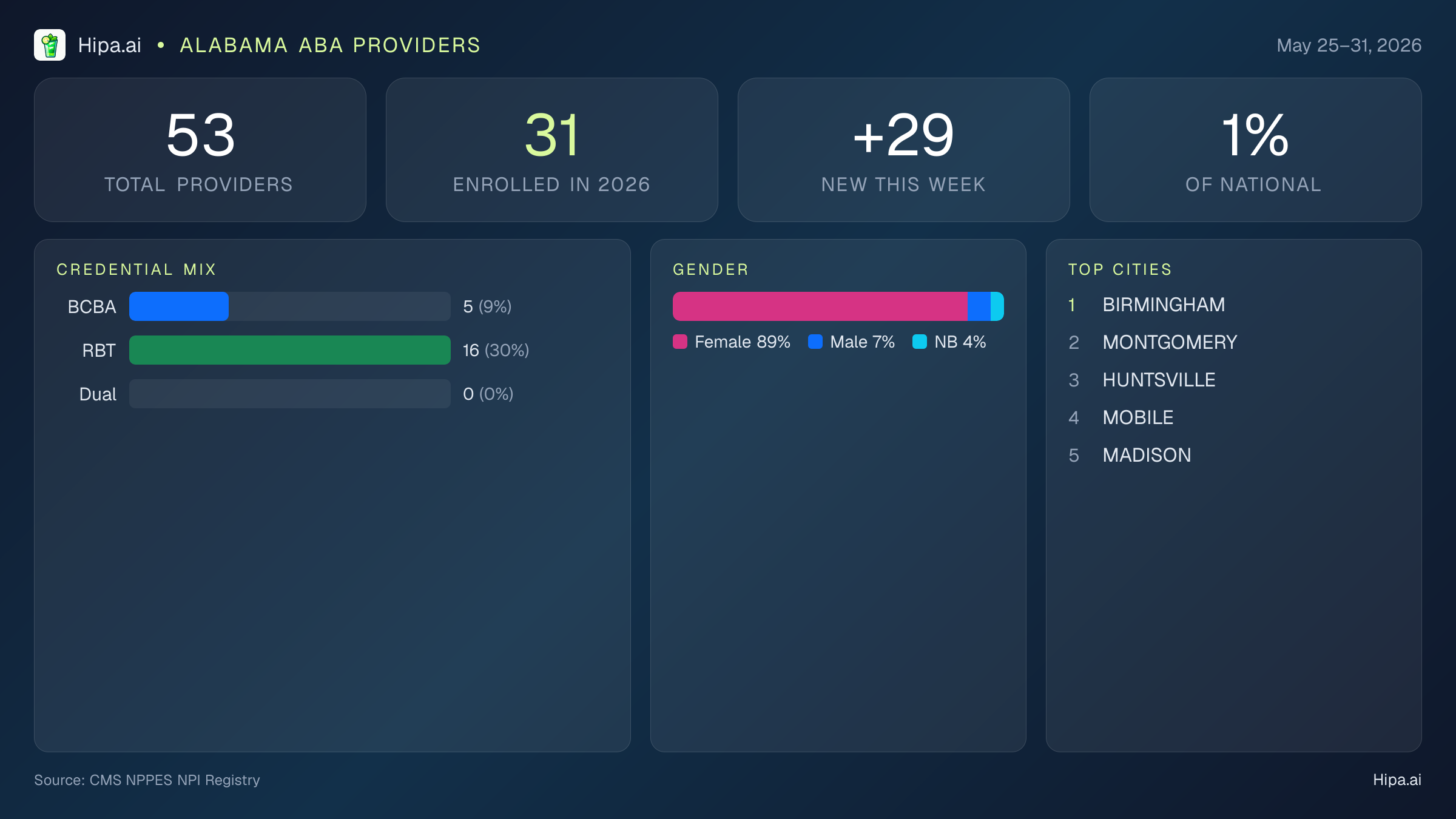
Alabama added 53 behavioral health providers in the latest CMS NPI registry weekly update, representing 1% of the national total. This modest contribution indicates a steady, rather than explosive, growth trajectory for the state's behavioral health workforce, suggesting a consistent demand for services without a sudden surge in new practitioners.
ABA Workforce Dynamics
Within the applied behavior analysis (ABA) sector, the data shows 5 providers explicitly listing 'BCBA' as a credential, alongside 16 RBT credentials. Additionally, one provider held an 'EDD, BCBA' credential, and another held an 'LBA' credential, which in Alabama typically signifies a licensed BCBA. It is important to note that these credential categories are not mutually exclusive; for instance, the LBA provider also has a BCBA taxonomy. There were 0 individuals holding both BCBA and RBT credentials among this week's new entries, suggesting distinct roles rather than career progression in this specific dataset. The ratio of 3.2 RBTs for every explicitly listed BCBA indicates a foundational capacity for direct service delivery, though the overall supervisory capacity is bolstered by the additional BCBA-level providers.
Provider Demographics
Of the 46 individual providers registered, 41 female (89%), 3 male (7%), and 2 nonbinary (4%) individuals were recorded. This gender distribution is consistent with broader trends observed in the behavioral health workforce. The remaining 7 providers were organizations. No specific organizations appeared multiple times in this week's data, suggesting a diverse landscape of smaller practices or individual practitioners rather than dominant multi-state chains making significant new entries.
This data suggests a consistent, albeit smaller-scale, expansion of Alabama's behavioral health workforce, with a particular emphasis on direct service providers, which is crucial for improving access to care.