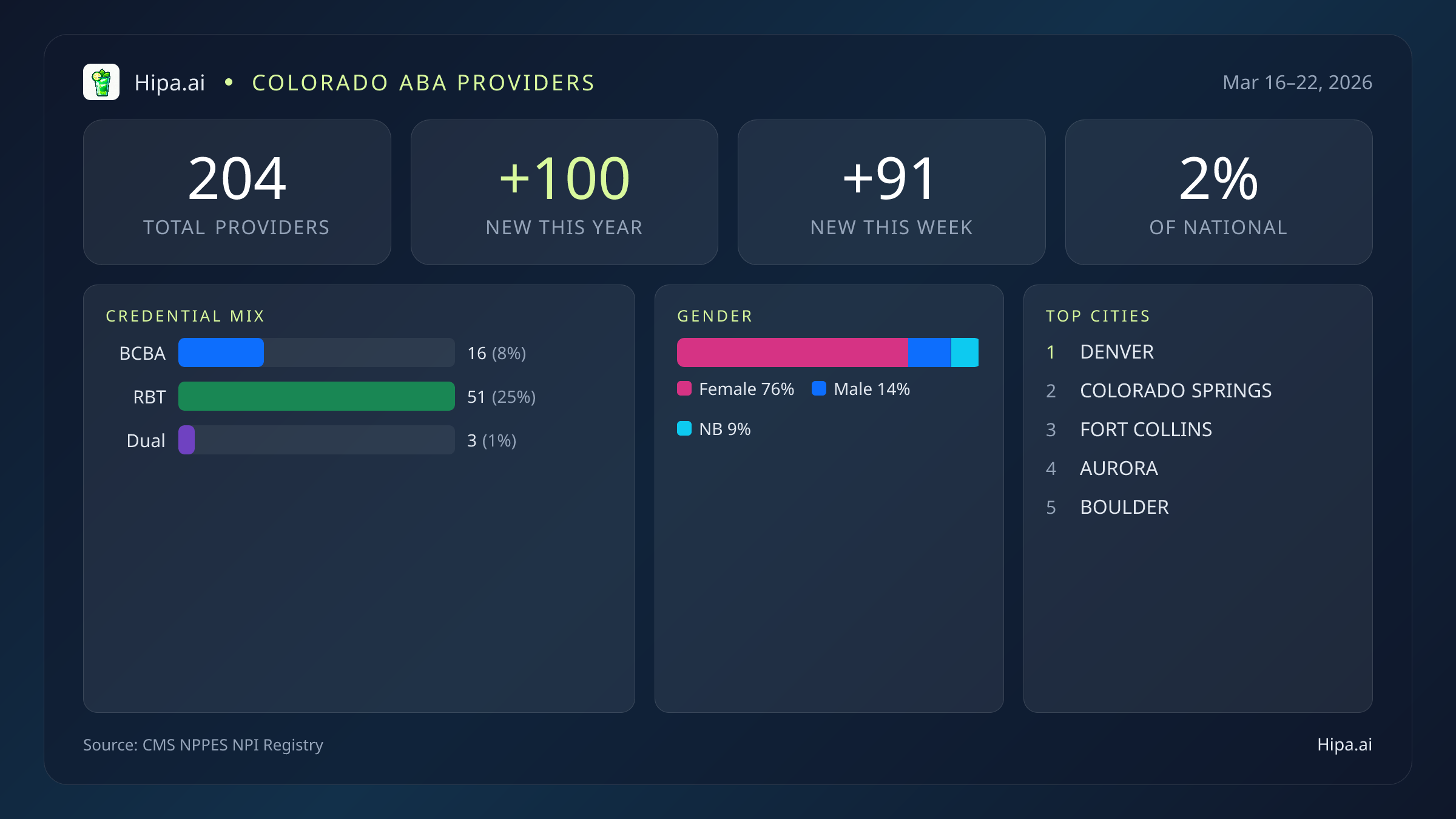
Colorado's behavioral health provider registry grew to 204 providers this week, representing 2% of the national NPI update. The state added 1 provider in this cycle but has grown substantially this year, with 100 new entries since January. This concentration reflects Colorado's established behavioral health infrastructure, particularly in its urban corridor stretching from Denver through Boulder and Fort Collins.
The ABA workforce shows a supervision challenge. Colorado lists 16 BCBAs but 51 RBTs, a ratio that suggests limited supervisory capacity relative to the technician workforce. Only 3 providers hold dual BCBA-RBT credentials, which typically signal practitioners who have advanced from line staff to leadership roles. This narrow dual-credentialed group may constrain how efficiently clinics can scale operations, a known constraint in PE-backed chains that rely on clear supervisor-to-technician hierarchies.
The workforce skews heavily female: 129 providers (76%) identify as female, while 24 (14%) are male and 16 (9%) are nonbinary. Beyond ABA credentials, the registry includes 12 LCSWs and 12 LPCs, reflecting Colorado's integration of licensed mental health professionals into behavioral health settings. Family Support Center of Colorado is the only organization appearing multiple times, with 3 listed providers, suggesting most Colorado behavioral health delivery remains fragmented across independent and small-group practices.
The dominance of non-ABA credentials and the tight BCBA-to-RBT ratio suggest Colorado's behavioral health market may be less concentrated in specialized ABA chains than peer states, potentially limiting access to intensive autism services for families seeking established multi-state providers.