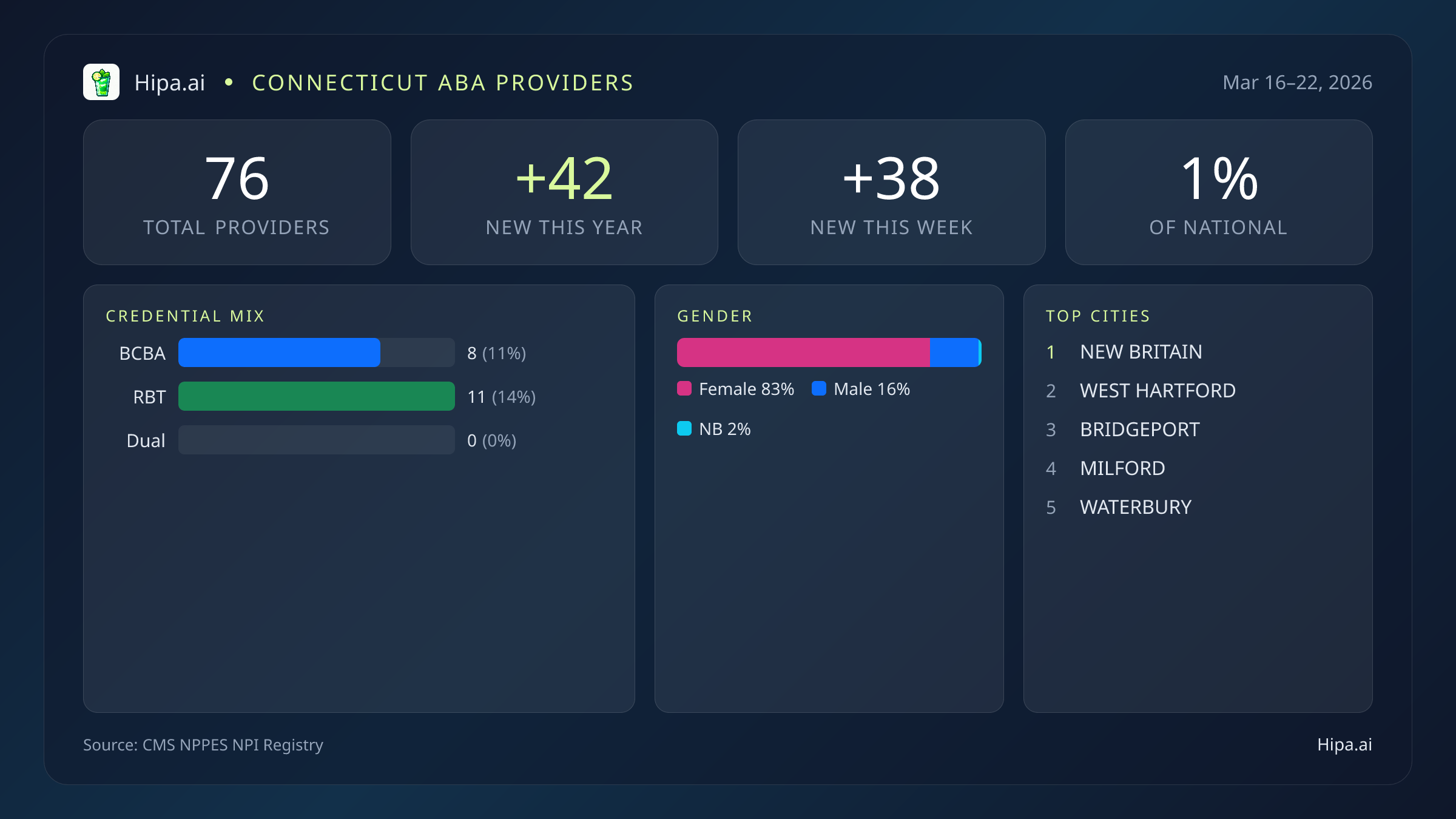
Connecticut's behavioral health workforce added 1 new provider this week, bringing the state's total to 76 providers—representing 1% of the national weekly update. This modest contribution reflects Connecticut's position as a smaller regional market, though year-to-date growth of 42 new providers signals meaningful expansion as ABA services continue to scale across the state.
The credential mix reveals a supervision capacity gap. Connecticut lists only 8 BCBAs against 11 RBTs, a ratio that raises questions about adequate oversight depth for a workforce of this size. Notably, there are 0 dual BCBA-RBT credentials in the registry, a credential pairing that typically signals clinical leadership and career progression within ABA. The broader provider base is dominated by 13 LCSWs, which reflects Connecticut's traditional reliance on licensed clinical social workers in behavioral health but underscores how ABA-specific credentials remain concentrated among a smaller cohort.
Women comprise 83% of the workforce—a gender composition consistent with behavioral health and ABA nationally—while men account for 16% and 1 provider identifies as nonbinary. 64 individuals and 12 organizations make up the registry; no single employer appears with outsized frequency in the data, suggesting a fragmented provider landscape rather than domination by PE-backed chains that characterize other Northeast markets.
Connecticut's thin BCBA-to-RBT ratio and absence of dual credentials may constrain rapid ABA program expansion without accelerated supervisor recruitment.