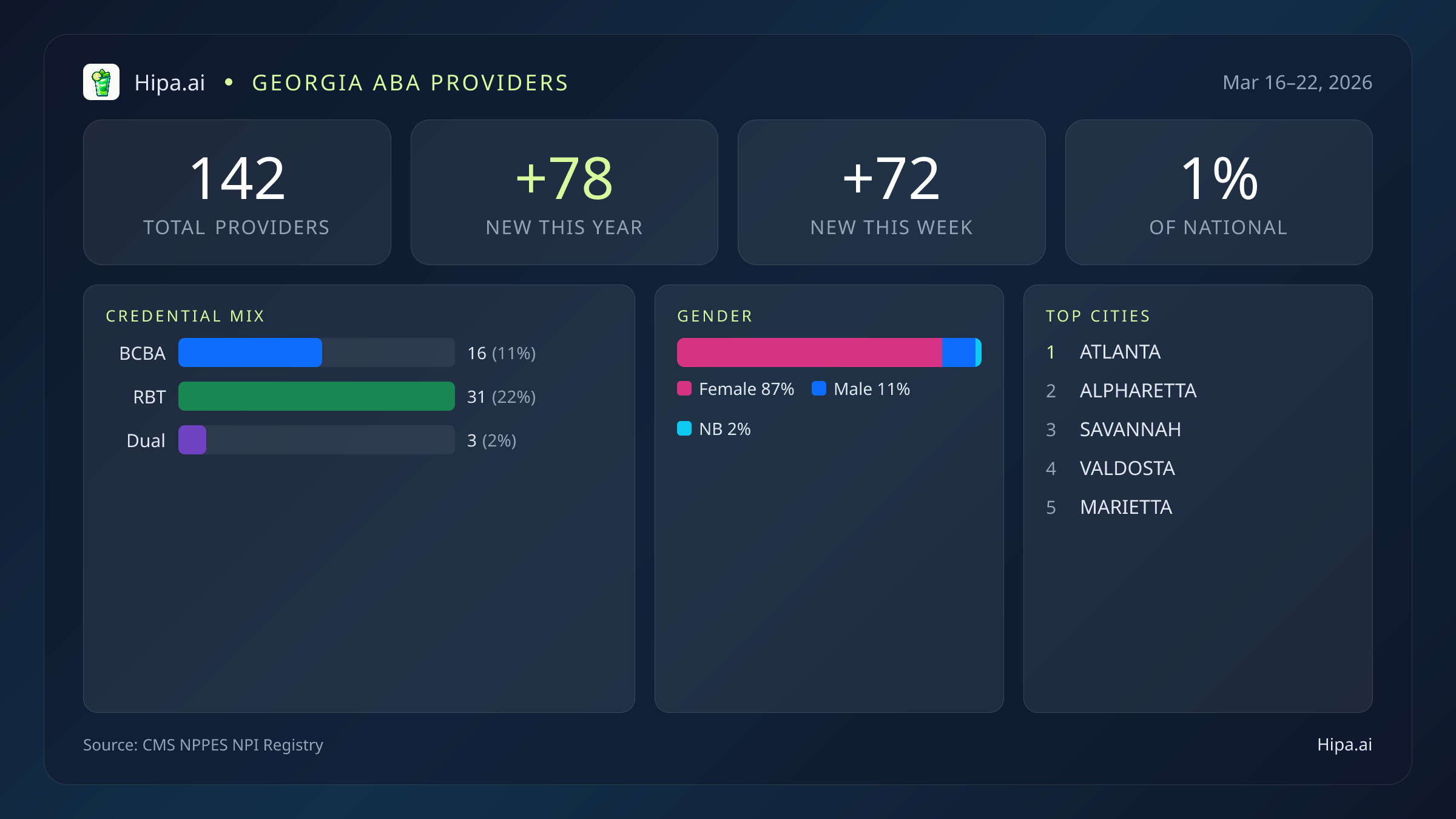
Georgia featured 142 behavioral health providers in the latest CMS NPI registry weekly update, accounting for 1% of the national total. Of these, 72 providers were new this week, contributing significantly to the 78 new providers registered in the state this year. This recent surge in registrations indicates a dynamic and expanding behavioral health sector in Georgia, with 108 individuals and 34 organizations contributing to this growth. The concentration signals a steady, albeit proportional, contribution to the national workforce, with a notable acceleration in new enrollments.
ABA Credential Mix and Supervision Capacity
Focusing on the ABA workforce, the data shows 16 BCBA credentials and 31 RBT credentials among the newly updated providers. It's important to note that 3 providers held dual BCBA and RBT credentials, meaning these individuals are counted in both categories. Considering the 16 BCBAs available for supervision and 31 RBTs requiring it, this results in an approximate ratio of 1.94 RBTs for every BCBA. This ratio is significantly lower than the industry standard of 8-10 RBTs per BCBA, suggesting either a robust supervisory environment within Georgia or an RBT workforce that is still in its early stages of growth, with BCBAs potentially dedicating more time to direct service provision. Beyond ABA, other prominent credentials included 15 LPC professionals and 10 LCSW professionals, indicating a broader need for mental health services.
Workforce Demographics and Organizational Footprint
The demographic breakdown for individual providers reveals a strong female presence, with 94 female providers constituting 87% of individuals. Male providers totaled 12, representing 11%, and 2 providers identified as nonbinary, making up 2%. This gender distribution aligns with broader trends in the behavioral health field. Among organizations, "KRAMLICH SPEECH & LANGUAGE SERVICES LLC" appeared twice, indicating its multi-NPI presence or multiple locations within the state's top cities for new enrollments, which include ATLANTA, ALPHARETTA, SAVANNAH, VALDOSTA, and MARIETTA. The fact that 35 providers reported multiple taxonomies further highlights the diverse service offerings and integrated care models emerging in Georgia.
This data suggests Georgia is experiencing a significant influx of new behavioral health professionals, particularly RBTs, under a relatively strong supervisory framework, which could enhance access to ABA services across the state.