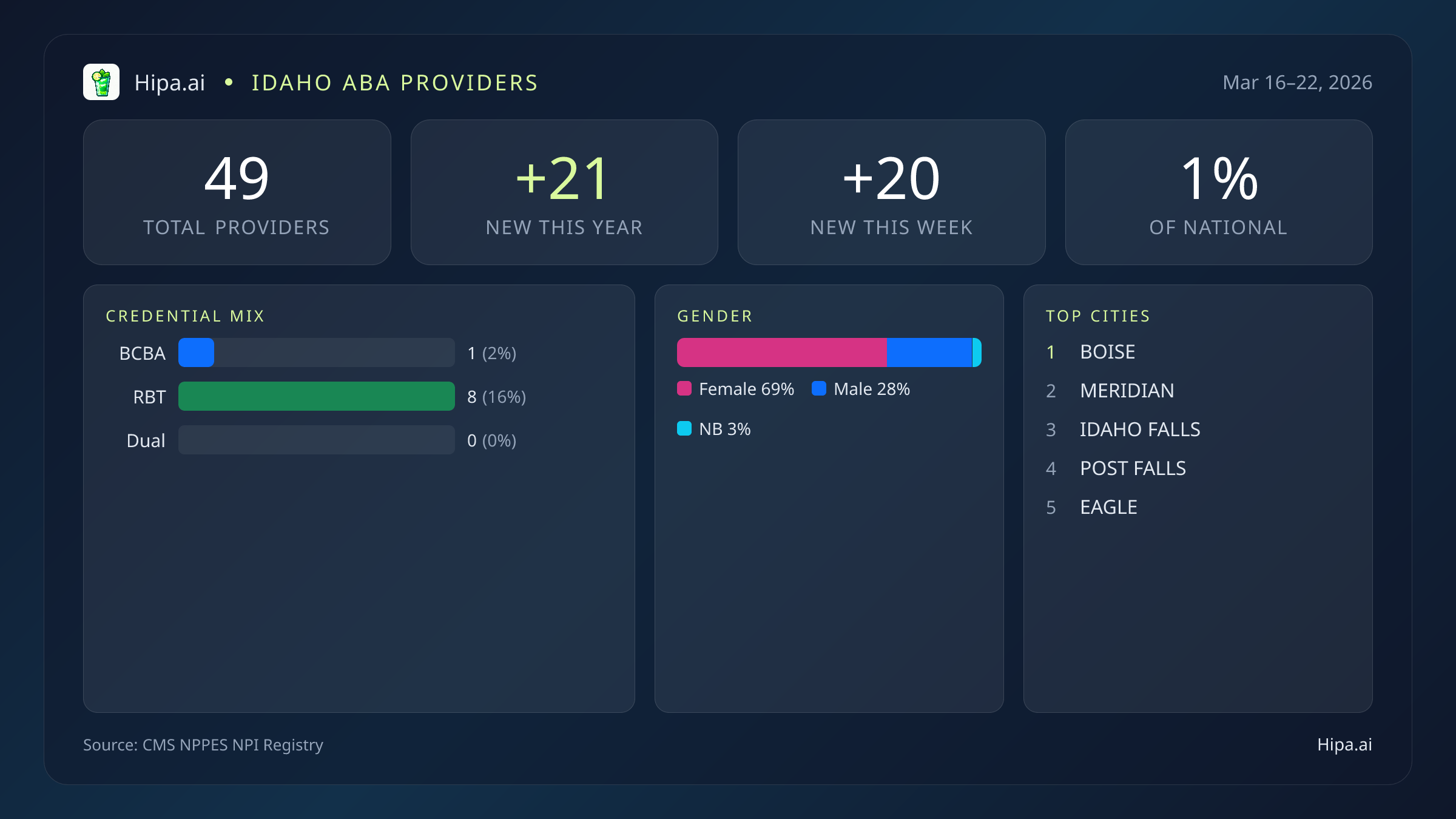
Idaho's behavioral health provider roster in the CMS NPI registry stands at 49 total providers, representing 1% of the national weekly update total. This modest concentration reflects Idaho's position as a lower-volume state for ABA services, though the 21 new providers added year-to-date signal steady workforce entry even in a smaller market.
The credential mix reveals a critical supervision gap. Idaho has only 1 BCBA against 8 RBTs—a ratio that suggests severe supervision capacity constraints. With zero dual BCBA+RBT credentials in the state, there is no evidence of career progression from technician to supervisor within the registered ABA workforce. This imbalance means existing BCBAs face heavy caseloads or practices may be understaffed for compliant supervision models. Notably, 18 providers hold multiple taxonomy codes, indicating cross-disciplinary work, though most carry counselor and social work licenses (LCPC, LPC, LCSW, LMSW) rather than ABA credentials.
The workforce skews female: 22 providers (69%) identify as women, with 9 (28%) male and 1 (3%) nonbinary. Saint Alphonsus Regional Medical Center is the only notable organizational anchor, appearing 5 times in the registry. Boise, Meridian, and Idaho Falls dominate geographically, clustering services in the Treasure Valley and southeastern corridor.
Idaho's low BCBA-to-RBT ratio and absence of dual credentials suggest limited internal pathways for technician advancement and potential reliance on out-of-state supervision or telehealth BCBA services to meet regulatory requirements.