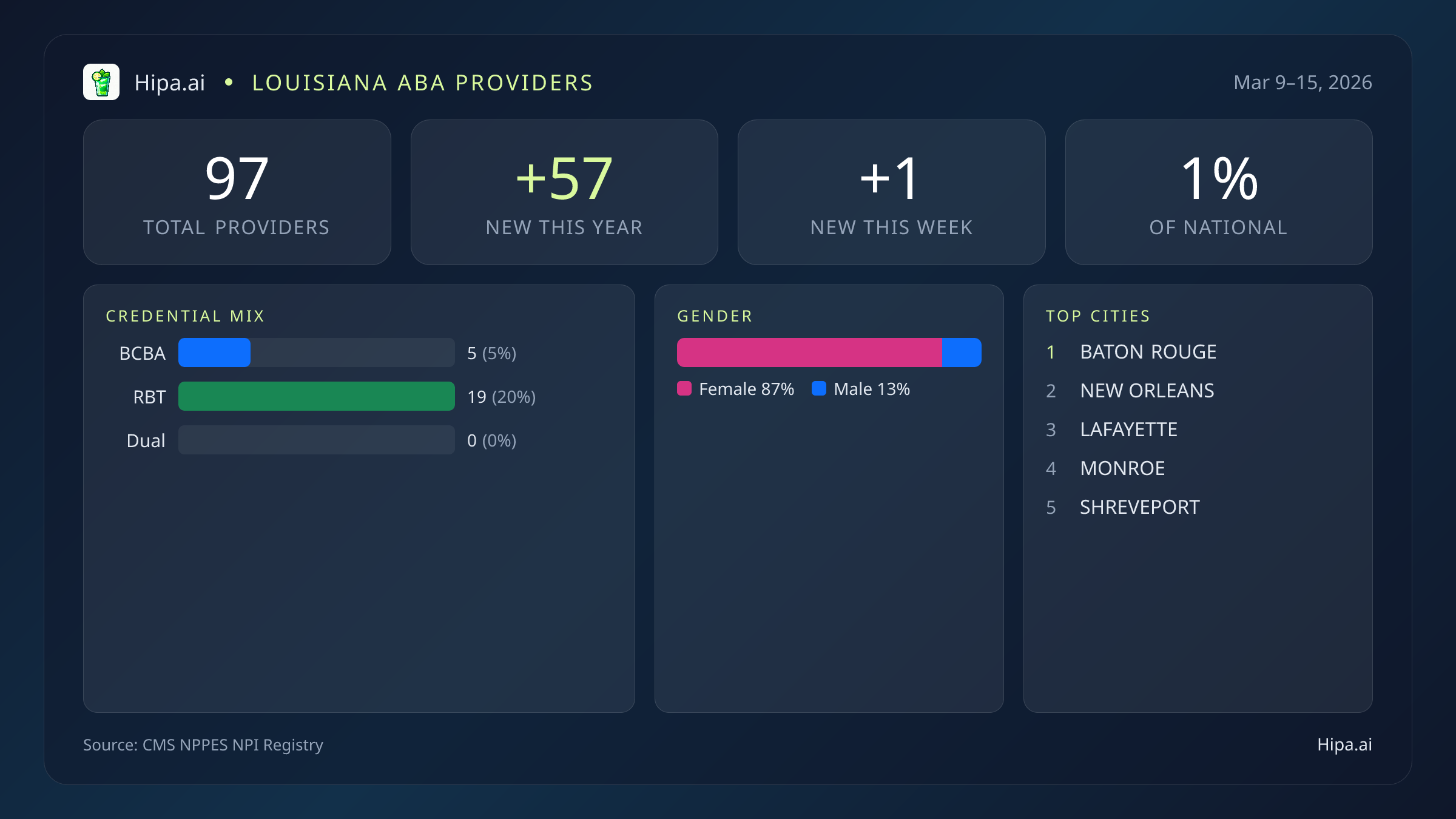
Louisiana's behavioral health sector saw 97 providers in the latest CMS NPI registry weekly update, representing 1% of the national total. This modest but consistent activity includes 1 new provider this week, contributing to a total of 57 new providers for the year. The majority of these are individual practitioners, with 86 individuals and 11 organizations listed, indicating ongoing, localized growth rather than a sudden influx of large entities.
Credential Mix and Supervision Capacity
Among individual providers, Louisiana added 5 BCBA credentials and 19 RBT credentials this week. Notably, there were no providers with dual BCBA and RBT credentials in this update, meaning individuals are not currently recorded as holding both certifications simultaneously. The ratio of RBTs to BCBAs, approximately 3.8 to 1, indicates a foundational workforce for ABA services. However, the relatively low absolute number of BCBAs suggests a potential constraint on supervision capacity, crucial for RBT practice, across the state. Beyond ABA-specific credentials, 5 individuals also hold LCSW and 5 individuals hold LPC credentials, highlighting a broader behavioral health provider base.
Workforce Demographics and Organizational Presence
The workforce demographics in Louisiana show a strong female representation, with 75 individual providers, or 87%, identifying as female, compared to 11 male providers, making up 13%. There were no nonbinary providers reported in this update. The top cities for provider activity include Baton Rouge, New Orleans, Lafayette, Monroe, and Shreveport. While 11 organizations were part of the total, no specific organizations appeared multiple times in this dataset, indicating a diverse organizational landscape rather than dominance by a few large entities. Additionally, 20 providers hold multiple taxonomies, suggesting a versatile skill set among a segment of the workforce.
This data suggests Louisiana's behavioral health workforce, particularly in ABA, is expanding steadily but with a noticeable need for more BCBA-level supervision to support its growing RBT base and ensure robust service access.