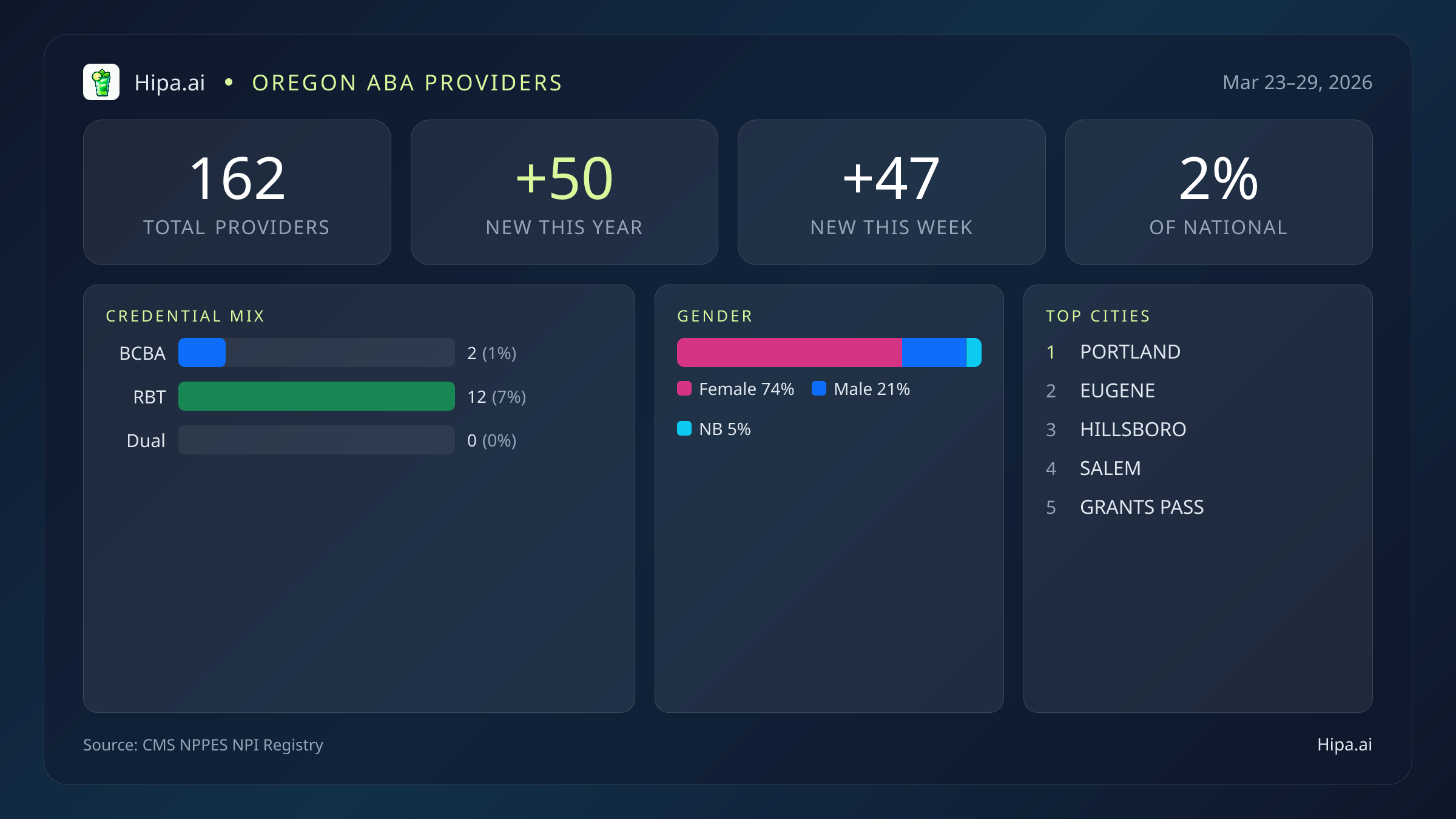
Oregon's behavioral health sector registered 162 providers in the latest weekly NPI update, accounting for 2% of the national total. This cohort includes 123 individuals and 39 organizations, indicating a mix of solo practitioners and larger entities entering the system. The state's share of new NPIs suggests a notable level of workforce activity relative to its population.
Credential Breakdown
Within the applied behavior analysis field, the update captured 12 RBTs and 2 BCBAs. No providers held dual RBT and BCBA credentials. This results in a 6-to-1 ratio of RBTs to supervising BCBAs, a figure that suggests a manageable supervision load and a balanced team structure for this group. Beyond ABA, the data also included 8 LCSWs and 6 LPCs. It is important to note that these credential counts are not mutually exclusive, as 65 providers in this update listed multiple taxonomies, reflecting a workforce with diverse skill sets.
Workforce Demographics
Among the individual providers, the workforce is predominantly female, with 91 women (74%) compared to 26 men (21%) and 6 nonbinary individuals (5%). On the organizational front, large regional health systems showed a significant presence. Providence Health & Services - Oregon was the most frequent name, appearing with 16 NPIs, while Options for Southern Oregon added 5.
This data points to a dynamic behavioral health landscape in Oregon, characterized by the expansion of large health systems alongside a growing ABA workforce structured to support direct service delivery.