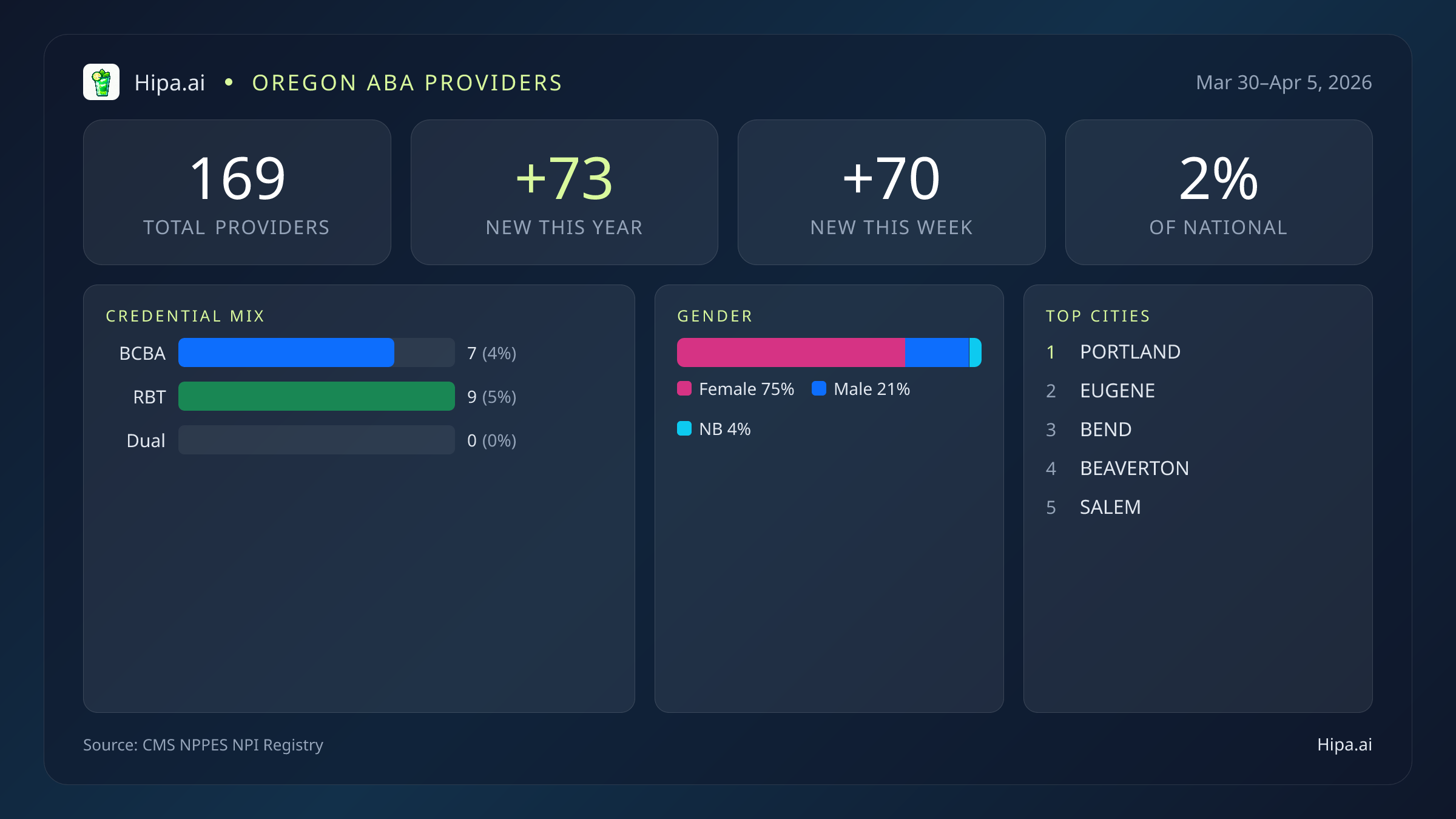
Oregon saw significant activity in the latest CMS NPI registry update, with a total of 169 behavioral health providers added. This represents 2% of the national weekly total. A notable 70 providers were newly registered this week, contributing almost entirely to the 73 new providers reported for the entire year. This signals a rapid recent expansion in the state's behavioral health workforce. Of these, 142 were individuals and 27 were organizations, indicating a mix of independent practitioners and structured clinics contributing to the state's provider landscape.
Credential Mix and Supervision Capacity
Among ABA-specific credentials, Oregon registered 7 Board Certified Behavior Analysts (BCBAs) and 9 Registered Behavior Technicians (RBTs). Notably, there were no providers holding dual BCBA and RBT credentials in this update. This results in an RBT-to-BCBA ratio of approximately 1.3:1. This ratio is significantly lower than the industry-standard 8-10:1, which could indicate a strong supervision capacity relative to the direct service provider pool or suggest that many BCBAs are actively involved in direct service delivery rather than solely supervision. Beyond ABA, the state also saw 14 Licensed Clinical Social Workers (LCSWs) and 5 Licensed Professional Counselors (LPCs) join the registry, highlighting a broader growth across mental health professions.
Workforce Demographics and Organizational Presence
The individual provider demographic data shows a workforce predominantly composed of women, with 107 female providers making up 75% of individuals. Male providers totaled 30, or 21%, while 5 individuals identified as nonbinary, representing 4%. Geographically, Portland, Eugene, Bend, Beaverton, and Salem were the top cities for new registrations, indicating growth concentrated in Oregon's urban centers. One organization, BRITTANY RUSS' CLINICAL SOCIAL WORK AND THERAPY SERVICES LLC, appeared twice in the registry, suggesting a multi-entity presence or diverse service offerings under the same organizational umbrella.
Overall, this data suggests a dynamic and expanding behavioral health workforce in Oregon, with a particularly strong supervisory foundation for ABA services, which could enhance access to quality care across the state.