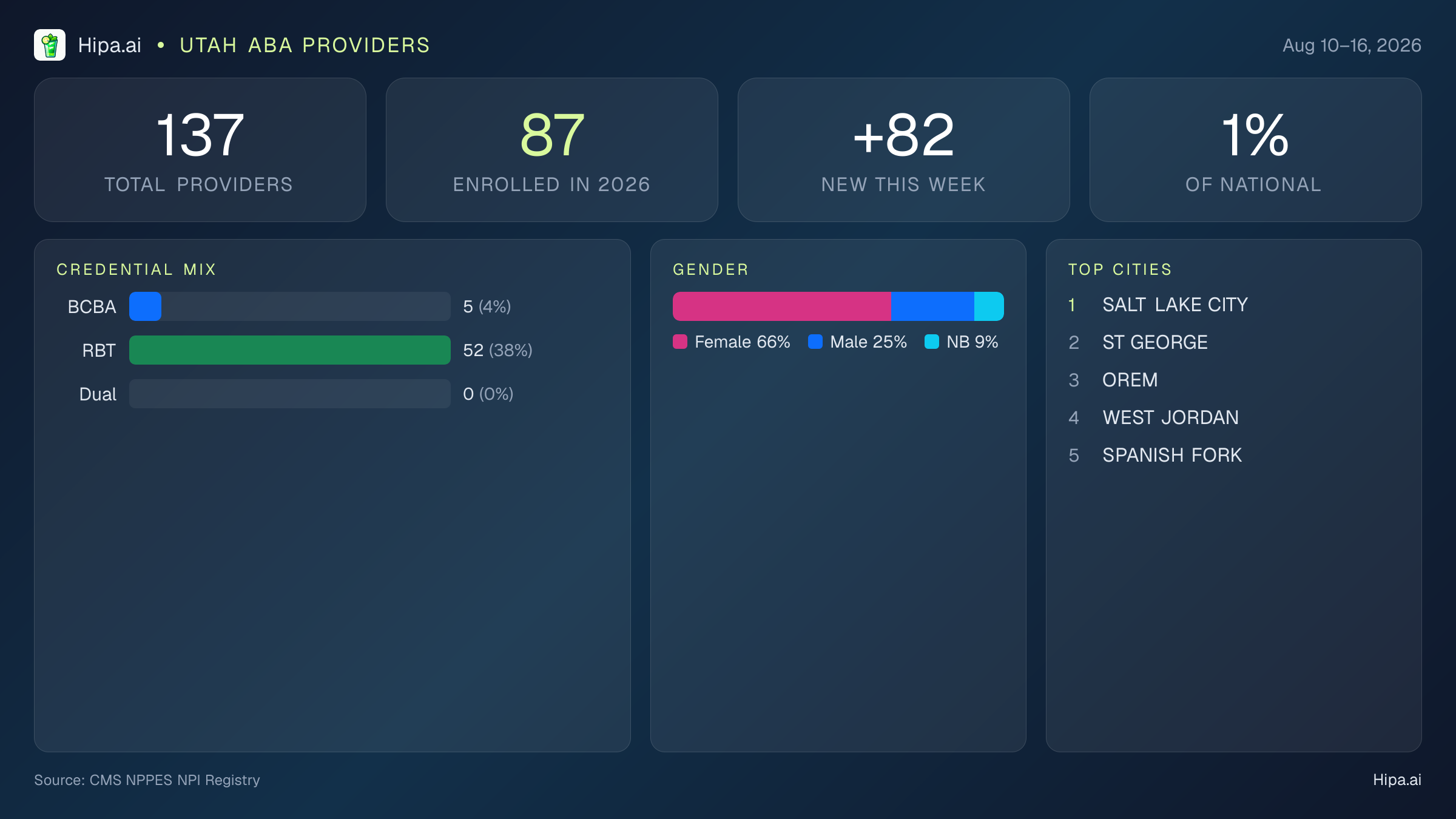
Utah recorded 137 providers in the latest CMS NPI registry weekly update, representing 1% of the national weekly total. The registry added 82 new providers this week, making Utah a visible but limited contributor to nationwide behavioral health activity. The volume points to continued provider onboarding in the state, while the small national share suggests Utah remains one part of a broader, distributed expansion.
ABA Workforce Mix
The registry reports 5 BCBA credentials and 52 RBT credentials, with 0 dual credentials recorded for BCBA-RBT holders. These categories are not mutually exclusive: credential fields and taxonomy fields can overlap, and the broader provider total includes counselors, social workers, case managers and other behavioral health professionals. Still, the pattern shows a much larger technician workforce than supervisory workforce. Because BCBAs oversee RBTs, develop treatment plans and monitor clinical quality, the mix suggests that supervision capacity could constrain how quickly Utah’s direct-service ABA workforce can translate into expanded access.
Demographics and Provider Activity
Utah’s registry includes 121 individuals and 16 organizations. Gender data identifies 80 female providers, 30 male providers and 11 nonbinary providers, listed as 66%, 25% and 9%, respectively. The leading cities are Salt Lake City, St. George, Orem, West Jordan and Spanish Fork, indicating activity across the Wasatch Front, southern Utah and growing population centers.
Southwest Behavioral Health Center appears multiple times in the notable-organizations field, with 2 entries. Overall, the registry’s RBT-heavy profile and limited BCBA presence suggest Utah may be adding frontline ABA capacity faster than clinical supervision capacity, leaving access gains dependent on recruiting and retaining more BCBAs.